Protesters in the city of Karaj set fire to a banner bearing images of Iran’s founding leader Ruhollah Khomeini and Supreme Leader Ali Khamenei on Sunday night, according to a video received by Iran International.
A senior adviser to Tehran’s mayor said on Monday that police were exercising restraint during nationwide protests and were barred from using weapons, despite reports of protesters being killed in recent days.
Abdollah Ganji, an adviser to Tehran’s mayor and former editor-in-chief of the state-run Hamshahri newspaper, wrote on X that law enforcement was implementing what he described as a policy of “security containment with tolerance and leniency.”
He said police officers were prohibited from using weapons.
Ganji also sought to minimize the scale of demonstrations, writing that aside from what he described as peaceful gatherings by bazaar merchants in Tehran, no protest had exceeded 150 people.
Protests were held across Iran for the eighth consecutive day, with demonstrations, strikes, and student unrest reported at 222 locations across 78 cities in 26 provinces, a US-based human rights group reported, as the overall death toll rose to 20.
Despite intensified security measures, increased deployment of police and security forces, and continued confrontations in several areas, the geographic spread of protests has remained intact, the Human Rights Activists News Agency (HRANA) said.
Over the past eight days, at least 19 civilians and one member of security forces have been killed, based on the data verified by HRANA. At least 51 people were also injured, most caused by pellet and rubber bullets.
Protests initially began with labor strikes and professional gatherings and have continued with broader street demonstrations, limited trade stoppages, and student protests openly calling for regime change.


Protests were held across Iran for the eighth consecutive day, with demonstrations, strikes, and student unrest reported at 222 locations across 78 cities in 26 provinces, a US-based human rights group reported, as the overall death toll rose to 20.
Despite intensified security measures, increased deployment of police and security forces, and continued confrontations in several areas, the geographic spread of protests has remained intact, the Human Rights Activists News Agency (HRANA) said.
Over the past eight days, at least 19 civilians and one member of security forces have been killed, based on the data verified by HRANA. At least 51 people were also injured, most caused by pellet and rubber bullets.
Protests initially began with labor strikes and professional gatherings and have continued with broader street demonstrations, limited trade stoppages, and student protests openly calling for regime change.
HRANA said 17 universities have seen student activism during the unrest.
In the past 24 hours alone, unrest was reported in more than 20 cities, including Tehran, Mashhad, Shiraz, Karaj, Qazvin, Yazd, Bandar Abbas, Tabriz, Kermanshah, Khorramabad, Shahrud, Dorud, Gachsaran, Yasuj, Bushehr, Lahijan, Nishapur, Mahallat, Rudbar, Borujerd, and Marvdasht, alongside heightened security deployments in several areas.
The protests have not been confined to major urban centers, with smaller cities and regional towns also affected—an indication of the horizontal spread of unrest across different social and geographic layers.
Reports and verified videos from multiple cities showed continued use of force by security services, including tear gas, live fire, pellet guns, and mass arrests.
The deadliest crackdown took place in the city of Malekshahi in Ilam province, western Iran, on Saturday where security forces opened fire on protesters, killing at least five and injuring 30 others, according to information obtained by Iran International.
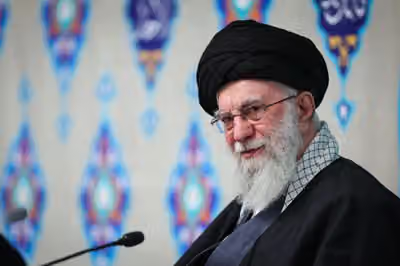
Supreme Leader Ali Khamenei has a back-up plan to flee Iran for Moscow with a close circle of up to 20 aides and family should unrest intensify and security forces desert or fail to suppress the protests, The Times reported on Sunday, citing an intelligence report shared with it.
“The ‘plan B’ is for Khamenei and his very close circle of associates and family, including his son and nominated heir apparent, Mojtaba,” The Times reported citing an intelligence source.
“They have plotted an exit route out of Tehran should they feel the need to escape,” which includes “gathering assets, properties abroad and cash to facilitate their safe passage," the source was quoted as saying.

Khamenei is now “weaker, both mentally and physically” since the 12-day war with Israel in June, The Times reported citing a psychological profile of Khamenei done by a Western intelligence agency.
The profile called Khamenei a “paranoid” leader, a trait that shaped his plan to leave Iran should the Islamic Republic's security forces desert him.
“On one hand, he is very ideologically motivated, but on the other he is pragmatic in what he sees: he sees tactical compromise for long-term greater cause. He is a long-term thinker,” read the assessment.
Komala Party Leader Abdullah Mohtadi on Sunday offered condolences to the families of slain protesters, and condemned what he described as a “major crime” by the Iran's Revolutionary Guards in Malekshahi, Ilam province.
"The great force of the popular movement will ultimately sweep away the apparatus of oppression and crime," he added in a post on X.