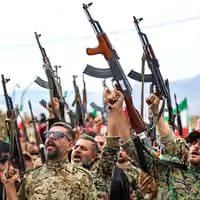
The people of Fooladshahr in Isfahan province, central Iran, chanted "death to the dictator" during street protests on Tuesday night, a video obtained by Iran International shows.
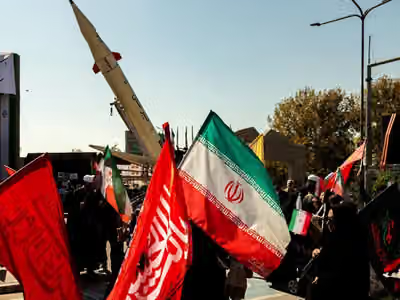

A spokesman for Iran’s Revolutionary Guards and top state officials on Tuesday warned Israel and the United States against launching any new attack on Iran, vowing a harsher and unpredictable response.
“Israel should remember the blows it received in the recent war and take a lesson from the previous attack before thinking of entering a new one,” IRGC spokesman Brigadier General Mohammad Ali Naeini said.
“Iran’s power is increasing by the day, and Israelis only talk about a weak Iran in the media while they themselves know very well how strong our missile capabilities are,” Naeini said.
Trump said on Monday he would support possible Israeli strikes on Iran if the Islamic Republic develops its ballistic missile or nuclear programs, warning Tehran against rebuilding military capabilities destroyed in Israeli and American airstrikes in June.
Parliament Speaker Mohammad Bagher Qalibaf on Tuesday issued a separate warning, saying that Tehran’s defensive actions do not require external approval.
“Iran does not ask anyone’s permission to defend itself. The Iranian people’s response to any adventurism and wickedness will be broad, uncompromising and even unexpected,” he said.
“Iran’s decisions and actions to secure national interests and exercise its legitimate self-defense will not necessarily be predictable or similar to the past,” he added.
President Masoud Pezeshkian posted a message on X earlier on Tuesday saying the Islamic Republic’s response to any “tyrannical aggression would be harsh and remorse-inducing,” adding that any new attack “will make the enemy regret what it has done."
The United States held five rounds of negotiations with Iran over its nuclear program earlier this year, for which Trump set a 60-day deadline.
When no agreement was reached by the 61st day on June 13, Israel launched a surprise military offensive followed by US strikes on June 22 targeting key nuclear facilities in Isfahan, Natanz and Fordow.
The attacks killed nuclear scientists along with hundreds of military personnel and civilians. Iranian counterattacks killed 32 Israeli civilians and an off-duty soldier.
Iran denies seeking nuclear weapons and says its nuclear program is for peaceful purposes. Supreme Leader Ali Khamenei has said dealing with Trump is beneath the dignity of the Islamic Republic, while Iranian officials have rejected US demands to end uranium enrichment and curb missile capabilities.
The United States has long insisted that Iran must completely halt its uranium enrichment program, stop supporting its armed allies in the Middle East and accept restrictions on its ballistic missile program.
Tehran rejects the conditions as a non-starter for any talks.

The US Treasury on Tuesday imposed new sanctions on individuals and firms in Iran and Venezuela, accusing them of facilitating weapons transfers, including Iranian-made combat drones for Venezuela and procurement networks tied to Iran’s missile program.
The Treasury’s Office of Foreign Assets Control said it was targeting ten individuals and entities linked to Iran’s unmanned aerial vehicle trade with Venezuela, as well as separate actors involved in sourcing missile-related chemicals for Iran’s defense industry.
Treasury said the measures build on earlier nonproliferation designations made in October and November, following the September 27 reimposition of United Nations sanctions on Iran.
Officials said Iran’s UAV and missile programs threaten US and allied personnel in the Middle East, destabilize commercial shipping in the Red Sea, and undermine US interests in the Western Hemisphere through arms transfers to Caracas.
“Treasury is holding Iran and Venezuela accountable for their aggressive and reckless proliferation of deadly weapons around the world,” said Treasury Under Secretary for Terrorism and Financial Intelligence John K. Hurley.
An Iranian vice president on Tuesday defended Tehran’s ballistic missile capabilities as essential for deterrence, after the US president warned of further attacks if Iran moves to develop its missile program which was severely damaged in a June war.
"Iran must have missiles; without them, we would be defenseless. We must stand for Iran’s dignity," Vice-President for Executive Affairs Mohammad-Jafar Ghaempanah said.
State Department warning
US State Department on Tuesday warned Tehran against what it called the expansion of its combat drone fleet and the continuation of procuring missile-related items in violation of UN restrictions.
“As President Trump has made clear in a National Security Presidential Memorandum, the United States will take action to curtail Iran’s ballistic missile program, counter Iran’s development of other asymmetric and conventional weapons capabilities, deny Iran a nuclear weapon, and deny the Islamic Revolutionary Guard Corps (IRGC) access to assets and resources that sustain their destabilizing activities,” the statement said. “We will not hesitate to hold accountable anyone who supports Tehran’s proliferation activities.”
Non-proliferation concerns
According to Treasury, the action was taken under Executive Orders 13382 and 13949, which target weapons of mass destruction proliferators and Iran’s conventional arms activities.
The designations were also linked to National Security Presidential Memorandum 2, which directs US agencies to curb Iran’s missile program and deny the Islamic Revolutionary Guard Corps access to financial resources.
OFAC designated three Iran-based individuals for efforts to procure chemicals used in ballistic missiles for Parchin Chemical Industries, an element of Iran’s Defense Industries Organization responsible for chemical imports and exports. Treasury said the materials sought included sodium perchlorate, sebacic acid and nitrocellulose, all used in solid-propellant rocket motors.
Treasury identified Mostafa Rostami Sani as a key figure in the procurement network, accusing him of sourcing large quantities of sodium perchlorate and acting as a liaison between foreign suppliers and Parchin Chemical Industries. Rostami Sani is the chairman of Pardisan Rezvan Shargh International Private Joint Stock Company, which was also designated. The company’s managing director, Reza Zarepour Taraghi, was sanctioned as well.
OFAC also expanded sanctions on Iran’s defense-linked technology sector, designating entities and individuals connected to Rayan Fan Kav Andish Co, a holding company tied to firms producing components and software for the Islamic Revolutionary Guard Corps’ UAV and aerospace programs. Newly designated entities include Fanavari Electro Moj Mobin Company and Kavoshgaran Asman Moj Ghadir Company, along with executives Bahram Rezaei, Erfan Qaysari and Mehdi Ghaffari.
Videos from the city of Izeh in Khuzestan province showed nighttime protest gatherings in the southwestern city on Tuesday, with eyewitnesses reporting gunshots and use of violence against protesters.
Protest gatherings were also held in the city of Hamadan on Tuesday night, with protesters chanting pro-monarchy slogans like "Long Live the King" and "Reza Shah may God bless your soul", videos obtained by Iran International show.

Iran’s foreign minister appealed directly to Donald Trump in a Guardian op-ed on Tuesday, urging him to reopen negotiations with Tehran, reconsider Washington’s alignment with Israel and acknowledge what he described as Iran’s invincibility.
“For those willing to go where no one has gone before, there is a brief window of opportunity,” Abbas Araghchi wrote.
The op-ed appeared just a day after Trump met Israeli prime minister Benjamin Netanyahu at Mar-a-Lago in Florida, where the two discussed Israel’s proposals for potential new strikes on Iran alongside the Gaza peace plan.
Standing beside Netanyahu, Trump warned that renewed Iranian missile expansion or nuclear advances would trigger a US response.
"We’ll knock the hell out of them," said Trump. “Now I hear that Iran is trying to build up again, and if they are, we’re going to have to knock them down."
In June, Israel and the US carried out coordinated strikes on Iran that severely damaged several key nuclear facilities. Iran retaliated with missile attacks on a US base in Qatar and on Israeli targets. After 12 days of escalation, a ceasefire was reached under US pressure.
Israeli officials say Iran is quietly rebuilding systems damaged during the conflict.
Trump on Monday expressed his support for possible Israeli attacks on Iran if Tehran continues to develop its ballistic missile program.
Israel shaped US policy through 'myths'
Araghchi argued that what he called a “manufactured crisis” over Iran’s nuclear program has long been driven by Israeli narratives, misleading Washington into abandoning the 2015 nuclear deal and adopting a “maximum pressure” strategy that produced only resistance, according to the foreign minister.
“Those myths encouraged Washington to abandon a functional diplomatic framework in favor of ‘maximum pressure’ that only produced ‘maximum resistance’,” he wrote.
He also pointed to what he described as shifting opinion among Trump supporters, saying Israel is increasingly seen as a liability rather than an ally.
“A growing number of Americans – particularly those who want a focus on rebuilding the US – are publicly acknowledging what has been taboo: that uncritical acceptance of Israel’s narratives has drained American resources, undermined American credibility, and entangled the US in conflicts that do not serve American interests,” Araghchi wrote.
Araghchi also said recent conflicts across Gaza, Lebanon, Syria, Iran, Yemen and Qatar have led regional governments to view Israel’s actions as “a threat to us all,” opening space for new diplomatic alignments.
Iran open to negotiations
Araghchi said “mutual friends of Iran and the US” are prepared to help facilitate talks and guarantee implementation of any future agreement, without naming those mediators.
Iran, Araghchi insisted, remains open to negotiations but not to surrender.
“Despite Israel’s attack on diplomacy amid Iran-US nuclear negotiations, Iran remains open to an agreement that is built on mutual respect and mutual interest,” he wrote, warning that Iran’s restraint should not be mistaken for weakness.
Araghchi reiterated that Iran will not give up what it regards as its rights under the Nuclear Non-Proliferation Treaty, including domestic enrichment for civilian use, and said any future deal must include “tangible and verifiable sanctions lifting.”
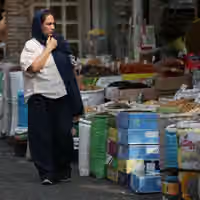
The appeal comes as Iran faces severe economic strain and a third straight day of nationwide protests. Bazaar merchants have launched strikes and university students are joining street demonstrations across multiple cities.
The unrest, driven by the plunging rial and surging prices, is widening in scope against the leadership and some analysts warn it could threaten the Islamic Republic itself.
Exiled Prince Reza Pahlavi on Tuesday urged Iranians from all walks of life to join ongoing protests and expand strikes which started on Sunday in protest at economic instability and soaring prices.
"Your presence in the streets across Iran has kindled the flame of a national revolution. The continuation and expansion of your presence, and taking control of the streets, is today our foremost, vital priority," the prince said in a post on his X account.
"I call upon the people of Iran to join in with the nationwide strikes and protests: government employees, workers in the energy and transportation sectors, truck drivers, nurses, teachers and academics, artisans and entrepreneurs, retirees and those who have lost their savings—everyone, unite and join this national movement."
"Iran and its streets belong to the Iranian nation. And we will be victorious, because we are united and we are many."