Jafar Panahi’s latest drama earns four Golden Globe nominations
Jafar Panahi received Palme d'Or at the Cannes Film Festival on May 24, 2025
Iranian filmmaker Jafar Panahi’s clandestinely filmed It Was Just an Accident was shortlisted on Monday for four major Golden Globe awards, even as he faces a new prison sentence in Iran after being convicted in absentia by a Revolutionary Court.
After winning the prestigious Palme d'Or at this year's Cannes Film Festival, Panahi’s film has now been nominated for Best Motion Picture (Drama), Best Non-English Language Film, Best Director and Best Screenplay at the Golden Globes 2026.
Panahi’s film will compete in the Best Motion Picture (Drama) category alongside Frankenstein, Hamnet, The Secret Agent, Sentimental Value, and Sinners.
In the Best Director category, he is nominated alongside Paul Thomas Anderson for One Battle After Another, Ryan Coogler for Sinners, Guillermo del Toro for Frankenstein, Joachim Trier for Sentimental Value and Chloé Zhao for Hamnet.
Shot secretly in Tehran, the film has already been selected by France as its official submission to the 2026 Oscars and will also represent France at the Golden Globes.
Last week, Iranian lawyer Mostafa Nili announced that Branch 26 of the Revolutionary Court in Tehran sentenced Panahi in absentia to one year in prison.
The verdict cited “propaganda against the state” and imposed a two-year travel ban and a ban on political or social group membership.
Panahi, a long-time critic of the Islamic Republic, said he plans to return to Iran despite the new ruling. The filmmaker has previously been detained and restricted from travel but continued to make movies that later received major awards at Cannes, Berlin and Venice.
The production was carried out under tight constraints inside the capital, continuing Panahi’s long pattern of making films despite restrictions, surveillance and repeated bans on his professional activity.
It Was Just an Accident follows Panahi’s established cinematic approach—minimalist storytelling, non-professional actors and a blend of documentary and fiction.
His earlier works, including Taxi and No Bears, were also created while he was banned from filmmaking and travel, drawing international support for his case.
President Masoud Pezeshkian acknowledged on Sunday that his government has been unable to lift longstanding internet restrictions, saying he has ordered the deactivation of so-called “white SIM cards” that granted unfiltered access to a circle of state-linked users.
Speaking at a ceremony marking Student Day, Pezeshkian addressed the controversy surrounding the preferential access system, which drew widespread criticism after a November update to X revealed that numerous journalists, officials and pro-government figures were using unfiltered connections.
“We have instructed that these white internet lines be turned black as well, to show what will happen to people if this blackness continues,” he said.
Pezeshkian has repeatedly promised to lift filtering, a key pledge of his 2024 presidential campaign. On Sunday, he again suggested that political constraints lie beyond his control. “It is not enough for me to simply order the lifting of filtering. If it could be solved by instruction, we would have done it on the first day,” he said.
The comments came as government spokeswoman Fatemeh Mohajerani said that the administration seeks “free internet for all,” despite saying last year that no such promise had been made. Instagram, X, Telegram, and some other platforms remain blocked more than a year into Pezeshkian’s term.
Iran's President Masoud Pezeshkian
A stalled pledge
Filtering reform was central to Pezeshkian’s campaign, when he said he would “risk his neck” to fix it. Yet in his first meeting of the Supreme Cyberspace Council he emphasized implementing the Supreme Leader’s directives on internet governance rather than easing restrictions and ordered action against the flourishing trade in VPNs.
Since then, senior officials have offered varying timelines. In December, Majid Farahani from the presidential office said filtering would be removed in three phases by the end of the year. The newspaper Farhikhtegan later reported consensus among Iran’s three branches of government to move from blocking toward “smart restrictions,” indicating the system is being recalibrated rather than dismantled.
Public anger intensified after revelations of the white SIM scheme, which critics said exposed a tiered access system contradicting the government’s rhetoric about digital equality.
FIFA has confirmed that Iran will play all three of its 2026 World Cup group-stage games in the United States, including two at Los Angeles, where the large Iranian-American community is expected to give Team Melli a rare home-style advantage.
The international football federation (FIFA) on Saturday released the final schedule for Iran’s matches at the 2026 World Cup, one day after Iran was drawn with Belgium, Egypt and New Zealand.
The federation confirmed that Iran will face the three teams at venues in the West coast of the United States.
Iran’s opening two games — against New Zealand and Belgium — will be held at Los Angeles’ 70,000-seat SoFi Stadium, effectively placing Team Melli in the heart of one of the largest Iranian diaspora hubs in the world.
Los Angeles, home to an estimated 300,000 to 500,000 Iranian-Americans, has long been known for its concentrated Iranian cultural presence, especially in neighborhoods like Westwood, also known as Tehrangeles or Little Persia.
Team Melli has experienced this before. In 1999, during a friendly with the United States at the Rose Bowl, more than 100,000 Iranian fans filled the stands, surpassing the stadium’s official 92,000-seat capacity and creating a near-home atmosphere. That match ended 1–1, with Iran scoring through Mehdi Mahdavikia.
Iran’s third match, against Egypt, will take place in Seattle, Washington, where analysts estimate more than 50,000 Iranian-Americans live. Fans from other states are also expected to travel, likely ensuring strong support despite the city’s sizeable Arab and Egyptian communities.
If Iran advances as the group’s second-place team — considered one of the more plausible scenarios — the team would remain in the United States for the first knockout round, extending what many are already calling an accidental home-field advantage.
Not alone despite travel ban
The White House on Wednesday said Iran’s national team will be allowed to enter the United States for the World Cup but suggested that Iranian fans will be barred, citing existing travel bans and declined to rule out immigration raids at matches.
“The President has, in his executive order, certainly named Iran as one of the countries whose teams will be exempt to come here,” the head of the White House task force on the World Cup, Andrew Giuliani, told reporters.
Asked whether there would be ICE raids at matches, Giuliani said “the President does not rule out anything that will help make American citizens safer.”
While there are concerns that fans traveling from Iran and other countries may be unable to secure US visas under the Trump administration's restrictions, the large Iranian diaspora already living in America is expected to more than compensate.
Members of the European Parliament and the US Congress have urged major technology companies to strengthen support for secure, uncensored internet access in Iran, citing a surge in digital repression and discriminatory access systems, Euronews reported.
In a letter addressed to Google, Meta, YouTube and Amazon Web Services, the European Parliament’s Delegation for Relations with the Iranian People warned that Iran’s widening use of AI-driven surveillance, recurrent shutdowns and a “white SIM card” scheme for officials had created a two-tier digital system isolating ordinary citizens.
The Iranian government enforces some of the world’s toughest online restrictions, blocking platforms such as X (formerly Twitter), Facebook, YouTube, WhatsApp, and Telegram for the general public. Most people rely on slow, unreliable VPNs that authorities routinely disrupt.
By contrast, X's new location feature recently revealed that select users receive government-issued SIM cards or whitelisted connections to bypass national filtering and throttling altogether.
The issue drew wide attention over the past few weeks, when the X feature revealed numerous pro-government figures were posting from inside Iran without VPNs – despite long claiming they used the same circumvention tools as ordinary citizens.
The disclosures triggered heavy public criticism, with many describing the system as “digital apartheid” or a “caste-based internet” that rewards political loyalty and entrenches inequality.
EU says firms must bolster anti-censorship tools
Hannah Neumann, who chairs the EU delegation, said a free internet remains the only barrier against propaganda and intimidation. “Technology companies are the guardians of this freedom, and now is the time to take their responsibility seriously,” Neumann said, according to a copy of the letter obtained by Euronews.
She added that companies were capable of measures that “ensure these voices are not silenced.”
Deputy chair Bart Groothuis said digital repression had become central to Iran’s authoritarian model. “By supporting tools to circumvent filters, we can improve secure communication and give Iranians access to the free internet,” he said.
The letter urged firms to fund open-source VPN and censorship-bypass projects, expand encrypted communication features and develop in-app proxies to keep users connected during outages. It also asked Amazon Web Services and human-rights–oriented VPN providers to offer free or discounted server space to stabilize services for Iranian users.
European legislators pressed Google to continue backing Jigsaw, Outline VPN and its SDK, and to consider integrating these tools into major apps. Meta was asked to embed filter-bypass technologies into Instagram, Facebook and Threads. Companies were also urged to provide simple procedures for appealing blocked accounts and to increase cooperation with digital-rights groups.
A young man plays a computer game in an Iranian internet cafe in this file photo.
US lawmakers pursue parallel push
In Washington, lawmakers introduced the FREEDOM Act on Thursday, which would require the secretary of state, the FCC and the Treasury to assess technologies capable of supporting unfiltered internet access for Iranians.
Representative Claudia Tenney highlighted the potential of satellite-to-mobile systems that could “bypass the limitations of censorship and government networks.” The feasibility review will also evaluate UAV-based platforms and counter-jamming tools.
Representative Dave Min, whose district includes a large Iranian-American community, said promoting internet freedom strengthens global family ties while confronting authoritarian practices.
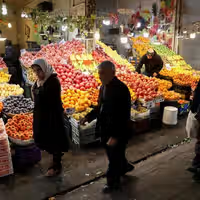
Iran’s soil is nearing bankruptcy, a senior agriculture official warned on Saturday, saying the country’s food production outlook will sharply deteriorate without urgent intervention.
Widespread awareness has not translated into action, Hadi Asadi-Rahmani, head of the Soil and Water Research Institute of Iran said at the World Soil Day conference in Ghazvin.
“We all know Iran’s soil is growing poorer, and without urgent action, the future of food production will face serious risk,” Asadi-Rahmani added.
Iran has 165 million hectares of land, of which only 24 million are arable. Half of national crop output, Asadi-Rahmani said, now comes from class-three and class-four lands.
He warned that continuous extraction, insufficient fertilizer inputs and erosion are pushing the country toward a structural crisis. “Seventy-five percent of Iran’s soils have less than one percent organic carbon,” he noted. “This shows how exhausted our soils have become.”
Roughly 30,000 hectares of land, according to him, degrade each year, reflecting patterns similar to the country’s water crisis.
Water authorities warn of parallel emergency
Iran is in its sixth consecutive year of drought, Arash Kordi, deputy minister of energy, also said on Saturday.
“Even with normal rainfall, current extraction patterns have no compatibility with Iran’s climate,” Kordi added.
“Delaying reforms directly threatens people’s livelihoods and the foundations of the country.”
Specialists warn of shrinking reserves
Dry conditions have pushed reservoirs in several provinces to record lows. Officials in the religious city of Mashhad have moved to full rationing, and parts of Kerman in the south report farmland abandonment linked to groundwater loss. Nationwide rainfall has dropped to about 18 percent of typical levels.
The twin crises of soil depletion and water scarcity, officials said, now reinforce one another. Asadi-Rahmani warned that postponing decisions would make damages irreversible.
Experts blame decades of over-extraction, unchecked urban growth and placing water-hungry industries in the desert – alongside drier weather – for pushing groundwater sources and lakes to the brink.
Two organizers of a marathon on Iran’s Kish Island have been detained following alleged legal and religious violations during the event, the island’s prosecutor said, after footage appeared to show women running without hijab.
The prosecutor said one of those detained is an official with the Kish Free Zone Organization and the other is from the private company that organized the race. Both have been charged and placed under bail orders after formal questioning. Judicial supervision measures were also imposed, barring the state official from public employment and the private organizer from managing or holding sports events.
The sixth Kish Marathon went ahead on Friday morning with nearly 5,000 runners on the Persian Gulf resort island, despite opposition from Iran’s Athletics Federation, which had cited concerns over “legal and religious requirements.”
“The manner in which the event was conducted damaged public decency,” the prosecutor’s office said earlier in a statement carried by the IRGC-linked Tasnim news agency. It said officials had been warned beforehand “to observe the country’s laws and religious and social norms” but had failed to comply.
‘The Las Vegas Republic
The announcement followed a cascade of attacks from hardline activists and media—including Tasnim.
The race, it asserted, promoted “open, public unveiling (and) debauchery,” for which those responsible “must be punished immediately.”
A hardline activist writing under the name Aminizadeh blasted officials as “careless and dishonourable,” describing the race as a “disco marathon.”
“Is this the Islamic Republic or the Las Vegas Republic,” he quipped. “Who sponsored this stupid act?”
‘Settling political scores’
Such interventions echoed broader efforts by conservative figures to reassert control over public space and dress codes three years after the widespread 2022 protests, which has eroded enforcement of Islamic dress code in many urban areas.
Many supporters of the event pushed back, accusing hardliners of exploiting hijab sensitivities for political gain.
Journalist Amir Taher Hosseinkhan wrote on X that women had run their race at 5:30am and men at 8:30am, with strict separation and control.
“So why are you still insisting on creating a false narrative?” he asked. “How did something you claim is sacred become a tool for bargaining and settling scores?”
Organizers have so far not publicly commented on the prosecutor’s announcement.