• العربية
  • فارسی
BrandBrand
  • Iran Insight
  • Politics
  • Economy
  • Analysis
  • Special Report
  • Opinion
  • Podcast
  • Live TV
  • Iran Insight
  • Politics
  • Economy
  • Analysis
  • Special Report
  • Opinion
  • Podcast
  • Live TV
  • Theme
  • Language
    • العربية
    • فارسی
  • Iran Insight
  • Politics
  • Economy
  • Analysis
  • Special Report
  • Opinion
  • Podcast
  • Live TV
All rights reserved for Volant Media UK Limited
volant media logo

After wedding scandal, Iranian academic accuses Shamkhani of killing father

Oct 22, 2025, 21:29 GMT+1Updated: 00:08 GMT+0
Iranian ex-security chief Ali Shamkhani, center, appears in this file photo.

Prominent Iranian American academic Mehrzad Boroujerdi has accused ex-security chief Ali Shamkhani of involvement in his father’s killing while a member of a militia group during the 1979 revolution.

Shamkhani, a senior advisor to Supreme Leader Ali Khamenei, has recently come under public scrutiny in Iran after a leaked video showed his daughter’s lavish wedding featuring unveiled women, Western-style celebrations and his daughter the bride.

“You are the same person who, in January 1979 in Ahvaz, along with your accomplice Mohsen Rezaei, assassinated Malek Mohammad Boroujerdi, my father,” Boroujerdi wrote on Instagram on Monday, addressing Shamkhani.

100%
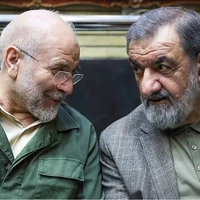
Professor Mehrzad Boroujerdi (left) and Ali Shamkhani (right)

Boroujerdi appeared on Iran International on Tuesday, elaborating on his accusations against senior Iranian officials, including Shamkhani and former Islamic Revolutionary Guard Corps (IRGC) commander Mohsen Rezaei.

Professor Mehrzad Boroujerdi (left) and Ali Shamkhani (right)

“The Mansouron Group, formed in 1975 by figures such as Mohsen Rezaei, Shamkhani and others created a terrorist cell that carried out assassinations in Khuzestan province, including my father’s killing in the city of Ahvaz,” Boroujerdi said.

Mansouroun was one of seven Islamist groups active before the 1979 revolution that later joined together to form the core of Iran’s Revolutionary Guards. The group, led by figures including Mohsen Rezai, united with six others — Towhidi Saf, Towhidi Badr, Falagh, Ommat-e Vahida, Saheban-e Safa, and Mo’tahedin-e Eslam — to establish the force that became the Islamic Revolutionary Guard Corps.

“Ayatollah Khomeini had urged oil company employees to strike, aiming to cripple the Shah’s oil-dependent economy. My father opposed this strategy for toppling the Shah’s government," he added.

"As a member of oil company management, he and others were placed on an assassination list circulated in Ahvaz mosques and executed in January."

Mehrzad Boroujerdi is a professor of political science at the Missouri University of Science and Technology and the author of the book ‘Iranian Intellectuals and the West.’

Shamkhani, a former secretary of Iran’s Supreme National Security Council and now a member of the Expediency Council, has long been a key figure in Iran’s security establishment. He also serves as the Supreme Leader’s representative on the National Defense Council.

He and his family have come under intense criticism by dissidents for their apparent wealth and influence as many Iranians struggle with costs of living wrought by corruption, mismanagement and sanctions from Western foes of Tehran's policies.

Hossein, his son, has been described in a series of reports by Bloomberg as a key overseer of Iran's efforts to circumvent sanctions, enriching himself in the process. Shamkhani the younger has insisted he is a legitimate businessman.

“Over the past 45 years, most senior military and security positions in the Islamic Republic have been held by members of the Mansouron Group including Shamkhani, Rezaei, and Gholam Ali Rashid (who was killed in an Israeli attack),” Boroujerdi said.

The Mansouron Group was an Iranian guerrilla organization active in the 1960s and 1970s, primarily in Khuzestan province, opposing the Pahlavi regime through armed struggle and political activism.

Formed around 1969, it later merged with other militant groups and played a role in the 1979 Islamic Revolution in Iran.

Most Viewed

Arab states warn Iran of individual, collective retaliation over attacks - WSJ
1

Arab states warn Iran of individual, collective retaliation over attacks - WSJ

2

Iran’s nuclear bomb debate gains ground on official platforms

3

Netanyahu pressing Trump to strike Iran immediately after midterms - Axios

4

Iran rejects nuclear talks despite ongoing mediation with US

5

Israel denies pressing Trump for Iran strikes amid diplomatic push

Banner
Banner

Editors' Pick

  • Iran says US tone shifts but demands still block talks

    Iran says US tone shifts but demands still block talks

  • Halloween gathering in Tehran ends in arrests and police crackdown

    Halloween gathering in Tehran ends in arrests and police crackdown

  • Netanyahu or Eisenkot? Tehran sees little difference on war
    INSIGHT

    Netanyahu or Eisenkot? Tehran sees little difference on war

Banner
Banner
Banner
Banner

Spotlight

  • Tehran denies Ghalibaf sidelined as Rezaei's role grows

    Tehran denies Ghalibaf sidelined as Rezaei's role grows

  • Qatar turns to US LNG to cushion Iran war losses

    Qatar turns to US LNG to cushion Iran war losses

  • Mohsen Rezaei’s negotiating calculus: someone else always pays the price
    ANALYSIS

    Mohsen Rezaei’s negotiating calculus: someone else always pays the price

  • Iran’s nuclear bomb debate gains ground on official platforms

    Iran’s nuclear bomb debate gains ground on official platforms

  • Residents describe struggle to afford basic needs as Iran inflation hits 88.7%
    VOICES FROM IRAN

    Residents describe struggle to afford basic needs as Iran inflation hits 88.7%

  • Netanyahu or not, the next move on Iran may be Trump's
    PODCAST

    Netanyahu or not, the next move on Iran may be Trump's

  • New Baha'i memoir recounts life inside Iran's prisons

    New Baha'i memoir recounts life inside Iran's prisons