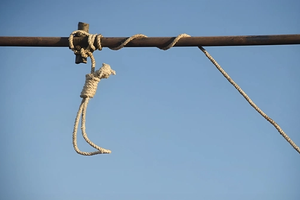
Iran executes man accused of spying for Israel in Qom

Iran executed a man on Saturday convicted of spying for Israel’s Mossad intelligence service, the judiciary said on Sunday, the second such execution reported in less than a month.

Iran executed a man on Saturday convicted of spying for Israel’s Mossad intelligence service, the judiciary said on Sunday, the second such execution reported in less than a month.
Kazem Mousavi, head of the judiciary in Qom province, said the unnamed man was executed on Saturday morning after the Supreme Court upheld his death sentence and rejected a clemency request.
“The spy’s sentence was carried out after being found guilty of moharebeh (enmity against God) and corruption on earth,” Mousavi told the judiciary’s news agency Mizan.
He said the man began cooperating with Israeli intelligence in October 2023 and was arrested four months later after sending classified information through online channels.
According to Mizan, the defendant confessed to meeting a Mossad officer, transmitting sensitive data, and receiving payment for his work.
The execution follows the late September hanging of Bahman Choubi-asl, a database specialist accused of providing information to Mossad in meetings abroad, including in India and Ireland.
Earlier in September, Iran also executed political prisoner Babak Shahbazi over similar charges.
Last month, the UN special rapporteur on human rights in Iran said the country had executed 11 individuals on espionage charges this year, with at least nine carried out after Israel's military strike on Iran on June 13. Saturday's execution brings the total to at least 12.


Iranian Vice Speaker of Parliament Hamidreza Hajibabaei called on Muslim countries’ parliaments to pass binding laws imposing a complete economic, trade, and political boycott of Israel during a speech at the Inter-Parliamentary Union (IPU) meeting in Geneva.
Hajibabaei said Iran “firmly supports the legitimate resistance of the Palestinian people” and the creation of an independent Palestinian state with Jerusalem as its capital.
He urged Muslim unity against what he described as Israel’s “decades-long impunity for war crimes.”
Speaking at the 151st IPU Assembly -- which focuses on humanitarian norms and inclusive democracy -- Hajibabaei warned that any temporary ceasefire should not mean “forgetting justice or accountability.”
He added that global action was needed to prosecute those responsible for crimes in Gaza and said Islamic solidarity was key to achieving “a just and lasting peace for Palestine.”

Iran’s Foreign Minister Abbas Araghchi has denounced the display of a drone in the British Parliament allegedly linked to Tehran, calling it “a pathetic show” staged by the Israeli lobby and its backers.
In a post written in Polish on X, Araghchi said, “The exhibition in the British Parliament of a drone falsely and maliciously attributed to Iran is a pathetic scene staged by the Israeli lobby and its sponsors.”
He added that “those hostile to friendly relations between Iran and Europe are creating fabricated narratives that do not reflect the historical ties -- including between Iran and Poland.”
Araghchi added that Tehran remained ready to engage in technical talks and exchange of documents to clarify the facts, dismissing what he called “an absurd performance.”
The remarks came days after Iran summoned Poland’s chargé d’affaires in Tehran to protest Polish Foreign Minister Radoslaw Sikorski’s participation in an event in London that featured a Shahed-136 drone allegedly used by Russia in its war in Ukraine.


The display, organized by the US-based advocacy group United Against Nuclear Iran (UANI), was held at the Houses of Parliament and attended by Western and Ukrainian officials.
Tehran condemned the exhibition as a politically motivated act, accusing organizers of spreading “baseless and repetitive accusations” about Iran’s drone program.
Iran says it supplied drones to Russia before the war began, but denies providing weapons for use in Ukraine. Western governments and Kyiv say Iranian-designed Shahed drones, now produced in Russia under the name Geran, have played a key role in Moscow’s air strikes.
Araghchi’s statement also followed a sharp exchange between Tehran and London over British intelligence claims of Iranian-linked plots on UK soil. MI5 chief Ken McCallum said last week that more than 20 Iran-related operations had been disrupted over the past year, describing Tehran as one of the UK’s most active hostile state actors.

An LPG tanker struck by an unknown projectile in the Gulf of Aden on Saturday was carrying an Iranian cargo, TankerTrackers reported, while Iranian state media denied the vessel had links to Iran.
The Falcon (IMO 9014432), a 31-year-old, Cameroon-flagged vessel owned by an Indian company, was laden with liquefied petroleum gas loaded in Iran's Assaluyeh on September 25, the tracking firm said.
The tanker was most likely en route to Yemen’s Ras Isa terminal to deliver fuel to Tehran-backed Houthis, according to Tanker Trackers.
Iran’s semi-official Mehr News Agency, citing informed sources, denied that the vessel had any links to Iran.
An informed source at the Iranian Oil Ministry also told IRGC-affiliated Fars News that the vessel does not belong to the Ministry of Oil or the National Iranian Tanker Company.
However, the Falcon had earlier been flagged by the US-based advocacy group United Against Nuclear Iran (UANI) as part of an alleged Iranian “ghost fleet” that transports oil products across international waters in violation of global sanctions.
The vessel was previously detained in Istanbul in January 2025 for 13 safety deficiencies, according to port inspection data.
Authorities said 25 of the 26 crew members have been accounted for, while one remains missing. The ship has no known insurer and is not currently listed on any international sanctions or blacklist databases.
Houthi-linked media outlets on Telegram and X denied any involvement in the incident, citing unnamed sources in the group’s defense ministry.
The Falcon had earlier signaled Djibouti as its next destination and made recent port calls in Iraq and Oman’s Sohar, in a pattern similar to that of the Clipper (IMO 9102198), which was struck off Yemen in August.
Since November 2023, Houthi forces have attacked commercial shipping in the Red Sea and Gulf of Aden, saying the campaign is a show of solidarity with Palestinians in Gaza.
The armed group, which governs around two-thirds of Yemen’s population, has claimed responsibility for dozens of missile and drone strikes on Israel-bound targets and vessels linked to the Jewish state.
According to figures compiled by the Associated Press, nearly 100 international ships have been attacked in the region since the campaign began, resulting in the sinking of four vessels and the deaths of several mariners.

Iran’s foreign ministry on Saturday condemned what it called Israel’s violation of the Gaza ceasefire, after the Israeli military said it struck a car in the enclave that had entered a restricted area, killing 11 members of a Palestinian family.
The Israel Defense Forces (IDF) said troops fired warning shots before hitting the vehicle when it continued to approach “in a threatening manner.”
Foreign Ministry spokesman Esmail Baqaei called the incident a violation of the ceasefire with Hamas and urged governments that brokered the truce to ensure its enforcement.
Israel’s actions, including the continued closure of the Rafah crossing, he said, "represented serious breaches of international obligations."
Gaza officials said the victims, including seven children and three women, were members of the Abu Shaban family, who were returning to their home in Gaza City’s Zeitoun neighborhood on Friday when their vehicle was struck.
Hamas described the attack as a “deliberate crime against civilians." The Gaza Civil Defense agency said the bodies were later recovered with the UN's help.
The IDF said the car had crossed into the so-called Yellow Line — a buffer zone separating Israeli-held areas from the rest of Gaza — and refused to stop after warning shots.
Israeli Defense Minister Israel Katz said his country's military would install clearer physical markers along the boundary to prevent future incidents, warning that “any violation of the line will be met with fire.”
Baqaei urged the international community to act to stop what he called further civilian deaths and to secure access to food and humanitarian aid for Gaza’s population.
The ceasefire mediated in early October by the United States, Egypt, Turkey and Qatar put an end to over two years of Israeli attacks on Gaza, which started in response to Hamas's October 7 attack.
Gaza’s media office says Israel has breached the ceasefire with Hamas 47 times since it took effect, leaving 38 Palestinians dead and 143 others injured.

An international human rights conference opened Saturday in Oslo, bringing together Iranian and non-Iranian activists, legal scholars, and political figures to debate the shape of a rights-based future for Iran after the Islamic Republic.
The event titled "Human Rights in Iran After the Islamic Republic" was hosted by the Oslo-based Iran Human Rights Organization, which said its goal was to foster a “respectful and neutral space” for discussion among diverse opposition voices.
Nobel Peace Prize laureate Shirin Ebadi told the gathering that building an effective coalition for change in Iran required agreement on concrete principles rather than abstract ideals.
“Using broad terms like democracy and freedom as a basis for unity has not worked,” she said. “We must ask what kind of democracy we want, define what we mean by freedom of expression, and see where we truly agree.”

Iranians should not fear transition, Ebadi added, rejecting comparisons between a post–Islamic Republic future and the turmoil that followed the 1979 revolution.
“People should not be afraid of change.”
Respectful dialogue among opposition groups
Mahmood Amiry-Moghaddam, director of Iran Human Rights, told Iran International that the Oslo meeting for the first time invited representatives from a range of political parties and civic movements opposed to the Islamic Republic.
“The aim is not to form a new alliance or enforce political uniformity, but to enable respectful dialogue among all groups on the foundations of human rights,” he said. “Whatever form the next political system takes, all Iranians must enjoy equal rights.”
Recognizing diversity was essential to preventing the return of authoritarianism, Asso Hassanzadeh of the Democratic Party of Iranian Kurdistan said. “The key to avoiding future tyranny is political justice and acceptance of plurality.”
Abdullah Mohtadi of the Komala Party of Iranian Kurdistan told the conference that any transition must follow today’s international standards.
“It should not turn into bloodshed or political revenge,” he said. “Transitional justice must be based on global norms.”
Fouad Pashaie, secretary-general of the Constitutionalist Party of Iran, said democracy starts today, warning that decades had already been lost.
“Every political group that cares about a united Iran must now cooperate, despite differences,” he said, stressing that opposition efforts should focus on how to end the Islamic Republic without allowing it to rebrand itself under a new guise.
The conference continues Sunday behind closed doors with addresses by party representatives and policy experts.
Iranian opposition figures have stepped up calls to rally against Tehran following a punishing 12-day war with Israel in June, but there have been no significant protests.
Iranian exiled prince Reza Pahlavi urged unity among Iran's opposition during a pro-monarchy conference in Munich in July, saying the Islamic Republic's downfall would lead to sustainable peace and prosperity in the Middle East.
Later that month, Maryam Rajavi, the leader of exiled opposition group the National Council of Resistance of Iran, vowed the armed ouster of its decades-old nemesis the Islamic Republic and the founding of a democratic, non-nuclear state in its place.