• العربية
  • فارسی
Brand
  • Iran Insight
  • Politics
  • Economy
  • Analysis
  • Special Report
  • Opinion
  • Podcast
  • Iran Insight
  • Politics
  • Economy
  • Analysis
  • Special Report
  • Opinion
  • Podcast
  • Theme
  • Language
    • العربية
    • فارسی
  • Iran Insight
  • Politics
  • Economy
  • Analysis
  • Special Report
  • Opinion
  • Podcast
All rights reserved for Volant Media UK Limited
volant media logo
OPINION

Iran remains central to any lasting peace in the Middle East

Samira Gharaei
Samira Gharaei

Iran International

Oct 16, 2025, 19:30 GMT+1Updated: 00:11 GMT+0
An Iranian commando during a training exercise

The hard-won ceasefire in Gaza is only the beginning, not the end of the crisis in Middle East. On the surface a fragile calm has settled over the region, but Iran's role in any new order remains undefined.

Without engaging Iran in a diplomatic process or decisively chastising it on the battlefield - genuine peace may remain elusive. Iran remains a key regional player capable of shaking the fragile detente.

While a punishing US-Israeli war battered its nuclear and military capabilities, a wounded and isolated Iran could yet be a spoiler for long-term stability.

Washington has yet to extract any meaningful concessions from Iran, neither by force of arms nor increasingly onerous sanctions.

The "dark cloud" US President Donald Trump repeatedly described Iran posing in the region may yet lower over any peace agreement.

For decades, Iran has been a central force of instability in the region. Now, following the October 10, 2025 ceasefire, it finds itself in a weakened position: an economy strangled by sanctions, diminished armed allies in the region and growing international isolation.

History shows that whenever Iran has felt cornered, it has not stepped back but rather sallied forth. It expanded its war with Iraq into the Persian Gulf in the late 1980s, announced continued uranium enrichment in defiance of UN sanctions and directed proxy attacks on key Saudi Aramco oil facilities in 2019.

This pattern suggests that mere containment does not restrain Tehran but provokes even more unpredictable behavior.

Waning crescent

Trump, however, seems convinced that Iran is ready for peace. In an address to the Israeli Knesset on Monday, he said, “Iran has informed us that it fully agrees with this deal,” even extending an offer of “friendship” to Tehran.

But why does Trump believe the Iran can be coaxed into a Mideast order at peace with Israel, which would violate the essence of the Islamic Republic's state ideology?

In his drive to declare victory and end the war, Trump may be too invested in his own narrative of success. He argues that strikes on Iran’s nuclear facilities forced Tehran out of the field and paved the way for peace.

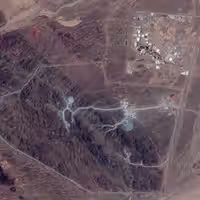
Yet was Iran’s menace really confined to the underground halls of Natanz, Fordow and Isfahan nuclear laboratories?

A glance at the so-called Shi'ite Crescent of Iranian influence in the Middle East - now very much on the wane still perceptible - suggests otherwise.

Iran has not renounced its nuclear activities and remains a vocal patron of armed Islamist movements.

The Arab world’s role is now decisive. In July 2025, the Arab League - working in an unprecedented joint move with Western powers - called for the disarmament of Hamas, stripping the group of its resistance legitimacy and disconnecting it from Iran’s paramilitary project.

The statement, urging Hamas to surrender its weapons and release hostages, marked a fundamental shift in Arab policy.

The success of Trump’s ceasefire plan now depends largely on Arab leverage. Gulf states, as key financiers of Gaza’s reconstruction, can condition their aid on Hamas’s compliance, including complete disarmament.

If the Arab world takes that path, how will Tehran respond? Capitulation seems unlikely. Iran sees Hamas as a pillar of its anti-Israel strategy, and its disarmament as a direct blow to Tehran’s regional influence.

Iran in response could intensify proxy operations - through Houthi attacks on Red Sea shipping or renewed militant activity in Iraq and Syria. Yet Iran’s current weakness - economic exhaustion, diplomatic isolation and recent military setbacks - might also push it toward negotiations.

Trump’s political bet

That is the political bet Trump is making. Still, Iran’s absence from the Sharm el-Sheikh summit, followed by Foreign Minister Abbas Araghchi’s sharp post telling Trump he was Israel's dupe, suggests talks remain far away.

The new Middle East order is no longer centered on the “axis of resistance” but on shared security and economic interests between Arab states and Israel.

Iran has gambled everything on its ideology of resistance and lost.

Its likely response will combine several tracks: rebuilding its regional standing through soft diplomacy with Arab neighbors, increasing pressure on Israel from secondary fronts like Lebanon or Syria and maintaining strategic ties with Russia and China as counterweights to the West.

At this moment, Trump is watching and waiting, ready to resort to force if Iran reacts, or to let Tehran drift into diplomatic irrelevance if it does not.

Either path could lead to a historic shift: the gradual erasure of Iran from the region’s balance of power and possibly its eventual collapse from within.

Most Viewed

100 days after carnage: Iran economy reels from war, inflation, unemployment
1
INSIGHT

100 days after carnage: Iran economy reels from war, inflation, unemployment

2
OPINION

The Hormuz get out of jail card turned to a grave

3
EXCLUSIVE

Iranian assaulted in London amid concern over threats to regime critics

4
PODCAST

Too early to tell who is winning Iran war, experts say

5

IRGC fires at Indian vessel in Hormuz

Banner
Banner

Spotlight

  • From instability to influence: Pakistan’s pivotal role in US-Iran diplomacy

    From instability to influence: Pakistan’s pivotal role in US-Iran diplomacy

  • A nation in limbo: 100 days after the massacre, has the world moved on?
    INSIGHT

    A nation in limbo: 100 days after the massacre, has the world moved on?

  • 100 days after carnage: Iran economy reels from war, inflation, unemployment
    INSIGHT

    100 days after carnage: Iran economy reels from war, inflation, unemployment

  • The Hormuz get out of jail card turned to a grave
    OPINION

    The Hormuz get out of jail card turned to a grave

  • How Tehran bends its own red lines to boost state rallies
    INSIGHT

    How Tehran bends its own red lines to boost state rallies

  • Iran blackout cripples freelancer, small business incomes
    VOICES FROM IRAN

    Iran blackout cripples freelancer, small business incomes

•
•
•

More Stories

Trump wants to bend world to his will, Khamenei advisor says

Oct 16, 2025, 01:30 GMT+1

A senior advisor to Iran’s Supreme Leader said on Wednesday that US President Donald Trump seeks to force the world to carry out his bidding but that Iran hopes a Gaza truce will hold.

“Trump is operating in a new paradigm and wants to unilaterally impose his power on the world,” Kamal Kharrazi said in an interview with Khamenei official website, adding Israel acts under green light of the United States. 

Kharrazi is veteran theocrat Khamenei's top foreign policy advisors and heads the Strategic Council on Foreign Relations. Members of the body are handpicked by Khamenei and its reports and advisories have often presaged major policy shifts by the ruling system.

His remarks carried on the official website of Iran's top decision-maker appear to represent one of the closest approximation of the Supreme Leader's view on the recent Gaza truce and Trump's role since it was clinched over the weekend.

“While we must not shy away from negotiations and should remain at the table, we must also ensure that nothing is imposed on us, and if they try, we must stand firm,” he added.

Kamal Kharrazi, former Iran's foreign minister and current Iran's supreme leader foreign policy advisor
100%
Kamal Kharrazi, former Iran's foreign minister and current Iran's supreme leader foreign policy advisor

'Missile are no up for negotiations'

“The issue of missiles and the issue of resistance are not issues that Iran wants to negotiate on,” Kharrazi added.

Members of the body he leads are by handpicked by Khamenei and its reports and advisories have often presaged major policy shifts by the ruling system.

A senior Iranian lawmaker said last week that Supreme Leader Ali Khamenei has lifted all limits on the range of Iran’s missiles, previously capped at 2,200 kilometers (about 1,367 miles), signaling a potential major shift in Tehran’s defense posture following the punishing June war.

The stance was echoed by other Iranian officials, who emphasized that there would be no negotiations over the missile program’s range.

“Americans will take the wish of reducing Iran’s missile range to below 500 kilometers to the grave,” Armed Forces Judiciary chief Ahmadreza Pourkhaghan said during a meeting with Revolutionary Guard Aerospace Force commanders, according to state media on October 7.

Kharrazi also warned that Israel seeks to dominate beyond its borders and that Iran must always be prepared.

“We must be vigilant against Israel’s future plans for the region and even the world. Though they are a small minority, they seek to dominate the region and the world by relying on great powers; hence, we must prepare for resistance starting today,” Kharrazi said.

Trump says Iran focused on survival, not rebuilding nuclear program

Oct 15, 2025, 21:45 GMT+1

President Donald Trump on Wednesday said Tehran is too focused on survival to rebuild its nuclear capabilities after US attacks in June, adding that the United States would attack again if Iran attempts to do so.

"Today, Iran is trying to survive. When I heard the reports two weeks ago, Iran is looking to build a nuclear weapon. I said, don't worry about it," Trump told reporters in the White House.

"I said the last thing they want to do is a nuclear weapon. It didn't work out. And if they did a nuclear weapon, before they got even close, that site would be attacked and it would be wiped out."

Trump earlier this year gave Iran a 60-day ultimatum to reach a nuclear deal, demanding it end all domestic uranium enrichment. Tehran denies seeking a weapon and sees enrichment as a right.

On June 13, the 61st day since US-Iran talks began, Israel launched a surprise military campaign which killed nuclear scientists along with hundreds of military personnel and civilians.

On June 22, the United States joined the fighting with strikes by B-2 bombers and submarine-launched missiles on three Iranian nuclear sites which US President Donald Trump has repeatedly said "obliterated" the country's nuclear program.

'Shot down 1000s of drones'

Trump appeared to acknowledge new details of US military efforts to repel Iranian counterattacks during the conflict.

"We were shooting them down like it was target practice, but we shot down thousands of drones and missiles," he said.

Trump on Monday clinched the release of 20 Israeli hostages in exchange for hundreds of Palestinian political prisoners in a complex international deal he said will bring the devastating two-year-old war in Gaza to a close.

His decision to attack Iran facilitated the breakthrough, he said.

"If we weren't involved, there wouldn't be peace," Trump continued. "If we didn't destroy the nuclear capability of Iran, that deal would have never happened for two reasons: the Arab nations would not have felt bold enough to do it, because you have a very powerful, at that time, Iran - it's not powerful anymore.

Russian President Vladimir Putin, Trump alleged, described the air attack on Iran as a success in private remarks at the two leader's summit in Alaska over the summer.

"(The B-2) is unbelievable as a weapon. I know Putin - when I was riding with him in Alaska, we passed a lot of them, and he said, 'that really did the trick.' I said, 'Yeah, it's amazing."

Khamenei aide unveils ‘Israel annihilation plan’ book

Oct 15, 2025, 16:00 GMT+1

A senior cleric close to Iran’s Supreme Leader on Tuesday unveiled a state-published book outlining what it calls Tehran’s plan to destroy Israel.

The book, titled “Israel Annihilation Plan: The Islamic Republic's Strategy for the Destruction of the Zionist Regime,” was presented at an event in Iran's holy city of Qom.

The presentation suggested that despite a Gaza ceasefire which could tamp down region-wide conflicts over the past two years, Tehran was far from retiring its hostility and harsh rhetoric toward its regional arch-enemy.

Alireza Panahian, a cleric close to supreme leader Ali Khamenei, praised the authors during the unveiling ceremony, calling the book a valuable step in elaborating on the views of Khamenei and his predecessor Ruhollah Khomeini.

Alireza Panahian, a cleric close to supreme leader Ali Khamenei, speaks at the unveiling of a new book on the destruction of Israel at a ceremony in the holy city of Qom, Oct. 14, 2025.
100%
Alireza Panahian, a cleric close to supreme leader Ali Khamenei, speaks at the unveiling of a new book on the destruction of Israel at a ceremony in the holy city of Qom, Oct. 14, 2025.

'Khamenei a hero'

Since the 1979 Islamic Revolution led by Khomeini, Iran has made opposition to Israel a core feature of its state ideology.

Under its founding leader, Israel was denounced as a “Zionist regime” lacking legitimacy, and it was cast as a symbol of Western imperialism in the Muslim world that must be annihilated.

Over time, this rhetoric has been echoed and expanded by his successor Khamenei, who has repeatedly called Israel a “cancerous tumor” and forecast its eventual demise.

In the ceremony held at Qom's Shrine of Hazrat Fatima Masoumeh, Panahian said “in the aftermath of the 12-day war (with Israel in June), the Supreme Leader’s name is recognized worldwide as that of a hero who stood up against the global order of domination."

Israel launched a surprise military offensive in June, striking Iran’s military and nuclear facilities as well as targeting top officials. Iran retaliated with salvos of drones and ballistic missiles.

A photo of Hajj Ramazan, an IRGC Quds Force commander in charge of Iran's operations in Palestine killed by Israel, displayed at the ceremony
100%
A photo of Hajj Ramazan, an IRGC Quds Force commander in charge of Iran's operations in Palestine killed by Israel, displayed at the ceremony

'Israel's Irreparable defeat'

Author Ali-Asghar Mohammadi-Rad told attendees the book delved into "the theoretical and strategic foundations of Iran's plan to end the life of this regime, as well as an analysis of Israel's irreparable defeats in the recent battle."

"In the final chapter of the book, the connection between the recent 12-day war and the Islamic Republic of Iran's grand strategy of collapsing the Zionist regime is explained, and it is shown that this battle is part of the process of realizing that same strategic plan," he added, according to Tasnim news agency.

The book's back-cover blurb praises the October 7, 2023, attack by Tehran-backed Hamas militants as "a wake-up call for Iran and the entire world."

"The global public—poisoned by the stench of lies and worldliness spread by their rulers—needed to hear the cry of Palestine’s oppression, and the fabricated oppression of (Jewish people in) the Holocaust should sound for them as a bell of disgrace and a cry for freedom," it said.

100%

Iran split over Trump’s Middle East peace push

Oct 15, 2025, 15:17 GMT+1
•
Maryam Sinaiee

The Gaza summit in Egypt and Iran's refusal to take part have ignited fierce debate in Tehran over diplomacy and regional strategy as US president Donald Trump moves to reshape the Middle East.

While hardline media aligned with the establishment condemned the summit outright, reformist and moderate voices turned their criticism inward, questioning the government’s decision to boycott the meeting and the reasoning behind it.

Hardline daily Jam-e Jam, run by state broadcaster IRIB, headlined its front page “The Shameful Summit.”

The gathering, the daily wrote, was not a symbol of peace, but "a stage for diplomacy wearing a mask of empathy — while the same actors keep the fires of war burning.”

'Resistance miracle'

Javan, linked to the Revolutionary Guards (IRGC), was more bullish.

“Does anyone in the West truly believe they ‘won the war’ and can dictate postwar conditions?” the daily asked in an editorial. “The new order favors the Resistance Front and the Islamic Republic, to the detriment of Israel and Saudi Arabia.”

The ultra-conservative Kayhan, funded by the Supreme Leader’s office, had the answer to Javan’s rhetorical question.

“The Zionist regime failed to achieve any of its military goals and had to negotiate with Hamas,” Kayhan wrote under the front-page headline “The Miracle of Resistance.”

Hamshahri, run by Tehran’s municipality, backed Iran’s decision to decline Egypt’s invitation, calling it “an effort to rescue Netanyahu from the Gaza quagmire through negotiation with Hamas.”

Hardline commentator Mohammad Nadimi issued a harsh warning.

“Sharm el-Sheikh is the completion of the Arab-Israeli-American alliance for a new Middle East. Join it, and we give up the islands, missiles, enrichment and drones; refuse, and we must prepare for war to restore balance,” he posted on X.

‘Peace hanging in balance’

Tehran moderates offered a more restrained response — with the reformist daily Shargh splashing “Peace on a Razor’s Edge” on its Tuesday front page.

“Whether Iran views this ceasefire as an opportunity to consolidate influence or a temporary setback depends on Washington’s policy toward Tehran and its regional competition with Riyadh,” the paper’s editorial read.

Former presidential aide Mohammad Ali Abtahi highlighted the human loss in Gaza.

“Two years ago neither Hamas imagined accepting peace after 65,000 martyrs and Gaza’s destruction, nor Israel thought it would end up signing a peace deal with the group it calls terrorist,” he wrote on X.

Former ambassador Nosratollah Tajik questioned the efficacy of the summit.

“Trump’s speech at Sharm el-Sheikh, with no mention of the Palestinian people, shows he does not intend to address the roots of the conflict. Without a Palestinian state and refugee settlement, this is just another painkiller, not a cure.”

Isolation or Strength?

The government-run Iran daily defended the decision to skip the summit, calling it a “Trump spectacle” to compensate for not winning a Nobel Peace Prize.

Tehran’s refusal to be part of the show, the paper said, underscored its “independent role amid geopolitical rivalries and chronic mistrust.”

But the reformist Ham Mihan rebuked that logic.

“If that is the case, why did you seek meetings with them (the Americans) at the United Nations?” it asked in its Tuesday editorial. “Such reasoning may appear principled but isolates the country further and defines Iran as outside the existing world order.”

Political analyst Majid Younesian, writing in the same paper, urged realism.

“Declining Egypt’s invitation is neither a waste of diplomatic opportunity nor a trap. The truth is that Iran’s state apparatus is still not ready to alter its approach toward engagement with the West,” he wrote.

Republican Senator says curbing Iran key to Middle East peace

Oct 15, 2025, 07:03 GMT+1
•
Marzia Hussaini

US Senator John Hoeven, a Republican from North Dakota, told Iran International that building the Gaza ceasefire into a broader Mideast peace hinges on curbing Iran’s influence and reviving the Abraham Accords it opposes.

“There’s a lot more work to be done on the overall peace agreement,” Hoeven said, referring to ongoing US-backed efforts to consolidate a regional peace framework following the Gaza ceasefire.

The ceasefire between Israel and Hamas is holding for now after Hamas released 20 hostages to Israel on Monday in exchange for hundreds of Palestinian political prisoners.

In Sharm el-Sheikh, regional and international leaders convened to advance the fragile peace process. Egypt’s president described the US-backed proposal as “the last chance” to secure lasting stability in the Middle East.

“If this peace agreement can come together, and it has such broad-based support among not only Israel and the United States, but the Arab countries, we have a chance to really change the paradigm in the Middle East," Hoeven told Iran International.

Hoeven, a senior senator and long-time supporter of Israel, said Iran remained the key obstacle to regional stability.

“As far as Iran and the reign of terror, they have been the number one state sponsor of terror for many years,” he said. “Hamas and Hezbollah and the Houthis, they are proxies for Iran. Iran props them up," Hoeven said.

The senator expressed optimism that renewed US and Arab cooperation could reshape the region’s security and economic future. “If we can change that dynamic and get back to the Abraham Accords and get Saudi Arabia engaged like we’d like to, hopefully we can really change the region for a better, peaceful, prosperous future.”

The Abraham Accords, brokered in 2020 by President Donald Trump and his senior adviser son-in-law Jared Kushner, normalized relations between Israel and several Arab states.

Current efforts to expand that framework could gain momentum following the Gaza ceasefire.

Hoeven’s remarks follow similar comments made to Iran International last week by Democratic Senator Cory Booke, who said Iran “plays a destructive role across the Middle East” and remains the main spoiler of peace efforts.