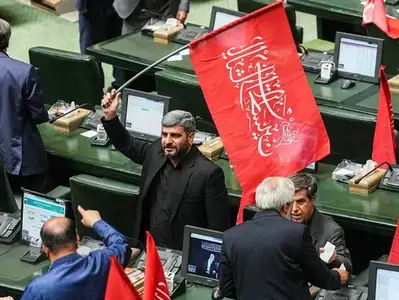
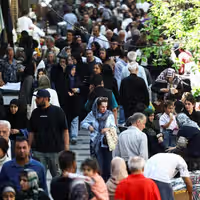
An Iranian lawmaker said on Wednesday that basic food prices were rising for reasons unrelated to sanctions or currency depreciation, leaving many families unable to afford staples.
“Some goods in this country have nothing to do with sanctions or the rise of the dollar, so why are we seeing higher prices for essentials?” Salman Es'haqi said at the parliament, suggesting that mismanagement in the supply chain and delays in allocating foreign currency for essential items are to blame for the soaring prices.
“People cannot afford rice, chicken, meat and basic commodities,” he added.
Iranian Foreign Minister Abbas Araghchi said on Tuesday that the future of a recent nuclear cooperation deal with the UN atomic watchdog signed in Cairo will be decided by the Supreme National Security Council, amid heightened tensions over the reimposition of UN sanctions.
“We are facing new conditions in the Security Council, the UN and the IAEA,” Araghchi said after returning from New York. “These issues must be discussed in the Supreme National Security Council and its nuclear committee. I am confident the right decisions will be taken.”
The Cairo accord, signed in early September, allows the International Atomic Energy Agency to resume inspections at all declared Iranian sites, including facilities damaged in June’s Israeli and US strikes.
IAEA chief Rafael Grossi called it a step toward restoring safeguards.
But Iranian officials, including Araghchi, had warned the agreement would collapse if hostile actions such as the activation of the snapback sanctions proceed. Deputy Foreign Minister Kazem Gharibabadi earlier cautioned that reimposed sanctions would “certainly halt” the deal.

Iran’s pharmaceutical sector is facing delays of four to six months in the allocation of foreign currency for importing raw materials, industry officials said, warning the hold-ups risk disrupting the drug supply chain.
Health Ministry officials have repeatedly pledged to secure strategic medicines, but suppliers say the central bank’s slow allocation of funds, coupled with sanctions-related banking hurdles, has left companies months behind in receiving payments, Tasnim reported on Wednesday.
From $3.5 billion in promised annual funds for pharmaceuticals and medical equipment, only about $3 billion is expected to materialize this year, according to the Food and Drug Administration.
“We may face shortages in coming months, and even need to seek antibiotics in winter,” said its drug chief, Akbar Abdollahi-Asl.
Industry representatives added that while Iran produces about 72% of its active pharmaceutical ingredients domestically, just $100 million in timely foreign currency allocations could cover most raw material needs. Importers urged urgent state support to prevent shortages, warning that patients could bear the brunt of the delays.
Kayhan, a hardline newspaper overseen by Iran’s Supreme Leader’s representative, said on Wednesday the reactivation of the UN snapback sanctions would be unlikely to inflict fresh economic damage on Iran and warned that the measure’s main effect would be psychological.
“Snapback will not be as terrifying as the West wants to frighten Iran with,” Kayhan wrote in an analysis, saying the return of UN sanctions would matter only if all countries implemented them “in a united and strict manner,” something it called unlikely given splits between East and West.
The paper argued that real economic pressure on Tehran has in recent years come mainly from unilateral US secondary sanctions, not Security Council measures, and pointed to growing trade and payment links with partners such as Russia and China as cushions against renewed UN restrictions.
Kayhan added that the principal danger was the “psychological shock” the snapback could create for markets and investors, and urged authorities to calm public sentiment. “What is most worrying is the psychological effect of the return of UN sanctions on society,” it said.
The paper also called for judicial action against domestic media outlets it accused of “creating fear and despair” among the public.
Kayhan concluded that with “program, prudence and resolve” Tehran could withstand pressure and that relying on domestic strength and broader diplomatic ties -- rather than hope for Western goodwill -- was the appropriate response.

The United States on Wednesday accused Iran of gross human rights violations following the deaths of three women in prison, the deteriorating condition of an imprisoned activist on hunger strike, and the looming execution of a Kurdish political prisoner.
The State Department’s Persian-language account on X said three women -- Somayeh Rashidi, Jamileh Azizi and Soudabeh Asadi -- died in recent days at Qarchak prison near Tehran after being denied medical care, adding their deaths followed that of Farzaneh Bijanpour in January.
It cited a statement by 45 women prisoners who condemned “inhumane treatment” of fellow inmates.
Washington also highlighted the case of Hossein Ronaghi, a well-known dissident jailed for criticizing the authorities, who is on hunger strike in protest at what it called “horrific prison conditions.”
The US said his health had sharply worsened due to denial of medication for chronic illness and demanded his immediate release.
Separately, it condemned what it described as the arbitrary detention and torture of Kurdish activist Pakshan Azizi, arrested with relatives in August 2023 and sentenced to death after what it called a sham trial.
“We call on the regime to halt her execution, free her and all political prisoners, and end its campaign of terror against its own people,” the statement said, adding more than 1,000 executions in Iran so far in 2025.

An Iranian remake of Love Island has exploded online, sparking fierce debate about taboos, personal freedom and the responsibilities of new media.
Marketed as Eternal Love, the show gathers young contestants in a luxury villa, reshuffles their romantic ties and pits them in staged challenges—following a formula that has proved commercially irresistible from Britain to Netflix.
But in Iran’s fraught cultural landscape, its rise is about more than entertainment: it reflects social shifts, strained relationships and the clash between audience demand and media censorship.
Global lessons
Reality shows worldwide have long faced serious criticism.
In the 2025 season of Love Island alone, Ofcom—the UK’s media regulator—received over 14,000 complaints.
Social pressure led to protective protocols: restricting contestants’ social-media use during broadcast, offering psychological support before and after filming and mandating training for television appearances.
In the US, lawsuits against Love Is Blind producers raised the question of whether contestants were mere “entertainment tools” or employees entitled to rights. The outcome was costly settlements and the entry of labor organizations into the fray.
The message is clear: reality TV is never “just entertainment”—mental health, labor rights and human dignity are at stake.
Added sensitivities
Eternal Love reproduces the same criticisms: commodifying emotions, privileging appearance over character, crafting heroes and villains and fueling collective judgment.
The main difference lies in its platform.
YouTube, unlike television, lacks a regulatory body and binding standards. That absence can intensify psychological and social pressure on participants—especially when their intimate relationships are laid bare to millions of viewers, including teenagers.
Supporters counter that a weary, anxious Iranian society deserves entertainment. They argue taboos must be broken and media should serve as a “mirror” to new realities of relationships.
There is some truth to this. Yet global experience shows that a mirror that sells also carries responsibility—for participants’ well-being and for the younger audiences exposed to such content.
Need for standards
This responsibility raises urgent questions for the makers of Eternal Love: is there a public care protocol, do contestants have access to counseling, are contracts fair and allow withdrawal without penalty, and has an age rating been defined?
Most of all, where is the line between reality and scripted drama, and don’t audiences have the right to know?
Eternal Love embodies two realities at once: society’s right to entertainment and taboo-breaking, and the dangers of crossing into unregulated territory.
If this genre is to persist in Persian-language media—and it likely will—clear standards are essential: transparent care protocols, contractual protections for participants, anti-harassment policies, social-media management during broadcast, age guidance and stronger media literacy.
Global precedents exist. It only takes the will to adopt and enforce them.