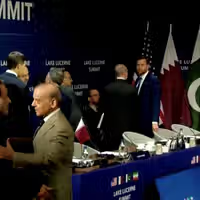
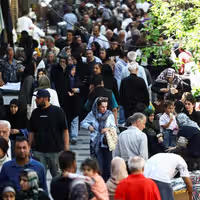
Iranian President Masoud Pezeshkian rejected Western pressure and sanctions, insisting the country would not yield to outside demands.
“They want to sanction us because we refuse to bow before them. The idea of bringing us to our knees is nothing but a fantasy,” he said at an event for firefighters.
“This human rights, the United Nations and UNESCO are nothing but lies. Israel can attack any country it wishes without cost.”
“They want to force us to yield before dishonorable people, but even the thought has no place in my mind,” he added.
Japan on Sunday urged renewed diplomacy after UN sanctions on Iran’s nuclear program were reinstated, following the collapse of efforts to sustain the 2015 nuclear deal.
“Japan has consistently emphasized the importance of resolving the issue through dialogue, based on the position that Iran's development of nuclear weapons must never be allowed,” Foreign Minister Takeshi Iwaya said.
“It is regrettable that the parties involved could not reach an agreement.” The sanctions returned Saturday after the Security Council failed to extend relief, following European warnings that Iran was not meeting its commitments.


Iran’s judiciary chief warned on Monday that those undermining public morale amid renewed international sanctions would face legal action, accusing them of aiding hostile powers.
“For nearly half a century, the front of arrogance has employed every kind of conspiracy and enmity against the Iranian nation and the Islamic Republic,” Gholamhossein Mohseni-Ejei told the Supreme Judicial Council, using a phrase Iranian authorities employ to refer to Western powers.
He said economic siege was “nothing new” for Iranians, adding: “At this time, when enemies are focusing all efforts to bring down the Iranian nation and system, we must be vigilant that their agents do not infiltrate and damage national unity.”
“Those who through psychological operations weaken people’s spirit and spread fear will face legal measures,” he said, warning that profiteers or individuals disrupting essential goods markets “whether out of greed, negligence, or acting as enemy agents, will be dealt with decisively under the law.”
Earlier this month, Iran’s prosecutor general’s office warned that media and online outlets would also face legal action if their coverage of the reimposed UN sanctions undermines public morale.
Judiciary’s news outlet Mizan said some websites and channels had posted “sensitive content” about rising prices, adding that such reporting threatened the “psychological security of society.”
The judiciary has previously pursued cases against journalists and citizens over commentary on political and economic issues.
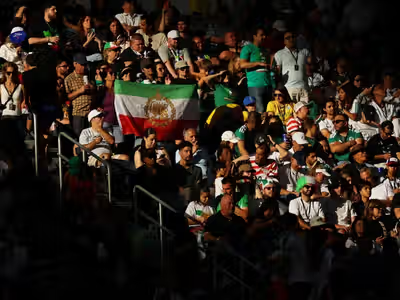
The return of UN sanctions carries more psychological than economic effects, Iranian lawmaker Hassan Qashqavi said Monday, urging media to avoid exaggeration and reduce hype around currency and gold prices.
“Right now the issue of suspending cooperation with the International Atomic Energy Agency is on the agenda, and previously parliament had approved the suspension of cooperation with the agency,” Qashqavi said.
"The activation of the snapback mechanism by the three European countries was illegal and extortionist," Qashqavi said.

The recent 12-day conflict was a confrontation between the United States and the Islamic Republic, senior Revolutionary Guards adviser Mohammad Reza Naqdi said Monday.
“In the recent imposed war, America stood against Islamic Iran. The condition of being a Muslim is to stand against the tyrants, and the blood of the martyrs awakens nations and clarifies the path of truth in this world,” Naqdi said.
The June conflict was a war between the United States and Iran, Naqdi said, adding: “The enemy, through a wrong calculation, put Israel forward, but the resistance broke the equation.”

The economic blockade of Iran is nothing new for the people, judiciary chief Gholamhossein Mohseni Ejei said Monday.
“We have been under economic blockade since the beginning of the revolution. Now there is no room for any leniency with traitors,” Ejei said.