US dollar nears 1.09 million rials in Iran on fears of UN sanctions
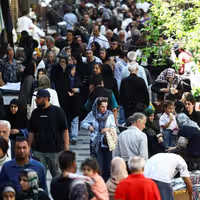
The US dollar surged past 1.08 million rials on Iran’s open market as the prospect of renewed UN sanctions weighed heavily on the currency.
Traders attributed the sharp rise to growing uncertainty over the activation of the snapback mechanism, which would restore international restrictions lifted under the 2015 nuclear deal.
Resistance is Iran’s main strategy against sanctions and rejected “submitting to US and European coercion,” a member of parliament’s national security committee said as reported by Didban Iran.
“If we leave the NPT, as an independent country we will no longer accept any IAEA oversight and will not allow its inspectors into Iran,” said Amir Hayat Moghaddam. He argued that Iran is militarily stronger than the West and should not concede under pressure.
His remarks followed European governments’ decision to move toward reactivating the snapback mechanism for reimposing international sanctions on Iran.
Esmaeil Khatib, Iran’s intelligence minister, during the televised presentation of alleged stolen Israeli data and documents aired on state TV, Wednesday, Sept. 24, 2025.
An outlet tied to Iran’s Revolutionary Guards acknowledged that a recent documentary from the Ministry of Intelligence relied on archival images from the internet, despite presenting them as exclusive material obtained from Israel.
Fars News Agency described the use of online images as “poor judgment” and said it gave rival outlets grounds to call the entire program fabricated. “Labeling all images, including archival ones, as exclusive allowed hostile media to portray the film as fake,” Fars wrote.
The documentary, broadcast on September 24 under the title The Spider’s Hideout, was presented as evidence of an intelligence penetration into Israel. It displayed materials said to be connected to Israeli nuclear facilities, including the Dimona site, along with details about individuals described as involved in the country’s nuclear program.
Intelligence Minister Esmail Khatib appeared in the program, calling the operation “a major infiltration” that yielded “a treasure of top-secret intelligence.” He described the outcome as the result of “months of complex planning and multiple successful operational phases inside the enemy’s structure.”
Since its release, however, attention has centered on the documentary’s reliance on readily available online photos, presented as exclusive visuals. The revelation has fueled ridicule across social media and intensified criticism of the government’s narrative.
The film was promoted as part of a broader presentation that Iran had secured “millions of pages” of Israeli defense documents. Earlier this year, state media reported that Iranian intelligence had obtained “abundant strategic and sensitive information” from inside Israel. At the time, Israeli security analysts told Iran International those assertions were exaggerated and part of psychological warfare.
Observers assess that The Spider’s Hideout is part of an effort to recast Iran’s recent setbacks against Israel, including intelligence and military losses, as victories. The exposure of online-sourced material has instead raised doubts over the credibility of the government’s portrayal, even among domestic audiences.
The European Troika’s move to trigger the snapback mechanism will inflict lasting damage on Europe’s credibility, said Iran’s foreign minister in an article published Wednesday by The Jakarta Post.
The minister wrote that the United States violated the 2015 nuclear deal by withdrawing in 2018, while Britain, France, and Germany failed to meet their commitments. Countries that undermine agreements, he said, cannot claim their benefits and added that supporting US strikes on Iranian nuclear facilities has further eroded Europe’s position.
He pointed to a recent IAEA agreement mediated by Egypt as evidence of Iran’s continued pursuit of diplomacy.
Iran’s parliament will review a letter from MPs urging Iran to build nuclear weapons Deputy Speaker Ali Nikzad said on Friday.
“In the doctrine of the Islamic Republic, the production of an atomic bomb has never been raised and we pursue nuclear energy for its benefits in areas such as water transfer, power generation, agriculture and medicine,” Nikzad added.
The letter on building a bomb will be considered on Sunday, he said.
70 MPs sent a letter on September 22, requesting a change to the Supreme Leader’s earlier fatwa and urging the state to build and retain atomic weapons as a form of deterrence.
An Iranian parliamentarian dismissed the snapback sanctions mechanism as serving European powers on behalf of Washington.
“The snapback is a servile tool of three European powers for the United States, which begged for a ceasefire in the 12-day war after its defeat,” Ali Shirinzad said on Friday.