More Stories
After the Security Council’s decision to reject a last-ditch bid to delay the reimposition of Iran sanctions, Supreme Leader Ali Khamenei’s page on X reposted part of his remarks in which he had said: “The other party breaks its promises in everything, lies about everything, and constantly threatens with military action.”
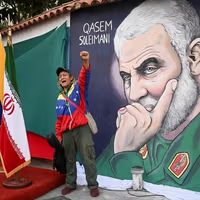
He also said: “If they can, they assassinate our figures such as Martyr Soleimani or bomb our nuclear facilities; one cannot negotiate with such a side, nor sit down with trust and confidence to make agreements.”

In a 4–9 vote with two abstentions, the UN Security Council on Friday rejected a Russian-Chinese proposal to delay the snapback of UN sanctions on Iran, which are set to be reinstated Saturday night, 30 days after being triggered by the Europeans.
The resolution aimed to extend sanctions relief under Security Council Resolution 2231 for six months to allow further diplomacy.
Russia, China, Algeria, and Pakistan voted in favor, while the United States, Britain, France, and five other members opposed it. Guyana and South Korea abstained.
Dorothy Shea, Acting US Representative to the UN advised Russia and China to ask Iran for full cooperation instead of postponing the sanctions.
“They must press leaders in Tehran to take meaningful immediate steps to fulfill its commitments and obligations, including by fully cooperating with the IAEA,” Shea said.
British ambassador to the UN Barbara Woodward told the Security Council the doors to diplomacy are not yet closed.
"The United Kingdom remains committed to pursuing a diplomatic solution that ensures Iran never acquires a nuclear weapon, while maintaining Iran's right to a civil nuclear program in line with the nuclear Non-Proliferation Treaty."
Russia's representative at the meeting said Moscow "had hoped that the US, that European colleagues in the US, would think twice and that they would opt for the path of diplomacy and dialog instead of their clumsy blackmail, which merely results in escalation of the situation in the region."
However, the envoy said, "what did we see instead, in the 29 days that have elapsed since then, was the very same typical scenario for Europeans of pressure."
Iran had already warned if the UN sanctions reinstated, it will halt cooperation with the International Atomic Energy Agency, (IAEA).
Iran's foreign minister Abbas Araghchi told the UN Security Council that "Iran put forward several constructive proposals in New York to avert an unnecessary and avoidable crisis, all were ignored."
"I have to remind the distinguished representative of France that two nights ago, I agreed with your foreign minister a framework agreement, but he was not able to get the agreement of the United States," Araghchi said.
Following the Security Council meeting, Araghchi told Iran International that the reimposition of UN sanctions could jeopardize Tehran's cooperation with the UN nuclear watchdog.
The snapback mechanism was triggered on August 28 by France, Germany, and the UK (E3), citing Iran's "significant non-performance,” including enriched uranium stockpiles exceeding JCPOA limits and restricted IAEA access to facilities like Natanz and Fordow.
Iranian Foreign Minister Abbas Araghchi told the Security Council on Friday that IAEA inspectors are currently in Iran carrying out their work. However, he did not specify which nuclear facilities they had been granted access to.
Earlier in the day, a senior Iranian lawmaker rejected media reports about any current or planned UN inspections of Iran’s nuclear facilities, calling them “sheer lies” and merely the fantasies of IAEA Director General Rafael Grossi.
"The three European powers and the United States bear full responsibility for the serious consequences of today's decision," Iran's foreign minister Abbas Araghchi told the Security Council.
"By ignoring facts, spreading false claims misrepresenting Iran's peaceful program and blocking diplomacy, they have actively and intently paved the way for dangerous escalation."

Iran's foreign minister told the UN Security Council that "Iran put forward several constructive proposals in New York to avert an unnecessary and avoidable crisis, all were ignored."
"I have to remind the distinguished representative of France that two nights ago, I agreed with your foreign minister a framework agreement, but he was not able to get the agreement of the United States," Araghchi said.