Iran’s president says policies will shift if UN sanctions return
Iran’s President Masoud Pezeshkian said the country is fully prepared to face any scenario and will adjust its policies if UN sanctions are reinstated.
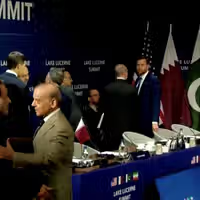
"We hope such a process does not take place; nevertheless, the Islamic Republic of Iran is fully prepared to face any scenario and condition," state media quoted Pezeshkian as saying in a meeting with Bolivia's president on the sidelines of the United Nations General Assembly.
"And it is obvious that the nature of our interactions and policies will also be adjusted in accordance with the new situation," he added.
Indian officials visiting Washington this week requested permission to import US-sanctioned Iranian and Venezuelan crude to make up for a shortfall from Russia, Bloomberg reported on Thursday citing sources.
The Trump administration has slapped New Delhi with steep tariffs for its brisk purchases of US-sanctioned Russian crude and ties between the two vast democracies have hit a low point over the impasse.
A delegation told US officials that blocking supplies from the three oil exporters could pressure Indian refiners and drive up global oil prices, Bloomberg reported.
President Masoud Pezeshkian showing photos of Iranians killed in Israeli attacks
President Masoud Pezeshkian’s speech at the United Nations drew an unusual split in Tehran: while conservatives and hardliners rallied behind him, many of his moderate supporters voiced sharp disappointment.
Parliament Speaker Mohammad Bagher Ghalibaf hailed Pezeshkian on X, saying he conveyed “the dignity and power of the Iranian nation at the UN” and exposed Israel as “child-killers.”
Ultra-hardliner Amir-Hossein Sabeti thanked him for recalling “the Zionist regime’s crimes,” while fellow lawmaker Hamid Rasaei called the address “worthy, good and influential.”
“His duty was to deliver the nation’s positions to the world,” one pro-government user commented on Ghalibaf’s post. “Thank God he passed this test of Western charlatanism.”
‘Wish you didn’t go’
Moderates and reformists, by contrast, were left underwhelmed.
Former Chamber of Commerce head Hossein Selahvarzi dismissed the trip as pointless. “So far, the outcome of the New York trip can be summed up in one sentence: ‘Being there so that we weren’t absent.’”
Prominent academic Sadegh Zibakalam directly addressed Pezeshkian: “Mr. President, after the Leader’s speech yesterday, what was left for you to say in New York? I wish you hadn’t gone—unless you intended to say something different.”
Others offered a more tempered defense.
Prominent centrist and former editor Mohammad Atrianfar compared Pezeshkian’s remarks to former president Khatami’s early UN addresses, calling them “clear, meaningful, and forward-looking … consistent with the Leader’s instructions.”
Maziar Balaei of the Etemad Melli Party said that given recent Israeli and US military actions, “it was in fact a good address.”
‘Not our representative’
Some critics also objected to the president’s choice of symbolism.
By holding up photos of Iranians killed in the 12-day war with Israel, they argued, he ignored violence inside Iran.
“I wish the Iranian people also had a representative at the UN who held up the pictures of the children Khamenei killed and showed them to the world,” one user wrote.
A viewer told Iran International in a video message: “Who killed Kian Pirfalak, Hamidreza Rouhi, Hadis Najafi and the Zahedan worshippers? If there is justice, it must first be applied for the people of Iran before you talk about Lebanon and Palestine.”
‘Little impact’
Outside observers were skeptical of the speech’s significance.
Turkey-based analyst Rouhollah Rahimpour described it as “a softer and more diplomatic version of Khamenei’s harsh stance,” noting that Pezeshkian avoided taking a position on negotiations with the US.
On X, he added: “What is left unsaid matters as much as what is said … rejecting talks with one hand while reaching for them with the other.”
Germany-based analyst Ahmad Pourmandi was harsher, calling Khamenei’s remarks ahead of the trip “the final blow to fading hopes of resolving the snapback crisis.”
Pezeshkian’s mission, Pourmandi added, “was the final nail in the coffin of normalization—deepening Iran’s crisis and its march toward war.”
Asked if looming international sanctions on Iran triggered by European states would prevent the rebuilding of its nuclear program, former Mossad chief Yossi Cohen told the BBC that Tehran responds only to attacks.
"I hope. I know that the only thing that speaks to the Iranian is kind of an attack. I don't think that they have ever reversed their agenda because of sanctions," he said.
US and Israel attacks on Iranian nuclear sites in June set the program back and Tehran no longer has the ability to enrich uranium, added Cohen, who ran the Israeli spy agency from 2016 to 2021.
"I think it is significantly destroyed. It would be very hard to rebuild. It would take them, I believe, in between, lots of months and maybe some years to rebuild what they've done. And there is not something much more significant to my understanding. Now, Iran cannot enrich."
Former Mossad director Joseph (Yossi) Cohen gestures as he addresses a conference in Jerusalem October 22, 2018.
US assertions that it was pursuing peace with Tehran were belied by its attack on the country in June and continued support for Israel, Iranian Foreign Ministry Spokesman Esmail Baghaei on Thursday.
"The United States claim of offering diplomacy is simply disingenuine and preposterous; you cannot bomb a country amidst ongoing diplomatic negotiations and offer peace," he wrote on X.