More Stories

The value of the US dollar surged to an unprecedented 1,060,000 rials in Iran’s free market on Sunday, setting a new all-time record as fears of renewed UN sanctions deepened.
By mid-afternoon, the rate had reached 1,062,600 rials, continuing a sharp climb that added more than 30,000 rials since Saturday. The jump comes amid heightened expectations that the snapback mechanism will be activated, reinstating international sanctions previously suspended under the 2015 nuclear deal.
On September 20, the dollar opened trading at around 1,013,000 rials and rose to above 1,035,000 by midday, immediately after the UN Security Council rejected a South Korean draft resolution that would have permanently lifted sanctions. With the measure defeated, all restrictions are now set to reimpose automatically from September 27.
The rial has faced repeated shocks since Donald Trump returned to the White House. The latest surge follows months of volatility, with the dollar climbing to 1,058,900 rials in April when US B-2 bombers were deployed to the region. Optimism over nuclear talks briefly brought the exchange rate down to 820,000 rials after a second round of negotiations in Rome, but subsequent Israeli strikes on Iranian targets reignited the currency’s slide.
Even after a ceasefire was announced, the US dollar remained high at 930,000 rials and later climbed back above 940,000 on speculation over snapback sanctions. Despite occasional dips, the overall trend has been steadily upward, culminating in Sunday’s record high.
The collapse of the rial underscores Iran’s deepening economic vulnerability as diplomatic isolation grows, with markets responding sharply to both international pressure and the stalled state of nuclear negotiations.
Iran’s army said it is more prepared than ever to safeguard the interests of the Islamic Republic.
“Today the army, more ready than in the past, stands like a mountain until the last breath in defense of security, national interests, and the Islamic Republic system,” the army’s Sunday statement added.

Iran’s Ministry of Education introduced the recent 12-day war with Israel into school lessons with special content on the conflict to be included across all school levels in the new academic year, Education Minister Alireza Kazemi announced Sunday.
“We have prepared three special issues for primary, middle, and high school students in the form of a book, which will provide students with an extraordinary and beautiful narrative of the 12-day war,” he said.
Figures including the Supreme Leader and commanders in the Revolutionary Guards have declared the war a victory for Iran.
Kazemi added that 20 educational packages were being rolled out in addition to the 12-day war, including themes such as the Iran’s missile program, and a unit called “Hard Slap.”
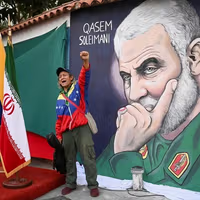
The phrase was first used to describe Iran’s limited missile strike on the US Ain al-Asad base in Iraq following the killing of Quds Force commander Qassem Soleimani.
School books were later updated to include tributes to the slain commander. Other material added to textbooks includes references to militants killed in Syria, officially commemorated by the Islamic Republic as “defenders of the shrine.”
Inspectors from the International Atomic Energy Agency will not be allowed to enter Iran’s recently damaged nuclear facilities, said Esmail Kowsari, a member of parliament’s National Security Committee.
“IAEA inspectors are barred from entering damaged nuclear sites,” he said.
The International Atomic Energy Agency has shown itself to be “a spy”, an Iranian lawmaker said on Sunday.
“The International Atomic Energy Agency has in practice shown its espionage and bad faith,’” said Hamed Yazdian, a parliamentarian from Isfahan.
The Islamic Republic, he said, has the right to respond "proportionately to illegal actions of Britain, France, Germany and the UN Security Council in reimposing sanctions."