South Korea convened Friday vote under Western pressure - Axios
The United States, France, and Britain pressed South Korea, the rotating chair of the UN Security Council, to convene the vote on Friday, before the beginning of UN General Assembly high-level week on Monday, Axios reported citing European diplomats and US officials.
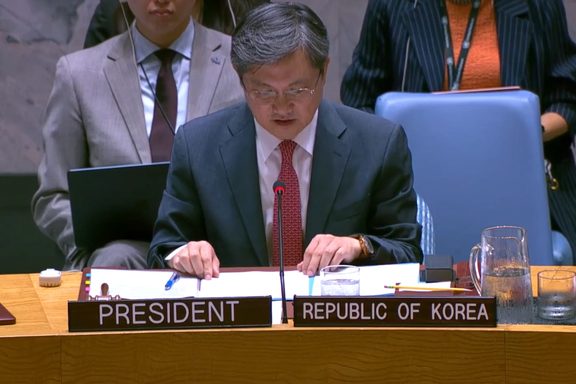
A UN Security Council resolution on whether to permanently lift UN sanctions on Iran was voted down on Friday, dealing a win for a European-led bid to reimpose them on September 28 over Iran's alleged nuclear non-compliance.
The resolution, tabled by South Korea in its role as Security Council president, was a procedural part of a process launched last month after Britain, France, and Germany triggered the so-called snapback mechanism, declaring Iran in “significant non-performance” of the 2015 nuclear deal.
The decision not to lift Iran sanctions means all pre-2015 UN sanctions on Iran will automatically return once the 30-day snapback period ends on September 28, unless the Security Council takes further action.
Iran along with permanent Security Council members Russia and China lambasted the vote on Friday as a blow to diplomacy.
Algeria, China, Pakistan, and Russia voted to lift Iran sanctions. Denmark, France, Greece, Panama, Sierra Leone, Slovenia, Somalia, Britain, and the United States voted against the resolution while Guyana and South Korea abstained.
Acting US Representative to the United Nations Dorothy Shea said the European troika was right to pursue sanctions given what she called Iran's clear violations.
“In July, the E3 offered to extend the snapback mechanism if Iran were to take steps to address concerns regarding its highly enriched uranium stockpile, comply with its IAEA obligations, and resume direct diplomacy with the United States," Shea said. "Despite suggestions to the contrary from Iran and others, Tehran has not yet fulfilled those conditions."
The resolution outcome does "not impede the possibility of real diplomacy,” Shea added, without elaborating.
Members of the UN Security Council vote against a resolution that would permanently lift UN sanctions on Iran at the UN headquarters in New York City, US, September 19, 2025
'Unlawful'
Iran blasted the move, calling it “hasty, unnecessary, and unlawful”.
“Iran's safeguarded nuclear facilities have been attacked not in secret, but openly by Israel, the rogue regime, and by the United States,” Iran's ambassador to the UN, Amir Saeid Iravani, said.
He was referring to a 12-day surprise military campaign by Israel which was capped off by US strikes on Iranian nuclear sites. “This reckless step undermines dialogue without aggression and sets a dangerous precedent,” Iravani added.
The Iranian envoy said Tehran never rejected diplomacy, presenting the recent agreement with the International Atomic Energy Agency (IAEA) to advance resumed international inspections of nuclear sites as evidence.
In a phone call with IAEA chief Rafael Grossi, Iran’s Foreign Minister Abbas Araghchi criticized what he called a politicized move that ignored Tehran's good faith approach.
“Araghchi stressed that Iran, as a responsible country, has always pursued the path of diplomacy and technical cooperation to resolve issues related to its nuclear program and rejects any political measures or unfair pressure that could escalate tensions,” his ministry added in a statement.
Britain's permanent representative to the United Nations, Barbara Woodward, questioned Iran's nuclear motives but said it was open to talks.
“The United Kingdom is committed to pursuing a diplomatic solution to ensure that Iran shall never seek, acquire or develop a nuclear weapon,” Woodward said.
“That is why, on August 28, the United Kingdom, France, and Germany notified this Council of Iran's clear and deliberate non-compliance,” she added.
Iran’s Ambassador to the United Nations, Amir-Saeid Iravani, is seen on a screen as he addresses members of the UN Security Council after a vote on a resolution that would permanently lift UN sanctions on Iran, at UN headquarters in New York City, US, September 19, 2025
Russia and China opposed
Moscow and Beijing have grown closer to Tehran as their relations with Washington have frayed in recent years. Their envoys castigated the Western position.
Fu Cong, China's permanent representative to the UN, raised doubts about the move by the three European countries, warning it might inflame the long standoff
“China maintains that under such circumstances, hastily pushing for a vote on the draft resolution might exacerbate confrontation further and is not conducive to the resolution of the issue,” Fu Cong said.
Despite defense and economic agreements with Iran, Russia and China offered little substantive support to Iran as it confronted Israel and the United States over the summer.
More willing to exert pressure on Iran at the time of the 2015 nuclear deal, the two superpowers have broken with Western countries by mending fences with another international atomic pariah, North Korea.
Russia's Permanent Representative to the UN Security Council, Vasily Nebenzya, said the sanctions bid violated a 2015 nuclear deal.
“Britain, France, and Germany grossly violated the procedure for the consideration of disputed situations we have under the JCPOA in particular,” Nebenzya said. “Here you have a very good illustration of the fact that our European colleagues do, in essence, reject diplomacy. They prefer the language of blackmail and intimidation.”
Long an advocate of more international pressure on Iran at the United Nations, Israel celebrated a diplomatic win.
Israel's Ambassador to the UN hailed the Security Council's decision, calling it “another step forward towards imposing sanctions on the Iranian regime.”
“It is good that the world has woken up and joined the fight against Tehran’s violence and terrorism toward the Western world. The State of Israel will not allow a nuclear threat from Iran,” Danny Danon said.
Iranian deputy foreign minister Kazem Gharibabadi in an interview with the state TV called on fellow Iranian authorities to prepare for the psychological impact of the snapback of UN sanctions on September 28.
The US State Department on Friday condemned the Islamic Republic's execution of political prisoner Babak Shahbazi this week as proof of what it called Tehran's use of the death penalty to scotch opposition.
Shahbazi, a father of two, was detained in January 2024 and later convicted of “spying for Israel” and “corruption on earth,” charges he denied before his execution early Wednesday.
The State Department said his execution "underscores the Iranian regime’s instrumental use of capital punishment to silence dissent and instill fear."
"Shahbazi, accused of espionage, was convicted in a grossly unfair trial based on forced confessions obtained under torture," it said in a post on its Persian-language X.
Rights groups have described the proceedings as grossly unfair and based on forced confessions obtained under torture.
His initial sentence was handed down in May 2025 by Judge Abolghasem Salavati, who was sanctioned by the United States in 2019 for presiding over unfair trials, extracting forced confessions, and imposing harsh sentences on political prisoners and journalists.
"Shahbazi’s case highlights the regime’s reliance on fabricated evidence and brutal tactics, including solitary confinement and physical abuse, to suppress opponents," the State Department said.
"The United States condemns this injustice and, while standing with the Iranian people in their struggle for freedom and dignity, remains committed to exposing the regime’s human rights violations."
Thousands of people in Iran face the risk of execution amid what Amnesty International on September 10 called a deepening execution crisis, with death sentences handed down after unfair trials and on vaguely worded charges such as enmity against God and corruption on earth.
The rights group said more than 800 people had been executed in 2025 so far, nearly double the pace of last year, and warned that thousands more remain under investigation or prosecution on capital charges, including drug-related offences and accusations of espionage.
Since the 2022 Woman, Life, Freedom uprising, Amnesty said, Iranian authorities have “weaponized the death penalty as a tool of oppression”.
In June, following Israel’s airstrikes and a 12-day war with Iran, officials intensified calls for swift trials and executions for those accused of collaborating with Israel. Parliament has also advanced legislation to expand the use of capital punishment, pending approval by the Guardian Council.
"Today’s action by the three European countries in the UN Security Council, aimed at completing the process of reinstating terminated resolutions, is unlawful, unjustified, and provocative, and severely undermines ongoing diplomatic efforts," Iran's foreign ministry said.
"Today’s move ... carried out without consensus and despite serious opposition from several Council members, further undermines the credibility of the Security Council," it added in a statement.
"(Iran) reserves the right to respond appropriately to any unlawful action," it added, without elaborating.
The Israeli military's Persian spokesperson hit back at Iran's assertion that the world was beginning to understand Israel's crimes, countering that the Islamic Republic has carried out crimes daily since its inception.
The social media spat comes as Israel steps up its Persian language rhetoric, in an apparent bid to communicate with Iranians it views as disaffected and sympathetic to its stated preference for regime change in Tehran.
In a video posted Friday on X, IDF spokesperson Kamal Penhasi responded to remarks by Iranian Foreign Minister Abbas Araghchi, who had said the world was coming to understand “the crimes of the Zionist regime.”
“The biggest criminal entity is the Islamic Republic. A regime that, from the first day of the revolution, executed the best commanders and officers of the army,” Penhasi said. “It has killed elderly, youth, and children during civil protests in the streets.”
“It has sentenced thousands of innocent Iranians to the gallows or imprisoned them in its dungeons for absurd charges,” he added. “A government that exports its destructive policies through proxy groups across the world no longer has any credibility.”
Over 900 executions occurred in 2024, the highest since 2015, with August 2025 witnessing an unprecedented wave, including political prisoners and public hangings.
Rights monitors report that political prisoners and protesters have also been executed, while arbitrary arrests, torture, forced confessions and unfair trials continue, particularly against activists and journalists associated with the 2022 “Woman, Life, Freedom” movement.
Gaza health authorities said this week that Israel's incursion into Gaza over nearly two years of war with Iran-backed Hamas fighters has killed over 65,000 Palestinians.
Israel accused of seeking regime change
The head of Iran’s Army Strategic Studies and Research Center, Ahmad-Reza Pourdastan, alleged on Friday that Israel is intent on overthrowing the Islamic Republic.
“In the 12-day war, the enemy was caught off guard. I tell you with evidence, they had come to celebrate victory; they had prepared a victory anthem for Tehran to broadcast on July 1,” Ahmad Reza Pourdastan said, as cited by Iranian state media.
Pourdastan claimed the United States supported Israel during the conflict by providing missile intercept coordinates from its Central Command.
“Upon launch, the missile gained initial altitude and was immediately detected by CENTCOM radars in Qatar. The missile’s path was tracked, and they quickly informed the Israelis,” he said.
Israel launched a surprise military campaign on June 13, 2025, striking military and nuclear facilities in Iran. Air attacks killed nuclear scientists along with hundreds of military personnel and civilians. Iran retaliated with drone and missile attacks which killed 31 Israeli civilians and one off-duty soldier.
The United States joined the conflict on June 22, conducting strikes on major nuclear sites including Fordow, Natanz and Isfahan, before brokering a ceasefire on June 24.
Pourdastan insisted that Iran’s retaliatory missile strikes forced Washington to seek an end to the fighting.
“Even Trump requested a ceasefire. By God, they were scared. After Iran’s missile response, Witkoff called Mr. Araghchi and said, ‘Stop, don’t strike anymore,’” he said.