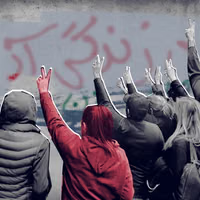
Women sing along during a concert by Iranian pop singer Behnam Bani on October 29, 2024.
Viral videos of women dancing unveiled in Iranian concerts have reignited debate over whether the apparent social opening is genuine or contrived by a ruling system facing external military pressure and domestic discontent.
For musician Arash Sobhani—a solo artist in exile in the United States and frontman of the acclaimed Iranian band Kiosk—the answer is complicated but clear: there is no real reform afoot, only a choreographed spectacle.
“Reform happens if we see a woman singer, if you see a female singer on stage, that would have been a reform,” said Sobhani, who left Iran in 2005 after performing underground in Tehran for two years.
Videos flooding social media show women in the audience discarding the compulsory hijab and dancing openly—acts that were harshly punished until recently.
The imagery from a site tied to Iran’s ousted monarchy struck some observers as a sign Tehran may have relaxed old taboos.
Sobhani urged caution. “We want people to be happy. Everybody should be happy all the time,” he told the Eye for Iran podcast. “But let’s not just close our eyes and ignore the elephant in the room. Female singers, your colleagues are not allowed to sing, yet, still, and nothing has changed.”
He argues that venue choice and access matter. Staging concerts in controlled, ticketed spaces—often priced beyond the reach of many—differs fundamentally from allowing free, mass gatherings in iconic public squares.
“They (the Islamic Republic) want (events) in closed spaces, not more than 2,000 to 3,000 people … because they can control that,” he said, contrasting it with a hypothetical crowd of “100,000 people” in a central square.
The push and pull were visible beyond Tehran. In Shiraz, the popular band Bomrani performed to jubilant scenes that some hailed as a cultural opening—only for authorities to ban the group from playing in the city and the wider Fars province days later, accusing it of “norm-breaking behavior.”
The reversal underscored how precarious such moments remain.
Joy is not structural change
Sobhani acknowledges that public joy can itself be opposition—but warns against mistaking it for structural change.
“Joy in the way we live is an opposition, is a form of rebellion, is a form of protest ... but ... as long as these guys are in power, no change is permanent. It’s just going to be temporary, makeshift, just cosmetic ... that’s going to be gone in two days.”
The concerts arrive amid the enduring legacy of Mahsa Jina Amini, whose September 2022 death in morality police custody sparked the Woman, Life, Freedom protest movement.
While the demonstrations were crushed, visible social shifts—like widespread noncompliance with hijab rules at public events—have persisted.
A proposed new hijab and chastity law was put on hold earlier this year amid concerns it could inflame tensions, even as authorities continue arrests and executions.
For Sobhani, the real test isn’t a few exuberant nights but who gets to stand on stage and who gets to attend without fear. Until women can sing freely and artists can speak without reprisal, he says, viral concerts are—at best—nuanced snapshots of resilience, not proof of reform.