Iran accused of shielding officials from accountability 3 years after protests – HRW
Iranian authorities have failed to investigate serious human rights violations committed during and after the 2022 Woman, Life, Freedom protests and continue to shield those responsible, Human Rights Watch (HRW) said on Tuesday.
Marking the third anniversary of the death in custody of 22-year-old Mahsa Amini, HRW said Iran had ignored findings by a UN fact-finding mission that concluded last year’s crackdown amounted to crimes against humanity, including murder, torture and sexual violence.
“The victims and their families who suffered brutal violence at the hands of Iranian authorities have no prospects for justice, as those who should deliver redress are themselves implicated in violations and crimes,” said Bahar Saba, HRW’s senior Iran researcher. “Countries that can prosecute such cases should seek every opportunity to do so.”
HRW said Iranian courts have executed at least a dozen men linked to the protests after unfair trials, most recently Mehran Bahramian on September 6, following allegations of torture to extract confessions.
Iranian security bodies summoned and threatened families of people killed in 2022 nationwide protests that followed the death of a young woman named Mahsa Amini in morality police custody ahead of the third anniversary, source told Iran International.
Amjad Amini, Mahsa’s father, marked the date with a message on Instagram. “Kurdistan and Iran will never forget the withering of their flowers’ smiles and beauty. We will never forget the butterflies of joy on her lips,” he wrote. The family hailed from Iran's Kurdish minority.
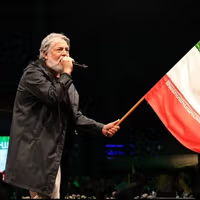
A concert by famed Iranian artist Sirvan Khosravi held on the grounds of what were once the Shah’s palace in Tehran has become an emblem of the 2022 Woman, Life, Freedom movement's legacy.
Videos circulating on social media show women in the audience not only discarding the compulsory hijab but dancing in unapologetically Western-style attire without a trace of enforced covering.
Iranian communities abroad staged demonstrations across Europe, North America, Australia, and New Zealand on Sunday to mark the third anniversary of Mahsa Amini’s death and to honor those killed in protests since 2022.
On the eve of the anniversary of Mahsa Amini’s death in police custody, families and victims of Iranians killed, tortured or injured by authorities have issued an open letter to world leaders calling for urgent international action to confront Tehran.
The signatories warn that current policies only embolden Tehran, which they describe as a menace to foreign powers and its people alike which survives solely through violence.
Iran’s Foreign Minister Abbas Araghchi addressing the Iran-Economic Cooperation Organization (ECO) conference in Tehran on September 16, 2025
Iran’s Foreign Minister Abbas Araghchi said on Tuesday that possible negotiations with the United States will hinge on Washington’s readiness for a deal based on mutual interests without threats or intimidation, not on which regional state mediates.
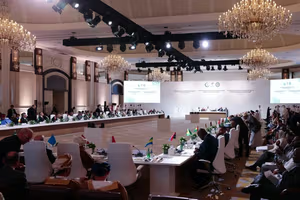
“Several countries in the region are trying to play a positive role, not only Qatar,” Araghchi told reporters at the opening of the second Iran-Economic Cooperation Organization (ECO) conference.
“But for starting negotiations, the question is not the mediator. The important point is the will of the other side. Whenever they accept that a deal must be based on mutual interests, without threat and intimidation, the rest are details.”
Araghchi used his speech to warn against what he called unchecked unilateralism and said the world needed to strengthen multilateral alliances.
“Today, more than ever, the world is faced with reckless unilateralism. This worrying trend has made the international order more fragile and posed serious challenges to security,” he said.“Cooperation among developing countries in multilateral formats is no longer a choice but a necessity.”
A scene from Iran-Economic Cooperation Organization (ECO) conference in Tehran on September 16, 2025
He said Iran had been a “victim of America’s unjust unilateralism and Israel’s dangerous adventurism” but would continue to act as an active regional player through bodies such as ECO.
Tehran and other member states are drafting a 10-year vision for the group until 2035 to expand its role in regional development, he said.
Turning to regional politics, Araghchi said this week’s emergency Arab-Islamic summit in Doha had highlighted a consensus on Israel as the main security threat.
“What the Islamic Republic of Iran has been saying for years -- that the Zionist regime is the main threat to the region and its aggression has no end -- has now become an undeniable truth for everyone,” he said.
He added that Iran welcomed the regional convergence and called for “collective movement and unity among all countries in the region” to respond.
On Monday, Iran’s foreign ministry rejected references to a two-state solution for the Israeli-Palestinian conflict in the final communique of the Arab-Islamic emergency summit in Doha, saying the approach would not resolve the issue and accusing US policies of sustaining Israeli aggression.
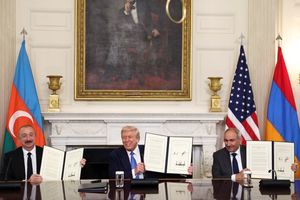
On the South Caucasus, Araghchi said disputes such as the Zangezur corridor remained complex and should be settled by regional states.
“The United States has not contributed to lasting peace in the region,” he said. “Our recommendation is regional mechanisms, and the Islamic Republic has proposed the 3+3 format.”
Araghchi and President Masoud Pezeshkian are due to attend this month’s United Nations General Assembly, which the minister described as an important platform for “conveying the voice of the Iranian people to the international community.”