Israel's ambassador to the United Nations Danny Danon said on Thursday that the European move to reimpose UN sanctions on Iran would help ensure international peace.
"I welcome the decision of Germany, France and the UK to reimpose sanctions against Iran," Danon said in a video message.
"Israel has already shown its commitment to fight the radical regime in Tehran. It is about time the international community will continue to apply more pressure, to apply more sanctions against this regime - that is the only way to ensure the safety and stability of the world."
Iran on Thursday blasted a move by Germany, Britain and France to trigger UN sanctions as malicious and illegal, upping the rhetorical ante in a diplomatic dispute which may fester during a 30-day period before they potentially take effect.
"The Ministry of Foreign Affairs of the Islamic Republic of Iran categorically rejects and condemns in the strongest possible terms the illegal declaration," it said in a statement.
"The abuse of the aforementioned mechanism in a situation where Iran's nuclear facilities have been severely damaged by an illegal attack by a former member of the JCPOA is a clear sign of malicious intent," it added, referring to the trigger mechanism and a 2015 nuclear deal to which Iran and the European powers are party.
Iran says its nuclear program is peaceful - an asserting Western countries doubt. Tehran argues that since a 2018 withdrawal by the United States, the nuclear agreement is defunct and can no longer be invoked by Europe as a means to restore international sanctions.
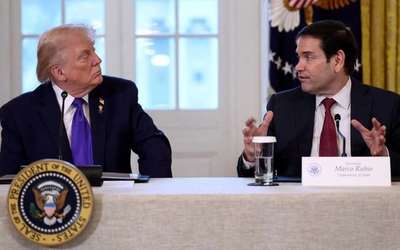
US Secretary of State and National Security Advisor Marco Rubio on Thursday said Washington backed a move by France, Germany and Britain to reimpose UN sanctions on Iran over its nuclear program.
Citing "Iran’s continuing defiance of its nuclear commitments," Rubio said, "the United States supports the E3’s decision and urges Iran to engage in serious diplomatic negotiations to resolve the nuclear issue."
The United States withdrew from the 2015 international deal over Iran's disputed nuclear program during President Donald Trump's first term in 2018, meaning only other parties to the agreement are able to pursue sanctions on Iran for its perceived non-compliance.
Talks between Tehran and Washington ended abruptly in June when Israel launched a surprise military campaign on Iran, in a 12-day war capped off by US attacks on three Iranian nuclear sites.
France, Germany and the United Kingdom said on Thursday they tirelessly sought to engage with Iran about their concerns over Tehran's nuclear activities but were met with evasion and violations of a 2015 nuclear deal, according to a letter they sent to the UN Security Council on Thursday.

"The E3 have consistently and in good faith sought to resolve with Iran issues with respect to Iran's non-compliance," the letter published by Germany's foreign ministry said.
"The E3 believe Iran to be in significant non-performance of its commitments," it added. "Since 2019 and as of today, Iran has increasingly and deliberately ceased performing its JCPoA commitments."
"Iran's actions stand in stark contrast to an exclusively peaceful use of its nuclear energy," the countries wrote.
Three European powers which initiated a mechanism to reimpose UN sanctions on Iran on Thursday hope to conclude the 30-day process before Russia assumes in the presidency of the UN Security Council in October, Axios reported citing European diplomats.
Russia and Iran inked a strategic partnership agreement in January and Iranian-designed drones have been key to Moscow's war effort in Ukraine. Still, Russia provided little support to Iran in a 12-day war with Israel joined by the United States in June.
"The E3 leaders think that Iran has been for years in clear violation of its obligations under the 2015 nuclear deal, with no concrete steps taken to remedy that situation," Axios cited a European diplomat as saying.
"Triggering the snapback process would not mean the end of diplomacy. The E3 remain open to engaging with Iran in the weeks until the UN sanctions will come into effect", the diplomat added.
Britain, France and Germany on Thursday triggered the so-called snapback mechanism, a 30-day process to reimpose UN sanctions on Iran over its disputed nuclear program, Reuters reported citing a document the trio sent to the UN Security Council.
The E3 said in the statement they had made the move before the expiry of their ability to do so in mid-October according to a timeline enshrined in a now mostly defunct 2015 nuclear deal.
Iran has warned of unspecified consequences if Europe made the move and has said the deal is no longer in effect and snapback cannot be invoked