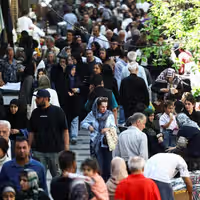
Iran detains 10 Jews in midnight raid – Channel 12
Iranian authorities arrested 10 Jewish citizens during a midnight raid, according to an eyewitness account reported by Israel’s Channel 12 on Saturday.
A woman identified as Miriam described armed men entering homes, threatening residents, and detaining six women and four men because of their Jewish identity.
The women were later released on bail, the report said.
The arrests are linked to unverified allegations of ties to Israel, reflecting a broader pattern of targeting religious minorities.
Some analysts have dismissed the charges as baseless, accusing Iran of politically motivated persecution.
Human rights groups have called for transparency as Iran’s Jewish community—now numbering fewer than 10,000—faces increasing pressure amid rising Iran-Israel tensions.
France's Foreign Minister Jean-Noel Barrot delivers a speech in Paris on June 19, 2025.
Europe plays a central role in negotiations with Iran and holds powerful leverage, including the snapback of UN sanctions, France’s foreign minister said, warning that European powers may trigger the mechanism if Iran fails to reach a deal with world powers.
“Europeans have extremely powerful leverage,” Jean-Noël Barrot said on LCI Television Sunday.
Europe could reinstate the UN sanctions through the so-called snapback mechanism to press Iran for a diplomatic resolution, Barrot added.
“France, together with its European partners, can, with a simple letter, reimpose a global embargo on weapons, nuclear equipment, and banking and insurance sectors in Iran, which were lifted 10 years ago.”
Under UN Security Council Resolution 2231, any current party to the 2015 nuclear deal (JCPOA) including France, Germany, the UK, Russia, and China can file a non-compliance complaint with the Security Council.
If no resolution is adopted within 30 days to maintain sanctions relief, all previous UN sanctions automatically snap back, including cargo inspections, arms embargoes, and restrictions on missile-related technologies.
To prevent snapback, the Council must pass a resolution during the 30-day review period; however, any permanent member can veto it. Therefore, if the US or E3 oppose, sanctions are reinstated by default.
US President Donald Trump said after military operations in Iran that Tehran "doesn’t want to speak to Europe. They want to speak to us. Europe is not going to be able to help in this one.”
In response to Trump’s remarks, Barrot said: “We hold this power, which is why we will play an essential role in these negotiations. Ten days ago, at President Trump’s request, I was in Geneva with my German and British counterparts to begin face-to-face discussions with Iran’s Foreign Minister.”
Barrot further said Iran’s continued cooperation with the International Atomic Energy Agency (IAEA) is vital, calling the agency the most effective tool to implement and verify Non-Proliferation Treaty compliance.
Last week, Iran’s parliament approved a bill to suspend cooperation with the IAEA, just one day after a ceasefire with Israel ended 12 days of conflict. Subsequently, Iran’s Guardian Council ratified the bill, mandating the government to halt cooperation.
There has been significant damage to Iran’s nuclear facilities, yet the country could restart uranium enrichment within months, the head of the International Atomic Energy Agency (IAEA) said.
“The capacities they have are there. They could have, in a matter of months—or even less—a few cascades of centrifuges spinning and producing enriched uranium,” Grossi told CBS News' Face the Nation on Sunday.
“Frankly speaking, one cannot claim that everything has disappeared. There is still something there.”
Asked about the extent of damage from US military actions on nuclear sites, Grossi said it depends on how one defines damage.
“What happened—particularly in Fordow, Natanz, and Isfahan, where Iran used to have, and still retains to some extent, capabilities for uranium treatment, conversion, and enrichment—has been significantly destroyed,” he said.
US special envoy Steve Witkoff said on Wednesday there are “signs” that an agreement can be reached with Iran.
“We’re having conversations with the Iranians. There are multiple interlocutors reaching out to us. I think that they’re ready,” he told CNBC.
In his interview with CBS, Grossi clarified that the IAEA is not involved in those negotiations. “Our role is to monitor and verify. We’re not part of the direct talks,” he explained.
On whether Iran’s nuclear activity before the US and Israeli strikes indicated weaponization, Grossi said: “We haven’t seen a program aiming in that direction. But they are not answering very important, pending questions. That’s the truth.”
Last week, Iran’s parliament passed a bill to suspend cooperation with the IAEA. The Guardian Council approved it shortly afterward.
Grossi said that Iran remains a signatory to the Non-Proliferation Treaty (NPT), which overrides domestic law.
“An international treaty takes precedence. You cannot cite internal legislation to avoid your international obligations. Iran has not done so yet, which I see as constructive,” Grossi added.
The recent reports of Iran's secret activities at the nuclear sites bombed by the US invite further attacks and heighten nuclear risks despite the current ceasefire with Israel, a former UN nuclear watchdog inspector told Iran International.
“This is a ceasefire agreement. This is not arms control. This is a ceasefire agreement, and the war can start at any moment,” said David Albright, the president of the Institute for Science and International Security in Washington, DC.
“There were reports yesterday in the media or on X that Iran was digging back into the Isfahan mountain complex where enriched uranium may be stored. It is inviting attacks.”
French Foreign Minister Jean-Noël Barrot says European powers "have an extremely powerful leverage" in nuclear negotiations with Iran, unlike what Donald Trump says.
"If Iran, which did not respect the commitments made 10 years ago when we reached an agreement with them, refuses to negotiate a strict and lasting framework for its nuclear program, then France, along with its European partners, can simply — with a single letter — reinstate the global embargo on weapons, nuclear equipment, as well as banking and insurance, which had been lifted 10 years ago," the French foreign minister said.
"We have this power, that's why one way or another we will play an essential role in these negotiations," he told La Chaîne Info (LCI).
Tehran’s stock market reopened after a 12-day conflict between Iran and Israel with a sharp collapse, as investor anxiety triggered a sweeping sell-off.
Over 99 percent of listed companies dropped in value, triggering an unprecedented 350 trillion-rial (approximately $416.7 million) sell-off queue.
By the close on Saturday, total sell orders reached 350 trillion rials. The main index fell 62,503 points, or 2.1 percent, to 2,922,101. The equal-weight index lost 15,522 points, ending at 908,163.
The market’s sensitivity to political and security developments deepened investor distrust and anxiety this time. Tehran’s stock market had previously declined amid Tehran’s risky foreign ventures.
In prior crises such as earlier missile strike operations on Israel and after the death of former president Ebrahim Raisi, the Securities and Exchange Organization curtailed daily trading limits to contain losses. Normally, Iran’s daily price fluctuation limit is five percent.
“It was expected the market would start negatively after nine days of closure. Officials tried to control the fallout from Israel’s attack but failed,” economic journalist Arash Hassannia told Iran International.
The market reopened amid crisis signals. Within 90 minutes, over 99 percent of stocks traded in the red. The main index dropped about one percent to 2,957,000 points. The equal-weight index slid nearly 3,800 points, nearing 920,000.
Trade volume in the first 90 minutes exceeded 20 trillion rials ($23.8 million), with nearly 12 trillion rials ($14.3 million) withdrawn by individual investors. Banks and investment firms led trading values with 6.6 trillion rials ($7.85 million) and 2.8 trillion rials ($3.33 million), respectively.
Economy news outlets described the market situation as “a full-scale crisis.” One warned that the military conflict’s end failed to calm the market; instead, uncertainty deepened, with investors fearing new fighting. Analysts see this drop as potentially signaling a longer-term crisis.
Massive sell queues, scarce buyers, broad liquidity outflows, and widespread losses are signs of what analysts call “the start of a psychological and structural crisis.”