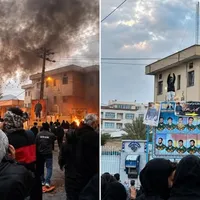
People attend the funeral of Iranian commanders and scientists killed in Israeli strikes, in Tehran, June 28, 2025.


Enemies of the Islamic Republic imposed a ceasefire out of fear, not through any agreement with Iran, retired Supreme Court adviser Ali Asghar Mojtahedzadeh said in remarks published Saturday.
Speaking to Rasa News, Mojtahedzadeh said Iran made no deal and did not seek peace, while the United States and Israel called for a halt to fighting after suffering heavy losses. He said Tehran’s official statements avoided any mention of a truce.
“The enemy attacked, was struck in return, and finally had to unilaterally announce a ceasefire,” he said.
“Iran is awake and armed,” said Mojtahedzadeh, the former head of the Special Clerical Court in Qom.
Iranian authorities have summoned and interrogated at least 35 Jewish citizens in Tehran and Shiraz over their contact with relatives in Israel, the US-based human rights group HRANA said on Friday.
The wave of interrogations began on Monday and marks one of the largest known crackdowns on Iran’s Jewish community since the early years of the Islamic Republic, HRANA said. Security agents told those summoned to avoid phone or online communication with family members abroad, according to a source close to the families.
The action comes amid rising tensions between Iran and Israel and appears to contradict the government’s claims that Iranian Jews enjoy equal rights. HRANA said the pressure has triggered serious fear within the community.
Iran criminalized travel to Israel in 2011, with penalties including prison and passport bans. Many Iranian Jews have relatives there due to decades of emigration.
The Tehran Jewish Committee declined to comment. But a senior figure in the community told HRANA the scope of the summonses is unprecedented and has caused deep concern about social and psychological safety.
Authorities have not explained the purpose of the interrogations. Some families were told the actions were preventive, not punitive, and tied to recent conflict. However, human rights lawyers argue that the measures could constitute religious and ethnic discrimination under international law, according to HRANA.
"Iran had a very vast, ambitious program, and part of it may still be there. And if not, there is also the self-evident truth that the knowledge is there," International Atomic Energy Agency chief Raphael Grossi told CBS in an interview.
"The industrial capacity is there. Iran is a very sophisticated country in terms of nuclear technology, as is obvious. So you cannot disinvent this, military operations or not. You are not going to solve this in a definitive way militarily."
Grossi said Iran had not yet asked IAEA inspectors to leave the country, in what he called a positive sign.
"The work will have to continue. Otherwise, nobody will have an idea of what is happening in Iran."
The Israeli military says it has identified the launch of a missile from Yemen toward Israeli territory."Aerial defense systems are operating to intercept the threat," the IDF said.