The US did not use bunker-buster bombs on Iran’s underground nuclear facility in Isfahan during last week’s military strikes because the site’s depth made the weapons ineffective, Chairman of the Joint Chiefs of Staff Gen. Dan Caine told US lawmakers in a classified briefing, CNN reported Friday.
According to multiple sources familiar with the briefing, Caine said the Isfahan site, believed to house a significant portion of Iran’s enriched uranium, was targeted instead with Tomahawk missiles launched from a submarine. The facility’s deeply buried tunnels were not fully destroyed.
By contrast, US B-2 bombers dropped bunker-buster bombs on other nuclear facilities, including Fordow and Natanz.
Iranian Foreign Minister Abbas Araghchi said Saturday that the country had paid a high cost in lives during its recent conflict with Israel and the United States, but had not yielded ground or dignity.
Speaking on the day of a state funeral in Tehran for those killed in the 12-day war, Araghchi said Iran’s losses would be remembered as a symbol of national resistance.
“Iranians gave blood, not ground; lost their children, but not their honor,” he said in a post on his official Instagram account. “They stood under thousands of tons of bombs, and did not surrender.”
Araghchi said physical infrastructure could be rebuilt over time, but “the pride of a nation is more valuable than anything.” He described the war as a moment that would “shine like a jewel” in Iran’s long history, and said the country had emerged “stronger and more dignified.”


A senior commander in the Revolutionary Guards warned on Saturday that any harm to Shia religious authorities would provoke a severe response against US personnel in the region.
Mohammad Reza Naqdi, the IRGC’s coordinating deputy commander, was quoted by state-affiliated Mehr News Agency as saying that “any American military, diplomatic, or administrative personnel in the region could be targeted if an attack on a cleric were attempted".
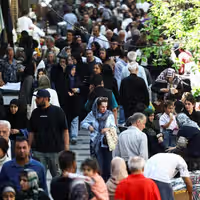
Iran held a funeral ceremony in Tehran on Saturday for dozens of people killed during the 12-day conflict with Israel, including senior military commanders and nuclear scientists.
Senior Iranian officials attended the event and delivered remarks touching on a range of themes, including national unity, military resilience, and nuclear oversight.
Read more here.


The spokesperson for the Revolutionary Guards (IRGC) warned US President Donald Trump on Saturday to stop what he called “reckless rhetoric,” saying any future attack on Iran would be met with a more destructive response.
“Our advice to Trump is to open his eyes and stop the baseless talk and erratic behavior,” Ali Mohamad Naeini said during a funeral ceremony for those killed in the Israeli strikes, according to state media.
Naeini said Trump’s recent remarks reflected confusion after what he described as an Israeli defeat in the 12-day conflict with Iran. “He still does not understand the real sources of Iran’s power,” he said.
Quoting Supreme Leader Ali Khamenei, Naeini added that Trump “speaks bigger than his mouth allows,” accusing him of trying to distort Iran’s claimed victory in the conflict.
The IRGC official said the missile and drone attacks launched by Iran had forced Israel to seek a ceasefire and demonstrated the vulnerability of Israeli cities. “If our interests are targeted again, the response will be more powerful and more devastating,” he said.

Iran held a funeral ceremony in Tehran on Saturday for dozens of people killed during the 12-day conflict with Israel, including senior military commanders and nuclear scientists.
Senior Iranian officials attended the event and delivered remarks touching on a range of themes, including national unity, military resilience, and nuclear oversight.
State media said the ceremony was held for 60 individuals. Among them were at least 16 nuclear scientists and 10 senior military commanders.
Among those commemorated were Mohammad Bagheri, commander of the Iranian armed forces; Hossein Salami, head of the Revolutionary Guards; and Amir Ali Hajizadeh, who led the Guards’ Aerospace Force. All three were killed on June 13, the first day of the conflict.
Ali Shamkhani, a senior advisor to Supreme Leader Ali Khamenei, attended the ceremony, appearing in public for the first time since being wounded in an Israeli strike earlier this month. He had been targeted on the first night of Israeli attacks, and initial reports said he had been killed. State-linked outlets later said he was wounded but survived.
Supreme Leader Ali Khamenei was absent, though in a televised message earlier this week, he said that Israel had been “brought to its knees” and that the United States had “gained nothing” from the war.
Officials denounce IAEA and bar inspectors
Several officials used the occasion to deliver criticism of the International Atomic Energy Agency (IAEA). Judiciary Chief Gholamhossein Mohseni-Ejei said cooperation with the agency “cannot continue as before,” and accused it of passing information to "hostile states".
Lawmaker Hamid Rasaei said parliamentary legislation bars IAEA Director General Rafael Grossi and his team from entering Iran, and that nuclear surveillance equipment had been deactivated. Deputy Parliament Speaker Ali Nikzad called Grossi a liar and said he would face consequences for his role.
Remarks emphasize strength, resistance and imposed ceasefire
Other speakers focused on the war’s outcome. Several described the ceasefire as something forced on Israel and the US, not the result of any concession by Iran.
Parliamentarian Ebrahim Azizi said Iran had never surrendered and instead “forced its enemies to submit to the will of the Iranian people.” Former IRGC intelligence chief Hossein Taeb said Iran was prepared to deliver a stronger blow in the event of renewed hostilities.