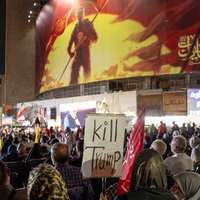
Headquarters of Internal Security Bureau of Law Enforcement Forces
Throughout Israel's 12-day war on Iran, it launched strikes on key state organs tasked with domestic surveillance, protest suppression, detention and propaganda, targeting what it called “repression infrastructure.”
The attacks focused on intelligence and security agencies, judicial and detention systems, and officials overseeing internal control.
Israel framed the strikes as a show of solidarity with Iranian protesters and an effort to disrupt the Islamic Republic’s repressive capacity.
"The Israeli Defense Force is now attacking with unprecedented force regime targets and government repression bodies in the heart of Tehran," the Israeli military said on Monday.
The targeted institutions included the following:
Islamic Revolutionary Guard Corps Intelligence Organization (SAS)
Established in 2009, SAS operates alongside the Ministry of Intelligence (MOIS) and reports directly to Supreme Leader Ali Khamenei.
Known for ideological rigidity, it suppresses dissent, especially through social media monitoring. It controls Evin Prison’s Ward 2A and other black sites nationwide.
Israel struck the SAS headquarters in Tehran on June 15, reportedly killing:
Brigadier General Mohammad Kazemi (SAS chief)
Hassan Movahed (or Mohaqeq) (deputy)
General Mohsen Bagheri (senior officer)
A separate strike on June 13 heavily damaged the Internal Security Bureau building in Tehran. Casualties remain undisclosed.
Sarallah Headquarters
This key IRGC base oversees security across Tehran and coordinates Basij deployments during unrest.
Israel struck Sarallah HQ on June 23, a day before a ceasefire.
Social media reports indicate the facility was destroyed. Multiple officers and personnel are believed killed, but names have been withheld.
Tehran Basij Headquarters
On June 13, a central Tehran Basij building sustained heavy damage from an Israeli strike.
Israel also hit Basij bases in the cities of Zarandiyeh, Behbahan and Karaj.
Casualties remain undisclosed.
Ministry of Intelligence (MOIS)
Known as VAJA, the ministry leads Iran’s domestic and foreign intelligence operations, including political repression. It controls Evin’s Wards 209 and 240.
Israel targeted the MOIS building in Tehran on June 15.
Casualties are likely but remain unnamed.
Internal Security Bureau of Law Enforcement Forces
This unit of Iran’s national police force (FARAJA) handles surveillance, riot control, and arrests.
Its Tehran HQ was struck on June 22 and 23.
Brigadier General Alireza Lotfi, acting head of the bureau, was killed in the June 22 attack.
The Islamic Republic of Iran Broadcasting (IRIB)
Israel labeled IRIB as a key “propaganda tool” of the Islamic Republic.
Its headquarters in Tehran was bombed on June 16, about an hour after civilian evacuation alerts.
Confirmed dead:
Nima Rajabpour (staff)
Masoumeh Azimi (staff)
One civilian bystander
Evin Prison in Tehran
Evin holds political detainees, dual nationals, those deemed as threats to national security, as well as others serving time for financial crimes.
The prison was struck on June 23, causing extensive damage to the main gate, administration offices, library, infirmary and Wards 4, 6 and the Women’s Ward.
Confirmed dead in the strike so far were:
Ruhollah Tavasoli and Vahid Heydarpour (prison officials)
Ali Ghanatkar (judicial official)
Several conscript soldiers
Two physicians, a social worker, her 5-year-old child, a visiting family member, and a bystander.
All inmates were later transferred to other facilities.
As a shaky Iran-Israel ceasefire holds, Israel’s Hostage Families Forum is demanding any deal with Iran must free dozens of hostages held by Iran-backed Hamas militants in Gaza since their October 7, 2023 attack.
“The ceasefire agreement (with Iran) must expand to include Gaza,” the group said in a statement on Tuesday.
“We call on the government to engage in urgent negotiations that will bring home all the hostages and ends the war. Those who can achieve a ceasefire with Iran can also end the war in Gaza.”
Of the 251 people abducted on October 7, around 50 remain in Gaza. Only 20 are believed to be alive.
“To conclude this decisive operation against Iran without leveraging it to bring home the hostages would be a grave failure,” the statement continued. “With our enemies at their weakest, this is a critical window—the deal to end all deals.”
The US continues to mediate between the two sides. In an interview on Fox News, Middle East envoy, Steve Witkoff said late on Tuesday that talks were promising and that Washington was hopeful for a long-term peace deal.
"We are already talking to each other, not just directly but also through interlocutors," Witkoff said.
Iranian losses
After a surprise attack on June 13, Israel assassinated some of Iran's top military leadership and nuclear scientists and pounded Iranian military infrastructure.
During the 12-day conflict, 29 Israelis and 610 Iranians were killed, according to official figures. Thousands more have been injured and displaced on both sides.
The ceasefire has drawn mixed reactions in Israel as US intelligence says Iran's nuclear program has only been set back by a matter of weeks or months and its enriched uranium supply remains intact.
President Donald Trump downplayed the claims, saying the US strikes have "obliterated" the three sites struck, Fordow, Natanz and Isfahan.
“Trump just wants this over quickly so he can claim he made peace,” said Zvi Tuito, a Jaffa resident whose home was damaged in strikes last week. “He needs to calm opposition in his party and boost his ratings, but I don’t think it’s over.”
Polls in Israel showed consistent support for the war among Jewish Israelis, though much less so among the 20% Arab minority.
'We can't go on like this'
Iran has long backed militant groups under its so-called ‘axis of resistance,’ pledging solidarity with the Palestinian cause. Since October 7, Israel has come under attack from Iranian allies in Gaza, Lebanon, Syria, Yemen, and Iraq.
“We can’t go on like this,” said Ilanit Neiman of Ramat Gan, a suburb of Tel Aviv which has been hit by rockets. “To stop this forever war, we need to cut off the source of weapons and funding—Iran.”
She was skeptical about the ceasefire’s durability. “We need to know this deal brings real security. Otherwise, we’ll be back here in months.”
As Israel's military campaign in Gaza continues - and 7 soldiers died since the Iran ceasefire took effect - some Israelis see the ceasefire with Iran as a gateway to broader peace.
“This has to be a comprehensive deal,” said a mother whose son is still fighting. “His wife and kids want him home. We’re in the best position in years—let’s not waste it.”
But even diplomats are unsure what comes next.
“Nothing is clear. Everything feels very fragile,” said one Israeli ambassador, speaking to Iran International minutes before an Iranian missile strike followed the ceasefire announcement.
Another said: “These are crazy days. We really can’t predict a thing.”
A nuclear Iran is still possible despite US and Israeli strikes on key nuclear sites, a former top UN nuclear official told Eye for Iran, noting that the whereabouts of Tehran's near-weapons grade uranium was unknown.
Around 400 kilograms—more than 900 pounds—of uranium enriched to 60% purity is unaccounted for.
Until the International Atomic Energy Agency (IAEA) confirms its location, the risk remains high, former Deputy Director General of the IAEA Olli Heinonen warned.
“One should not relax because this material as such is enough for 10 nuclear weapons if it is enriched further to 90%,” Heinonen toldEye for Iran.“So in a big picture, yes, Mr. Trump was correct, but it should have had this caveat telling that it's not yet over.”
Trump gave the green light to launch 75 precision-guided munitions—including bunker-buster bombs—and more than two dozen Tomahawk missiles against Fordow and two other Iranian nuclear sites in the early hours last Sunday, Tehran time.
Satellite imagery appeared to show that the strikes had severely damaged or destroyed the Fordow plant and possibly the uranium-enriching centrifuges it housed.
Trucks had reportedly been seen lining up at the Fordow facility in the days before the attack, prompting speculation Tehran may have relocated its uranium stockpiles in advance.
US and Israeli intelligence officials were aware of the movement at the time but opted not to act in order to track the trucks and await Trump’s final order to strike.
A combative Defense Secretary Pete Hegseth forcefully defended the US strikes on Iran’s nuclear program, calling them a “resounding success” and accusing the media of rooting for failure.
“Because you cheer against Trump so hard — in your DNA and in your blood, cheer against Trump — because you want him not to be successful so bad, you have to cheer against the efficacy of these strikes,” Hegseth told reporters at a Pentagon briefing. “You have to hope maybe they weren’t effective.”
A satellite view of the Fordow underground complex before and after the US struck the nuclear facility near Qom on June 22.
What can you do with enriched uranium and obliterated nuclear sites?
Heinonen explained that even with Iran’s main enrichment facilities damaged, the risk remains. A small, easily concealed facility, could turn the missing uranium into weapons-grade material within days.
“Then someone may ask, but they were just wiped away these enrichment plants, so why one has to worry, because such kind of installation, which can convert this material in a matter of days for the first weapon, needs about 1,000 centrifuges only."
"It's just a normal workshop,” he added, “not a big building. And it would be very difficult to find, because it can be concealed among others. Technical buildings in any industrial site or warehouse complex.”
Heinonen joined the IAEA in 1983 and served as Deputy Director-General and Head of the Department of Safeguards from 2005 to 2010. He was among the top officials overseeing Iran’s nuclear file during the pivotal period from 2002 to 2010.
“There is this history of concealment and I think that one has to be careful in accepting explanations,” Heinonen warned. “Iran started to work with uranium metal in early 1990s in secrecy ...to the IAEA… Never disclosed it… until we found it at a later date.”
Heinonen said even after the Fordow, Natanz, and Isfahan strikes, “the question is what about the rest of the weapon?” Iran would still need to machine uranium metal into a weapon-ready shape, using small, controlled batches of critical material.
“It will take all this one about one month. That’s it,” he said. “From start to have the weapon components on your hand.”
But the presence and availability of trained engineers and technicians is also a factor. “They are technicians, they are engineers, they are people who get their hands dirty with this material. Are they still available?” he asked.
“If they are available, then this scenario… in principle [is] possible.”
A race to verify
Heinonen said the IAEA must now be given full access and cooperation by Iran to verify the location and condition of the uranium. If Iran is unwilling, there’s no magic tool to find it.
“Only intelligence. There is no magic detector which you fly around and say, okay, it's there,” he said. “If Iran wants to prove that they have the material, why to hide it? If they have no intention to use it, why to [not] find it?”
The missing material is a red flag that should expand the scope of inspections and investigations.
Iran recently informed the IAEA about a new underground enrichment facility, described as “heavily secured,” but Heinonen said its nature remains unclear.
“Let's find facts first. What was the new site? Can anyone tell? Was it enrichment? Was it the storage? Was the storage of centrifuges? Was it assembling of centrifuges?” he asked.
Iran’s Foreign Minister, Araghchi, posted on X Friday: “The Parliament of Iran has voted for a halt to collaboration with the IAEA until the safety and security of our nuclear activities can be guaranteed.”
Araghchi’s statement signals a hardening stance in Tehran just as international inspectors are racing to verify the fate of Iran’s enriched uranium.
For Heinonen, the message is clear: transparency is now the only path to de-escalation.
“This is the truth-telling test,” he warned. “Because there's no reason to resist. If this is a civilian program, why restrict the IAEA's work?”
Until Iran proves otherwise, the world must treat the threat as far from over.
You can watch the full episode of Eye for Iran on YouTube or listen on any major podcast platform like Spotify, Apple, Amazon Music and Castbox.
In the aftermath of a 12-day war with Israel, Iranian leaders and media are celebrating an unusual show of nationwide solidarity, but some warn that this calm—marked not by rallies but by silence—may soon give way to a deeper reckoning.
On Thursday, President Massoud Pezeshkian thanked all Iranians for their restraint during the conflict, including political prisoners.
The relative moderate was, in effect, praising the absence of street protests even as the state failed to protect civilians or address their fears.
Sociologist Saeed Moidfar, chairman of the Iranian Sociological Association, countered with a stark warning: “Unless the government takes serious steps to bridge the widening gap between the system and the people, the war’s end may not bring peace—but rather a fresh social crisis.”
A nation on display
Since the ceasefire, the vocabulary of Islamic ideology has yielded to an appeal to national identity. Headlines now lead with “Iran,” pushing aside references to Islam.
Even in Supreme Leader Ali Khamenei’s latest speech, the phrase “Islamic Iran” appeared only once, with no further mention of Islam.
State-affiliated outlets echoed the shift.
Reformist dailies Etemad and Arman Melli ran front-page features lauding “national coherence” and praising public figures who promoted solidarity.
In a symbolic flourish, the Tehran Symphony Orchestra performed the patriotic anthem “O Iran” beneath the Azadi Monument.
Dozens of artists and cultural figures gave scripted interviews celebrating the country’s cultural legacy. Etemad devoted an entire front page to their portraits.
A government in debt
Calls for unity came with a growing sense that the state now owes the public something in return.
Reformist sociologist Hamid Reza Jalaipour urged the state “to reward the people after the cease-fire as a gesture to strengthen national unity.”
Even some conservatives echoed the theme.
“It is now the government’s turn to respond to the people’s resistance during the war,” former newspaper editor and pundit said—a tacit admission that officials failed to shield citizens from missile strikes.
The elephant in the room
Members of parliament have also been busy readjusting to the post-war reality—calling for changes to show they stand with the people, even as they unanimously voted to sever Iran’s cooperation with the UN nuclear watchdog to affirm their ‘revolutionary’ credentials.
“The government must overhaul both its economic and foreign policies,” national security committee member Ahmad Bakhshayesh Ardestani said, calling for urgent measures to rectify failure and improve people’s livelihoods.
Committee colleague Behnam Saeedi also urged policies that would ease economic pain and “reconcile with critics alienated from the system.”
In nearly every appeal for reform, the word “government” functions as a cautious euphemism. Almost no one dares name the real decision-maker.
Supreme Leader Ali Khamenei bears ultimate responsibility for leading Iran into this war. His directives, even implicit gestures, determine the country’s foreign, military and economic policy.
Only he can authorize a course correction—something few expect him to do.
For now, Iran’s leadership is leaning on a language of inclusion and patriotism. Whether or not it lasts, and whether it can translate into meaningful change, remains uncertain.
Israel’s twelve days of air attacks on Iran killed hundreds of civilians—among them an eight-year-old gymnast in a red dress whose last joyful dance has become a symbol of the war’s human cost.
A video posted on Instagram by a relative appears to show Tara Hajmiri dancing in a dentist’s office. Her black ponytail sways behind her as she beams with joy and glides toward the treatment chair. Hours later, her short life was over.
Tara died alongside her parents when Israeli missiles struck three six-story residential buildings on Patrice Lumumba Street in central Tehran in the early hours of June 13.
Her father, an estate agent, and her mother were found in the rubble. Israel's military later said the buildings were targeted to eliminate an unnamed nuclear scientist.
Tara's name spread quickly across Iranian social media, where she came to represent innocence lost in war.
Asian Gymnastics Union's tribute to Tara Hajmiri
The war's youngest victim appeared to be Rayan Ghasemi, a two-month-old infant, who succumbed to burn injuries after an Israeli strike on June 19.
His parents, Behnam Ghasemian, an engineer, and Dr. Zohreh Rasouli, a gynecologist, were also killed. His older brother, Kian, remains hospitalized with serious injuries.
A poet’s last verse
Another victim whose story and face became an instant icon was 23-year-old Parnia Abbasi—a poet and English teacher who loved Coldplay, Italian food and mountain climbing.
She was one of the very few to grab attentions outside Iran, her smile and her verses touching hearts.
Young poet Parnia Abbasi and her family
Her family said she often wrote about love and longing. One poem, Returning to You, was widely shared after her death:
You crash upon my shore
the rhythmic pearl of your body bursts across the sand
I row toward your embrace
cast your smile like a hook
The fish are caught and I fall in love
all over again.
Parnia was killed with her entire family—father Parviz, a retired teacher, mother Masoumeh, a retired bank clerk and 14-year-old brother Parham—when their building was leveled.
Israeli authorities later said the intended target was Abdolhamid Minouchehr, head of nuclear engineering at Shahid Beheshti University.
Sarvnaz Vaezzadeh, young business development expert killed in Tehran
Hundreds More
Another victim, graphic artist Saleh Bayrami, was killed while waiting in his car at a traffic light on June 15, en route to a job interview. The strike near Tehran’s Tajrish Square killed several others.
Iran’s Health Minister Mohammad Reza Zafarghandi said on June 23 that 606 people had been killed, without specifying how many were civilians.
Independent tallies put the toll higher—1,190 according to the US-based human rights group HRANA, which reported military deaths just above 400, with the rest either civilian or yet to be determined.
The Israeli government has defended its actions as pre-emptive strikes on Iran’s nuclear infrastructure. But the deaths of Tara, Rayan, Parnia, and Saleh have sparked grief—and questions.
Their names stand for the civilians caught in the crossfire of a conflict paused for now, but which could return with a vengeance at any moment.
Their faces—once full of promise—have become symbols of loss, of questions unanswered, of the cost of ideology and war.
Iranians speaking via Iran International's submission line doubted Supreme Leader Ali Khamenei’s declaration of victory over the United States and Israel in a televised speech on Thursday.
“If the killing of the Revolutionary Guards' top commanders in the first 10 minutes of war counts as a victory, then let Khamenei live in his delusions," said one person, whose identity was withheld for their safety.
"The people have seen and felt the Islamic Republic’s defeat and humiliation"
Comments were submitted by viewers of the Persian-language broadcaster.
“The fact that Netanyahu walks among his people without bodyguards, and this shameless coward is sending videos from a rat hole says everything,” said another. “Even a 13-year-old can analyze what really happened.”
Khamenei appeared in a pre-recorded video aired Thursday, speaking from what observers believe is a fortified underground facility in an undisclosed location. The video setting matched hisprevious wartime address.
The veteran leader declared Israel had been “brought to its knees” and the United States had “gained nothing.”
Many Iranians expressed anger at his absence as average people fretted and fled.
“You disappeared for twelve days. Now you crawl out and call this 'victory'? Not a word for the people who were terrified," another person wrote."Not even an image, not a sentence for those who were dying."
“During those twelve days, mothers hugged their children so the last missile wouldn’t take them,” one woman added. “Now you return like some fake hero and say ‘we won’? Won what—destroyed cities? Dead children in Tehran? Protesters arrested for nothing?”
The US-based human rights website HRANA reported on Wednesday that 823 Iranian citizens had faced political or security-related charges since the outbreak of the war.
According to the report, 286 people were detained for their online activities, including sharing content about Israel’s attack on Iran.
Say 'I beat them'
Another viewer sarcastically referenced a line from one of the most iconic soliloquies in a so-called Film-Farsi movie from before the Islamic Revolution to describe Khamenei's claim of victory.
In the scene, a character recounts a fight in which he was badly beaten and collapsed before he could even draw his knife—but still boasts about winning.
He said, half-pleading, half-boasting: “Now, I told everyone I beat them. You say I did too; it doesn’t look good.”
Some also directly criticized Khamenei’s personal safety measures: “If he’s telling the truth, let him come out and speak. He’s still hiding in the sewers. These cowards only speak from a distance.”
Some replies even mocked the Supreme Leader’s physical appearance. “He looked pale and shaken,” one person wrote.
“He says 90 million Iranians are standing behind the armed forces. I’d like him to come out of his bunker and see for himself how many people actually support this regime.”
Massive costs
One of the most repeated themes in the reactions dwelt on the costly destruction the war wrought. Many commenters pointed to the toll on ordinary Iranians, saying the only outcome had been ruin.
“Nothing has come out of this except the destruction of Iran, massive costs and making life even worse for the people — and nothing else ever will,” read one message.
“All this destruction, all these deathsxand now they talk peace?” another said. “Khamenei wasn’t crushed? Just look at his voice—shaky, scared. He’s hiding underground, while we’re left in the rubble.”
Accountability
Another recurring theme was frustration over the perceived lack of accountability.
“The country is in ruins," one person said. "Did you even offer condolences for your own commanders who died overnight? You only care about those close to you. The rest of us don’t matter.”
The responses also reflected exhaustion with decades of problems.
One viewer said: “It’s been forty years of war, sanctions, and lies. Enough. We can’t breathe anymore.”
Another emotional message said: “We’ve been living in this Islamic Republic for half a century. We’ve learned to reverse whatever they say. If they say Israel was crushed, it means we were.”
A cleric and his wife carry Iranian and Hezbollah flags as they attend a gathering to support Iran's Armed Forces after US President Donald Trump announced a ceasefire between Israel and Iran, in Tehran, Iran, June 24, 2025.
Call for referendum
Some viewers called for a referendum to determine whether Iranians truly support continued conflict with Israel or financial support for proxy groups abroad.
“They’ve gotten so used to privilege and plundering public wealth that they refuse to let go, no matter what," one message read. "Enough is enough — for God’s sake, hold a referendum and see how many people actually support this regime.”
“Conduct a free and independent poll and find out how many Iranians really want to fight Israel or support Hezbollah and others. We don’t want war, we don’t want disaster — what are we supposed to do now? Just sit and wait for them to build a nuclear bomb and officially turn us into another North Korea?”
Others condemned what they described as the Islamic Republic's weaponization of Shia identity and historical symbols, accusing it of betraying the values of Imam Hussein by taking the Iranian people hostage.
“Imam Hussein didn’t use the people of Mecca and Medina as human shields to fight Yazid,” one viewer said. “Why are we being held hostage for your battles? You’re not fighting tyranny—you are the tyranny.”