UN chief welcomes upcoming European-Iran meeting as ‘positive step’
UN Secretary-General Antonio Guterres welcomed a scheduled meeting tomorrow between European diplomats and Iran as a positive step amid ongoing tensions, a spokesman said on Thursday.
The foreign ministers of Britain, France, and Germany will meet in Geneva with Iran’s Foreign Minister Abbas Araghchi.
UN spokesman Stephane Dujarric emphasized that “diplomacy is the only and best way forward” to end the Israel-Iran conflict, urging all parties to “stop the military action and avoid at any cost the further internationalization of this conflict.”
The White House said on Thursday that President Donald Trump will make a decision within two weeks on whether to launch a military strike on Iran.
Citing a message from Trump, White House Press Secretary Karoline Leavitt told reporters: "Based on the fact that there's a substantial chance of negotiations that may or may not take place with Iran in the near future, I will make my decision whether or not to go within the next two weeks."
“It is a fact and the United States government maintains this fact that Iran has never been closer to obtaining a nuclear weapon,” Leavitt said when asked whether Trump is relying on US intelligence or intelligence sharing from an ally when he says Iran is very close to a nuclear weapon.
About the possibility of a deal with Iran, she said, "Iran is in a very weak and vulnerable position because of the strikes and the attacks from Israel... And he has been very direct and clear. Iran can and should make a deal. We sent a deal to them that was practical, that was realistic, or they will face grave consequences."
Replying a question about how close Iran is to potentially build a nuclear bomb, the spokeswoman said, "Iran has all that it needs to achieve a nuclear weapon. All they need is a decision from the Supreme Leader to do that. And it would take a couple of weeks to complete the production of that weapon, which would, of course, pose an existential threat, not just to Israel, but to the United States and to the entire world."
Smoke rises following an Israeli attack in Tehran, Iran, June 18, 2025.
Air raids continued over Tehran late Thursday, with Iranian media reporting activation of air defense systems in the capital's northern districts.
A video received by Iran International captured the sound of air defense activity in the southern neighborhood of Naziabad.
A resident told Iran International: "They just hit western Tehran—maybe the airport or Chitgar, I don’t know. The sound was terrible, then the air defenses kicked in."
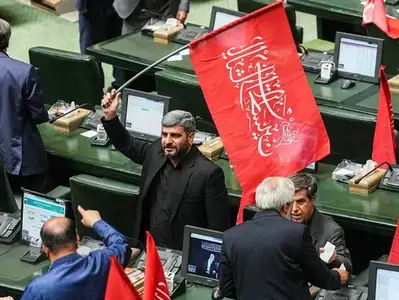
Iranian Parliament Speaker Mohammad Bagher Ghalibaf said on Thursday that Tehran has so far exercised restraint in the face of regional conflict, warning the United States against further escalation.
"We have shown self-restraint in response to the expansion of war in the region," Ghalibaf said in remarks reported by Iranian media.
Addressing the United States, he added: "The delusional American president should know he cannot impose peace on us through imposed war and threats."
Change or fall of the Islamic Republic establishment is not a goal but could be a result of the conflict between Iran and Israel, Prime Minister Benjamin Netanyahu said in an interview with Israeli public broadcaster Kan.
He added that the matter is for the Iranian people to decide, saying, “There is no substitute for this.”
He added that Israel has destroyed over half of Iran’s missile launchers.
“We’re striking [Iran’] launchers. It doesn’t matter so much how many rockets they have. What matters is how many launchers they have — and we’re already getting there. I think we’ve already passed the halfway mark of the launchers they have.”
Israeli Prime Minister Benjamin Netanyahu visits the Soroka hospital complex, after it was hit by a missile fired from Iran, in Beer Sheva, Israel on 19 June 2025.
US special envoy Steve Witkoff and Iranian Foreign Minister Abbas Araghchi have held multiple phone conversations since the Iran-Israel conflict erupted last week, aiming to find a diplomatic solution to the crisis, Reuters reported on Thursday.
Citing three unnamed diplomats, the report said Araghchi told Witkoff that Tehran would not return to negotiations unless Israel halted its attacks on the Islamic Republic.
The talks also touched on a US proposal from late May to create a regional uranium enrichment consortium outside Iran, which Tehran has rejected.