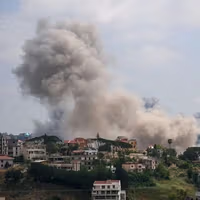
Emergency teams in Ramat Gan, central Israel, responded Thursday to damage caused by the new wave of Iranian missile attacks.
Israeli air defense systems activated to intercept incoming projectiles during the assault.
Iran’s state-run TV broadcast images Thursday showing the aftermath of an explosion at the Khondab heavy-water complex near Arak, a key site in the Islamic Republic’s nuclear program.
Iran’s Foreign Ministry spokesman Esmaeil Baqaei accused IAEA Director General Rafael Grossi on Thursday of enabling a war against Iran through what he called a "biased report."
“This is too late, Mr. Grossi,” Baqaei wrote on X, responding to Grossi’s recent statement that the IAEA had no evidence Iran sought nuclear weapons.
“You obscured this truth in your absolutely biased report,” he said, adding it was used by the E3 and US to pass a resolution later exploited as a pretext for attacking Iran’s nuclear facilities.
“You turned the IAEA into a tool of convenience,” Baqaei said, accusing Grossi of "betraying the non-proliferation regime."
Iran's Foreign Minister Abbas Araghchi confirmed he will meet with his British, French, and German counterparts and the EU representative in Geneva on Friday, saying the talks “will be held at the request of the European troika.”

Any direct US involvement in the war alongside Israel would escalate the conflict regionally, the Revolutionary Guards' Khatam al-Anbiya Central Command said Thursday.
“We warn the United States: entering this war will expand it and result in heavy, irreparable blows,” the statement said.

Iran’s Khondab heavy-water reactor in Arak was inactive and contained no nuclear material at the time of the Israeli strike, the International Atomic Energy Agency said Thursday.
The agency confirmed the attack caused no radiological impact.