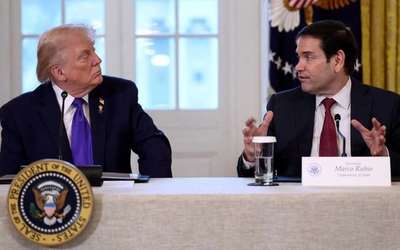
US President Donald Trump had left the summit early to address the crisis but not before signing off to a relatively diplomatic joint statement that backed Israel's right to self-defense and criticized Iran but mooted a resolution.
"We urge that the resolution of the Iranian crisis leads to a broader de-escalation of hostilities in the Middle East," the wealthy democracies said.
But Trump ratcheted up his rhetoric on Tuesday, noting "we" - Israel and the United States - had gained control of Iran's air space, suggesting Iran's Supreme Leader could be easily killed and demanding "unconditional surrender" in social media posts.
French President Emmanuel Macron warned harshly against seeking to topple Tehran's ruling theocratic system by first, citing cautionary tales in recent Mideast history.
"The biggest error would be to use military strikes to change the regime because it would then be chaos,” Macron said.
“Does anyone think that what was done in Iraq in 2003 was a good idea? Does anyone think that what was done in Libya the next decade was a good idea? No!” he added.
“We don’t want Iran to get a nuclear weapon. But our responsibility is to return discussions as quickly as possible.”
British Prime Minister Keir Starmer pushed back against suggestions that US President Donald Trump is planning imminent military intervention in Iran, following Trump’s calls on Monday for the evacuation of Tehran’s 10 million residents and his late-night convening of the US National Security Council in the White House Situation Room.
“There is nothing the president said that suggests he’s about to get involved in this conflict,” Starmer told reporters, adding that there was “no doubt in my mind” based on his dinner discussion with Trump on Monday that he sought de-escalation.
"I'm no supporter of the regime in Iran," told the BBC. Asked if he would support a popular uprising, the prime minister demurred.
"Look, it's not for me as the UK prime minister to start, you know, encouraging people in relation to what they might do at home. My absolute focus is on the need to deescalate this."
Germany’s Chancellor Friedrich Merz offered a more hedged view, praising Israel for doing "the dirty work" by confronting Iran, also a Western foe.
Israel, he added, likely could not destroy Iran’s fortified nuclear facility at Fordow without US firepower. “The Israeli army is obviously unable to accomplish that. It lacks the necessary weapons. But the Americans have them,” Merz told broadcaster ZDF.
On the possibility of the United States joining the fight, Merz said, “we have talked about this.” That decision, he added, depends on whether the Iranian regime “is prepared to return” to the negotiating table.