The United States has deployed more than 30 aerial refueling tankers to the Middle East in recent days as part of contingency planning in the event of direct American involvement in the escalating conflict, CNN reported citing two US officials.
The tankers would enable Israeli fighter jets to extend their operations over Iranian airspace by providing in-flight refueling, the officials said.
They could also support US strategic bombers, including B-2 and B-52 aircraft, if President Donald Trump authorizes military action.
Iranian ambassadors to Italy and Spain have warned that Israel is pushing for a wider regional war and ruled out any negotiations while airstrikes continue, calling instead for an immediate halt to hostilities.
Iran’s envoy to Rome, Mohammad Reza Sabouri, told Italian news agency Adnkronos that Israel is seeking escalation, not diplomacy, and described the country’s military actions as a violation of international law.
“We are not ready to negotiate under bombardment,” Sabouri said, but added that Iran remains open to talks with the United States once the violence stops, as long as peaceful nuclear development is not compromised.
He also cited Italy’s potential to play a constructive role and welcomed the idea of Russian mediation.
Separately, Iran’s ambassador to Spain, Reza Zabib, echoed the message, saying the war could end swiftly “if the aggressor is stopped,” referring to Israel.
Speaking to Spain’s COPE Radio, Zabib said Iran is acting in self-defense and called for accountability and reparations if the conflict ends.
Both diplomats emphasized Iran’s right to respond under Article 51 of the UN Charter, while asserting that any sustainable peace must involve guarantees to prevent future attacks.
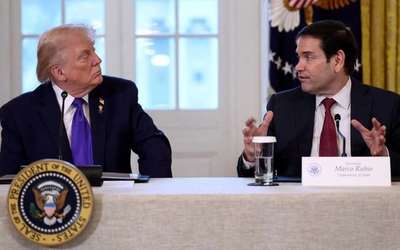
Iran will retaliate against the United States if it determines that Washington is directly involved in attacks on its territory, Tehran’s ambassador to the United Nations in Geneva said on Wednesday.
“If we come to the conclusion that the United States is directly involved in attacks on Iran, we will start responding to the US,” Ambassador Ali Bahreini said.
Bahreini warned that Iran’s response to ongoing Israeli strikes would be without restraint, though he emphasized that it would remain “proportionate and in accordance with international law.”
“We will not show any reluctance in defending our people, security and land. We will respond seriously and strongly, without restraint,” he said.
Iranian President Masoud Pezeshkian on Wednesday urged officials to rally local communities and boost public participation in response to ongoing Israeli attacks.
“Bring the people and neighborhoods to the scene and create participation,” Pezeshkian said during a cabinet meeting, signaling a call for grassroots mobilization.
He did not elaborate on any plans.
He also directed all government institutions to provide support for those affected by the strikes, as the conflict with Israel continues to escalate.
Israeli Foreign Minister Israel Katz on Tuesday likened the current situation in Tehran to a “tornado,” saying Iranian state symbols were collapsing and citizens were fleeing.
"Symbols of the regime are being bombed and collapsing – from the broadcasting authority and soon other targets, and masses of residents are fleeing. This is how dictatorships fall," Katz posted on X.
Israel is running low on its stock of Arrow missile interceptors, raising fresh concerns over the country's ability to counter long-range ballistic missiles from Iran if the conflict drags on, the Wall Street Journal reported.
The report cited a senior US official as saying that Washington has been aware of the issue for several months and has stepped in to bolster Israeli air defenses, deploying systems across land, sea, and air.
Since hostilities intensified in June, the Pentagon has ramped up its regional missile defense presence, though US interceptor supplies are also under strain.
“Neither the US nor the Israelis can continue to sit and intercept missiles all day,” said Tom Karako, director of the Missile Defense Project at the Center for Strategic and International Studies. “The Israelis and their friends need to move with all deliberate haste... we cannot afford to sit and play catch.”
The Israel Defense Forces said in a statement it was “prepared and ready to handle any scenario,” but added it could not discuss munitions-related matters.
Arrow is a critical part of Israel’s multi-layered defense shield, designed to intercept high-altitude ballistic missiles, including those potentially launched from Iran.