• العربية
  • فارسی
Brand
  • Iran Insight
  • Politics
  • Economy
  • Analysis
  • Special Report
  • Opinion
  • Podcast
  • Iran Insight
  • Politics
  • Economy
  • Analysis
  • Special Report
  • Opinion
  • Podcast
  • Theme
  • Language
    • العربية
    • فارسی
  • Iran Insight
  • Politics
  • Economy
  • Analysis
  • Special Report
  • Opinion
  • Podcast
All rights reserved for Volant Media UK Limited
volant media logo

Rights group accuses IRGC of using civilian sites in Kermanshah as weapons depots

Jun 16, 2025, 13:10 GMT+1

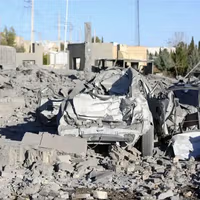
The Hengaw Organization for Human Rights said Monday that Iran’s Islamic Revolutionary Guard Corps (IRGC) had turned buildings near Farabi Hospital in Kermanshah into storage sites for munitions, effectively making the area a military target.

Hengaw said at least seven such sites in the Dizelabad and Dolatabad districts were struck by Israeli forces. The group warned against what it described as the IRGC’s organized use of civilians as “human shields,” calling it a war crime.

Most Viewed

Ghalibaf defends Iran-US talks amid hardline backlash
1
INSIGHT

Ghalibaf defends Iran-US talks amid hardline backlash

2
INSIGHT

Iran diplomacy wobbles as factions compete to avoid looking soft on US

3
VOICES FROM IRAN

Bread shortages, soaring prices strain households in Iran, residents say

4
ANALYSIS

The politics of pink: how Iran uses cuteness to rebrand violence

5

War-hit homeowners feel abandoned as Iran’s reconstruction aid fades

Banner
Banner

Spotlight

  • Lights out, then gunfire: Witnesses recount Mashhad protest crackdown
    VOICES FROM IRAN

    Lights out, then gunfire: Witnesses recount Mashhad protest crackdown

  • Family told missing teen was alive, then received his body 60 days later
    EXCLUSIVE

    Family told missing teen was alive, then received his body 60 days later

  • Is Iran entering its Gorbachev moment?
    INSIGHT

    Is Iran entering its Gorbachev moment?

  • Iran crackdown reaches cemeteries as graves of slain protesters defaced
    EXCLUSIVE

    Iran crackdown reaches cemeteries as graves of slain protesters defaced

  • Iran diplomacy wobbles as factions compete to avoid looking soft on US
    INSIGHT

    Iran diplomacy wobbles as factions compete to avoid looking soft on US

  • The politics of pink: how Iran uses cuteness to rebrand violence
    ANALYSIS

    The politics of pink: how Iran uses cuteness to rebrand violence

  • Bread shortages, soaring prices strain households in Iran, residents say
    VOICES FROM IRAN

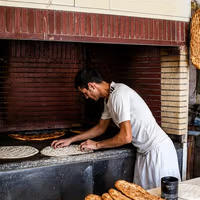
    Bread shortages, soaring prices strain households in Iran, residents say

•
•
•

More Stories

Former Israeli PM urges Iranians to reject ruling system

Jun 16, 2025, 12:41 GMT+1

Former Israeli Prime Minister Naftali Bennett posted a video message on social media Monday addressing the Iranian people, calling on them to oppose the clerical establishment amid Israeli strikes.

“This is your chance to get rid of this terrible regime,” Bennett said. “The people of Iran are not Israel’s enemy. Your only enemy is this corrupt, brutal, and oppressive regime.”

IRGC commander says Iran will continue operations even if Israeli attacks stop

Jun 16, 2025, 12:25 GMT+1

Mohammad Pakpour, commander of Iran’s Islamic Revolutionary Guard Corps (IRGC) Ground Forces, said Monday that Iran will continue its military operations regardless of whether Israel halts its attacks.

“Even if Israeli attacks stop, we will carry on until the end,” Pakpour said, according to state media.

He added that key areas had been hit and that operations would continue.

Panic in Tehran: exodus as Israel strikes for a fourth day

Jun 16, 2025, 12:13 GMT+1
•
Maryam Sinaiee

Panic-stricken residents began fleeing Tehran on Sunday as Israeli strikes and air defense fire rocked the city, sending thick plumes of smoke into the skyline of a capital unprepared for war.

The latest wave of Israeli airstrikes, which began at midday, followed hours after a warning from Israel’s Ministry of Defense urging civilians to avoid areas near military and weapons facilities.

The attacks have sparked deep anxiety across Tehran, a city already struggling under energy shortages and economic malaise before the conflict.

“I can’t think straight. I’m packing as we speak. The whole city is under attack and the roads out are jam-packed with cars,” said Neda, a 37-year-old mother of two, struggling to hold back tears.

“My elderly parents are reliving the traumas of the Iran-Iraq war every time a missile lands,” she added. “I have very little hope that the Islamic Republic and Israel will stop anytime soon. I just hope our home is still standing when and if we return.”

Reported targets included the Justice, Intelligence, and Oil ministries located in densely populated residential and commercial districts.

Multiple residential buildings were also struck during the ongoing daytime raids.

“The first two days were incredibly terrifying because there are so many military facilities near my home. A missile could land on us with no warning any minute. I’m praying for all this to end soon,” said Ladan, a 46-year-old housewife who lives in northeast Tehran, after reaching Mazandaran in the Caspian region.

Bazaar shuttered

Tehran’s Grand Bazaar and many other businesses shuttered quickly as queues outside petrol stations grew longer. Authorities have now capped fuel purchases at 15 liters per private vehicle per day.

While Iran’s government has not released overall casualty figures, state media reported that ten children were killed overnight in a residential building in northeast Tehran.

Arash, a 48-year-old engineer, said his entire family is preparing to flee.

“Israel struck several places near our neighborhood this morning. One explosion blew the windows open. We’re heading to my parents’ home in the Caspian region—but I’m not sure it’s safe there either.”

Ali, a 38-year-old teacher, said he was still looking for somewhere safe to take shelter. “People with money have already left. For people like us, it’s hard to survive more than a few days away from home.”

Online, confusion and fear are spreading.

“Every [Telegram] channel that I check says to leave Tehran -- but where exactly should we go when we don’t have anyone [to stay with] or know any places [that are safe]?” @stillwjm97 posted on X.

Shelters, human toll

Outspoken former lawmaker Mahmoud Sadeghi echoed the urgency in a post on X.

“The war has truly begun. Declare a state of war. Prioritize protecting people's lives. Let’s minimize human casualties by preparing shelters and issuing warnings,” he addressed the authorities.

“So many missiles are landing in Tel Aviv and Haifa, but the human toll is not comparable to Iran.”

Tehran has no dedicated, fully stocked public bomb shelters like those in Israel. Some neighborhood bunkers built during the Iran-Iraq War remain unused and unprepared, and no sirens have been sounded ahead of the recent attacks.

The government on Sunday announced metro stations, mosques and schools would stay open overnight for shelter. But residents say that metro stations are not equipped as bomb shelters and lack basic amenities such as toilers.

Some social media users are expressing concern that most mosques and schools may be as vulnerable to bombs and missiles as their homes.


Iran shuts financial markets amid conflict with Israel

Jun 16, 2025, 11:51 GMT+1

Fatemeh Mohajerani, spokeswoman for the administration of President Masoud Pezeshkian, announced Monday that Iran's stock exchange and financial markets will remain closed until further notice due to ongoing military tensions with Israel.

She said the decision was made “to protect the public’s financial assets.” Since the conflict began, the Iranian rial has sharply declined against foreign currencies.

Satellite images appear to show retaining wall collapse near Iran’s Fordow nuclear site

Jun 16, 2025, 11:43 GMT+1

New satellite imagery appears to show damage outside the Fordow nuclear site in Iran, The Times of Israel reported on Monday, citing images released by US geospatial intelligence firm Planet Labs.

The report said that before-and-after pictures show what may have been the collapse of a retaining wall on the side of the mountain, alongside a road that rings the edge of the underground nuclear facility, which is buried deep beneath the mountain.