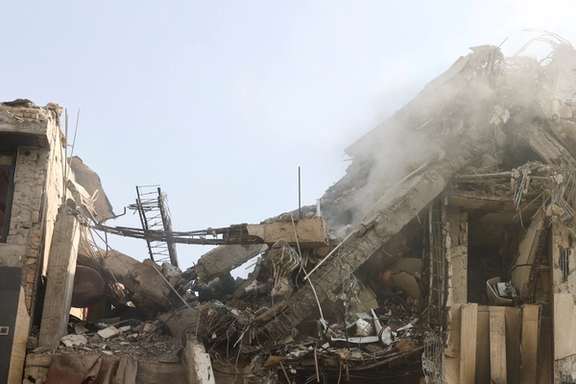
Iran’s Red Crescent Society said on Friday that emergency response teams are operating in more than 60 locations affected by Israeli attacks.
In a statement posted on X, the organization urged the public to remain calm and avoid crowding the affected areas to allow rescue efforts to proceed more efficiently.


IAEA Director General Rafael Grossi said Friday that the agency is ready to support technical discussions and efforts aimed at ensuring transparency, safety, and non-proliferation in Iran following Israeli strikes.
In a statement, Grossi said he had conveyed to the relevant authorities his willingness to travel to Iran "at the earliest" to assess the situation on the ground.
He also called on all parties "to exercise maximum restraint to avoid further escalation."

Russia and China have both voiced concern following Israeli airstrikes on Iran. Kremlin spokesperson Dmitry Peskov said Friday that Moscow condemns the sharp escalation and is monitoring the situation closely, according to the Interfax news agency.
Meanwhile, Chinese foreign ministry spokesperson Lin Jian told reporters that Beijing is "deeply concerned" about the possible consequences of the Israeli operations and called on all parties to avoid further escalation. He said China is paying close attention to developments and is ready to play a constructive role in de-escalating tensions.

Iran’s Ministry of Cultural Heritage, Tourism and Handicrafts announced the closure of all museums, historical buildings, and heritage sites across the country until further notice, following Israeli airstrikes.
Ali Darabi, the deputy minister and head of the cultural heritage division, said Friday the closures are a precautionary measure “to protect public safety under the current wartime and emergency conditions.”
He also instructed custodians to follow crisis protocols and begin transferring artifacts to secure storage facilities. Security units have been placed on full alert to protect cultural and historical properties.

Israel’s killing of Iranian military and scientific personnel showed its "desperation" and would bring a strong response, Lotfollah Dezhkam, the representative of the Supreme Leader in Fars Province, said on Friday.
In remarks carried by Iranian media, Dezhkam described the airstrikes as "cowardly" and said they signaled the eventual end of Israel’s presence in the region. “Israel must know it will never realize its dream of staying in the region,” he said. “Its end is near.”
He added that those killed in the attacks had long aspired to martyrdom and their deaths would only strengthen public resolve: “If the enemies think by targeting a few prominent individuals the people will retreat from the path of resistance, they are gravely mistaken.”
Calling on the public to remain disciplined, Dezhkam emphasized that all action must follow the guidance of Iran’s Supreme Leader. He warned against any uncoordinated retaliation but affirmed readiness for “any necessary steps” in what he referred to as the “arena of resistance.”
Dezhkam concluded by expressing hope for what he called a "great victory" and said Iran would respond more forcefully than in the past.

Iran’s Atomic Energy Organization said on Friday that the Israeli strikes damaged parts of the Natanz enrichment facility, but initial assessments indicated no casualties among site personnel and no radiation or chemical leaks beyond the complex.
In a statement, the organization said several military commanders, nuclear scientists, and civilians were killed in what it described as an unlawful attack that violated international norms.
“The damage at the Shahid Ahmadi Roshan enrichment complex is still being assessed,” the statement read, referring to the Natanz site. “So far, there have been no reports of casualties among staff or any radiation or chemical contamination spreading outside the facility.”
The agency said it had repeatedly warned the IAEA about Israeli threats targeting Iran’s nuclear facilities, and criticized the agency’s director-general for what it called silence even after the attack.
“The agency, by ignoring these threats and relying on politically motivated reports based on false information, has lost credibility and risks becoming an instrument of Israeli policy,” the statement said.
The Atomic Energy Organization added that political and now military pressure would not deter Iran’s nuclear scientists from pursuing the country’s nuclear goals.