• العربية
  • فارسی
Brand
  • Iran Insight
  • Politics
  • Economy
  • Analysis
  • Special Report
  • Opinion
  • Podcast
  • Iran Insight
  • Politics
  • Economy
  • Analysis
  • Special Report
  • Opinion
  • Podcast
  • Theme
  • Language
    • العربية
    • فارسی
  • Iran Insight
  • Politics
  • Economy
  • Analysis
  • Special Report
  • Opinion
  • Podcast
All rights reserved for Volant Media UK Limited
volant media logo
INSIGHT

Iranians are accused of waste while struggling with shortages

Dalga Khatinoglu
Dalga Khatinoglu

Oil, gas and Iran economic analyst

Jun 9, 2025, 18:43 GMT+1Updated: 08:06 GMT+0
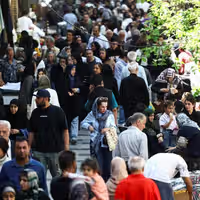
A woman walks pulling along her shoppings, Hamedan, Iran, June 8, 2025

People in Iran are often accused of contributing to the country’s economic woes through wasteful habits—not just by officials, but by one another. But how much truth is there to these claims?

People in Iran are often accused of contributing to the country’s economic woes through wasteful habits—not just by officials, but by one another. But how much truth is there to these claims?

One common claim is that Iranians use far more electricity than other nations. But data from Iran’s Energy Ministry shows that per capita household electricity consumption is about 1,100 kilowatt-hours per year—40% lower than the EU average, and well below usage in the US, Canada, Japan, or even many neighboring countries.

It’s the same story with food.

Iran’s agriculture minister recently criticized Iranians for “excessive consumption” of sugar and cooking oil, asserting that government subsidies are being squandered.

But that assertion appears to contradict data from the UN’s Food and Agriculture Organization (FAO), which shows that Iran’s per capita consumption of both items is below the global average and significantly lower than in nearby countries like Turkey.

Last year, Iranians consumed 2.3 million tons of cooking oil, compared to 3.5 million tons in Turkey, which has a similar population. On a per capita basis, Iranian consumption is 30% lower than the global average.

The minister also claimed that 90% of Iran’s cooking oil is imported at subsidized rates, yet FAO data puts the figure closer to 56%, with imports steadily declining over the past three years.

Sugar tells a similar story. Iranians consume about 10% less than the global average, and nearly half as much as Turks. Far from being excessive, these levels reflect increasing constraints on household consumption.

Chasing the basics

These accusations also overlook a crucial fact: food inflation in Iran is out of control. The price of cooking oil surged 20% in just three months, according to a report by economic outlet Tejarat News on Monday. 

Iran’s Statistical Center reports annual inflation of 31% for cooking oil and 41% for sugar.

Such price spikes make basic goods increasingly unaffordable for most households. And the toll is visible in declining food security.

FAO data shows that per capita meat consumption in Iran has fallen by 40% over the past decade, while dairy consumption has dropped by 30%.

A senior food industry official said last week that the average Iranian now consumes 7–10 kilograms of meat per year—consistent with FAO’s estimate of just over 8 kilograms, down from 12 kg just a few years ago.

“Meat consumption in Iran is deeply unequal—some eat nothing, while others manage 20 kilograms a year,” said Masoud Rasouli, secretary of the Meat Production and Packaging Association, adding that the global average is 32 kilograms.

The figures don’t lie: Iranians are not consuming too much—they’re getting by with less.

Contrary to the official line—and even public opinion—excess is not a national trait. It’s an alien concept to the majority chasing the basics.

Most Viewed

Iran negotiators ordered to return after internal rift over Islamabad talks
1
EXCLUSIVE

Iran negotiators ordered to return after internal rift over Islamabad talks

2
ANALYSIS

US blockade enters murky phase as tankers spoof signals and buyers hesitate

3

US tightens financial squeeze on Iran, warns banks over oil money flows

4
INSIGHT

Ideology may be fading in Iran, but not in Kashmir's ‘Mini Iran'

5
INSIGHT

Hardliners push Hormuz ‘red line’ as US blockade tests Iran’s leverage

Banner
Banner

Spotlight

  • Hardliners push Hormuz ‘red line’ as US blockade tests Iran’s leverage
    INSIGHT

    Hardliners push Hormuz ‘red line’ as US blockade tests Iran’s leverage

  • Ideology may be fading in Iran, but not in Kashmir's ‘Mini Iran'
    INSIGHT

    Ideology may be fading in Iran, but not in Kashmir's ‘Mini Iran'

  • War damage amounts to $3,000 per Iranian, with blockade set to add to losses
    INSIGHT

    War damage amounts to $3,000 per Iranian, with blockade set to add to losses

  • Why the $100 billion Hormuz toll revenue is a myth
    ANALYSIS

    Why the $100 billion Hormuz toll revenue is a myth

  • US blockade targets Iran oil boom amid regional disruption
    ANALYSIS

    US blockade targets Iran oil boom amid regional disruption

  • Iran's digital economy battered by prolonged blackout
    INSIGHT

    Iran's digital economy battered by prolonged blackout

•
•
•

More Stories

Iran extends dog walking bans to more than 20 cities as crackdown widens

Jun 8, 2025, 17:30 GMT+1

Iranian prosecutors have expanded a ban on dog walking to more than 20 cities across the country, building on similar restrictions first introduced in the capital Tehran in 2019.

The ban has now spread to at least 25 cities, including Kermanshah, Ilam, Hamadan, Kerman, Boroujerd, Robat Karim, Lavasanat, and Golestan, according to a report by Tehran-based reformist-leaning outlet Faraz News on Sunday.

While no national legislation has been passed, judicial authorities are enforcing the ban through local directives and police orders, citing various articles of Iran’s Penal Code and Constitution.

These include Article 638 on public morality, Article 688 on threats to public health, and Article 40 of the Constitution, which prohibits harm to others.

Several prosecutors across various provinces announced the new bans over the weekend.

Kashmar, a city in northeastern Iran’s Razavi Khorasan province, is among the latest to implement the ban.

“Dog walking has been prohibited in this county in order to safeguard public hygiene and the physical and psychological safety of the public,” the city’s public prosecutor said on Sunday.

Khalkhal’s public prosecutor Mozaffar Rezaei in northwest Iran’s Ardabil province announced the ban came into effect on June 6. “Offenders will face consequences if they are seen walking dogs in parks, public spaces, or carrying them on their vehicles,” Rezaei said in remarks to Islamic Republic News Agency (ILNA) published Sunday.

"In addition to the financial and physical damages, religious rulings and cultural considerations must be taken into account, as this practice reflects the promotion of a Western lifestyle," he added.

In Ilam, western Iran, authorities imposed a dog walking ban on Saturday, warning that anyone seen walking dogs in parks, public areas, or transporting them in vehicles would face legal action. Police have also been instructed to impound vehicles involved in violations, according to provincial judicial chief Omran Ali Mohammadi.

In Isfahan, central Iran, the ban was announced last week by Mohammad Mousavian, the city’s public prosecutor who also ordered police to impound vehicles carrying dogs and shut down pet shops and unauthorized veterinary clinics.

A group of animal rights activists gathered outside the governor’s office in Isfahan on Sunday, calling for an end to what they described as municipal dog culling.

Average red meat intake in Iran drops by over half as millions go without

Jun 8, 2025, 11:52 GMT+1

Iran’s average meat consumption has dropped to as little as seven kilograms per person annually from an average of 18, with some citizens eating none at all, according to Masoud Rasouli, secretary of the Meat Production and Packaging Association.

“Meat consumption in Iran is deeply unequal—some eat nothing, while others manage 20 kilograms a year,” Rasouli said on Sunday, pointing to the vast economic inequalities in the country.

Iran once averaged 18 kilograms of meat consumption per person annually, while the global average remains around 32 kilograms, he added.

“In some countries, especially in South America, people consume up to 100 kilograms of meat per year,” Rasouli said.

Rasouli added that a kilogram of mutton now costs about 10 million rials—around $13—while the average monthly income in Iran is just $200 to $250. With the rial trading near 830,000 to the dollar, even basic food items have become inaccessible for many.

Rasouli added that processed items like sausages and cold cuts have become more expensive than fresh meat.

After years of crippling inflation, averaging around 40 percent annually for five consecutive years, over 30 percent of the population now lives below the poverty line. Food, housing, and healthcare costs have risen sharply, cutting deeply into household consumption.

In April, a World Bank brief about Iran said that with a projected contraction in per-capita GDP, poverty is expected to increase to 20 percent in 2025-2026.

"Poorer households are disproportionately rural, uneducated, female-headed, and have not historically benefited from periods of economic expansion," the report said.

A report released in September by The Statistical Center of Iran showed that since 2022, the divide between rich and poor in Iran continues to widen.

Dozens arrested as Iran truckers’ strike enters third week

Jun 6, 2025, 09:25 GMT+1

Iranian authorities have arrested more than 40 people, including truck drivers and supporters of a growing nationwide truckers’ strike, according to the Human Rights Activists News Agency (HRANA).

The detentions span several provinces, including Kurdistan, Gilan, Fars, Qazvin, and Kermanshah, and involve both striking drivers and citizens accused of promoting the protests online or documenting blockades.

The strike began on May 22 in the southern port city of Bandar Abbas, triggered by mounting frustrations over rising costs, falling freight rates, fuel restrictions, and lack of state support. The movement quickly spread, and the Alliance of Iran Truckers and Truck Drivers’ Unions (AITTD) now says drivers in at least 155 cities and towns are participating.

Those arrested include named individuals such as Farzad Rezaei, Zanko Rostami, Rezgar Moradi, Sediq Mohammadi, Ata Aziri, Alireza Faghfoori, and Shahab Darabi—who has reportedly been released. Authorities in Qazvin said nine people were detained for allegedly disrupting traffic and posting videos on social media. In some cases, state media aired what appeared to be forced confessions.

The Center for Human Rights in Iran (CHRI) has called the strike “the largest labor protest in recent years,” citing it as evidence of growing discontent over the country’s deepening economic crisis.

Desperate odds: inside Iran’s quiet gambling boom

Jun 5, 2025, 21:41 GMT+1
•
Mehdi Jedinia

Despite legal and religious prohibitions, online gambling is quietly on the rise in Iran, offering an illusory hope of gain to many worn out by economic hardship.

The phenomenon is steeped in contradiction, with many platforms operating in plain sight despite the Islamic prohibition of gambling.

While supreme leader Ali Khamenei recently ruled that predicting sports outcomes for prizes is not inherently forbidden (haram), Iran’s judiciary continues to treat gambling as a criminal offense—punishable by lashes and imprisonment.

Still, with the national currency, the rial, in free fall and opportunities dwindling, many see gambling as one of the few remaining ways to beat inflation—or to reclaim a fleeting sense of freedom.

Bet to breathe

For Maryam, 49, a former schoolteacher, online poker began as a form of relief from daily suffocation.

"In Iran, we are prisoners—not just of the regime, but of our own despair," she says from her Tehran apartment. "The leaders want to drag us back to rules from 1,400 years ago, while the world moves forward. These games … they let me breathe."

She’s lost several months’ wages in a single night but insists the emotional release is worth it. "When I win, I feel like I’ve beaten the system. When I lose, at least I was free for a moment."

Mohammad, 35, a software engineer, sees gambling less as a thrill than as a necessity. "Look at our currency," he says. "You save 100 million rials today, and in six months, it buys half as much."

Using VPNs to access offshore sportsbooks, he trades in dollars or cryptocurrency to hedge against both inflation and sanctions. "Gambling isn’t a game here—it’s a financial tactic."

Loopholes, laundering, and lashes

The rise in betting has exposed a divide at the highest levels of authority.

While Khamenei’s office has carved out a religious loophole for prize-based predictions, senior Shi’a jurists like Ayatollah Makarem Shirazi maintain that all forms of monetary betting are haram.

Due to this inconsistency, perhaps, enforcement remains patchy and ineffective.

Although Iran’s Cyber Police (FATA) have shuttered over 1,500 gambling websites since 2021 and frozen 72 billion tomans in suspected gambling funds, many platforms operate freely, using registered banking gateways that suggest official indifference—or even complicity.

Tehran MP Mojtaba Tavangar recently called on Iran’s Central Bank to impose tighter controls on the country’s 3.8 million unregistered point-of-sale (POS) systems, which he says are conduits for illicit cash flows.

He blamed anonymous banking transactions for fueling the online gambling surge, asserting that $1 billion in gambling profits exited the country last year.

The warning was echoed by senior FATA official Ali Niknafs, who accused payment processors of enabling a “black-market economy” and faulted the Central Bank for what he called lax oversight.

A symptom, not a vice

Gambling is a rising concern in many societies, but in Iran, it thrives in the shadows—fueled by economic despair, filtered through VPNs, and punished with lashes.

What elsewhere may be a regulated vice has here become an act of defiance and desperation, shaped by repression and the absence of lawful outlets for risk or relief.

Experts say Iran’s gambling boom reflects a deeper breakdown.

"When people lose faith in banks and jobs, they turn to risky alternatives," says Stockholm-based economist Ahmad Alavi. "The regime blames Western decadence, but the real problem is their own mismanagement."

The growing habit is now affecting workplaces too.

"Employees gamble during work hours—some even stealing to cover losses," says an IT supervisor at a Tehran bank who asked not to be named. "We fire them, but new ones do the same thing."

Saman, another IT manager, says he has deployed firewalls and screen monitoring systems, only to see workers bypass them using secret Telegram channels and disguised apps.

With VPN usage at record highs and underground betting networks expanding, crackdowns—by officials or employers—appear increasingly futile. More and more people chase the dream in desperation, many aware it’s an illusion but not seeing any alternative.

"We’re trapped in a broken system," Maryam says. "So we roll the dice."

Island vibes? US and Iran joust over where to enrich uranium

Jun 5, 2025, 19:21 GMT+1
•
Maryam Sinaiee

The location of a proposed uranium enrichment consortium to help resolve Iran's nuclear impasse is emerging as a central point of contention, as Tehran insists enrichment must occur on its own soil.

Axios and The New York Times reported earlier this week that US negotiator Steve Witkoff has proposed creating a regional consortium to break the deadlock in stalled nuclear talks.

In a June 4 speech, Supreme Leader Ali Khamenei rejected the US proposal—delivered by Oman’s Foreign Minister Badr Albusaidi on May 31—saying a halt to enrichment inside Iran was “out of the question.”

Iranian Foreign Ministry Spokesman Esmail Baghaei had earlier said Tehran would welcome a nuclear fuel consortium “if it were proposed,” but added: “It cannot be a substitute for enrichment within Iran.”

Details of the proposal

According to Axios on June 2, Witkoff’s proposal would, restrict enrichment to civilian-grade levels (3%), suspend underground enrichment for a negotiated period, limit above-ground enrichment to reactor fuel standards under IAEA guidelines and require Iran’s immediate adoption of the IAEA’s Additional Protocol

On June 3, Axios quoted a senior Iranian official as saying Iran might accept a consortium based in Iran—but not if enrichment occurred elsewhere.

Qeshm, Kish or some other island?

A New York Times report on the same day noted that Omani and Saudi officials had discussed placing the facility on a Persian Gulf island.

“This would potentially give both sides a talking point,” the Times wrote, with Iran claiming enrichment is still happening and the US saying it isn’t on Iranian soil.

Israel Hayom cited an unnamed Arab source suggesting the facility might be built on one of three disputed islands: Greater Tunb, Lesser Tunb or Abu Musa. All are controlled by Iran but claimed by the UAE.

The outlet described the idea as a “diplomatic sleight of hand,” sparking backlash on Iranian social media, where critics warned it would undermine Iran’s sovereignty claims.

Alternative: the Oman model

Some nuclear experts, including former Iranian negotiator Hossein Mousavian, have promoted a model where Oman would host the facility, operated by Iran under IAEA supervision.

In this setup, ore would be processed in Saudi Arabia, enriched product would be stored there and a commercial office based in the UAE.

Possible participants

Axios reported the consortium could include the US, Iran, Saudi Arabia, the UAE, Qatar, and possibly Turkey. Other outlets have mentioned Oman, Egypt, and Russia.

A June 3 editorial in Arman-e Melli argued Egypt’s inclusion would offer both regional legitimacy and diplomatic utility.

“Egypt’s good relations with the US and Europe could serve as a bridge between Iran and the West,” it noted.