Iran faces 'grave consequences' if it refuses US proposal, White House says
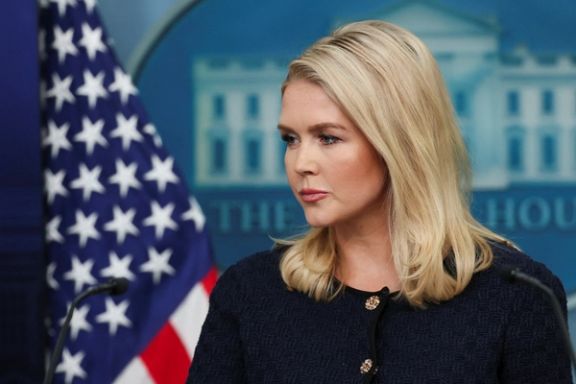
"Special Envoy Witkoff sent a very detailed and acceptable proposal to the Iranian regime that the President hopes they will accept," White House Press Secretary Karoline Leavitt told reporters on Tuesday.
"If not, they will face grave consequences, as the President himself has reiterated."
Rolling power cuts across Iran continue to mar daily life and livelihoods, according to firsthand accounts by everyday people submitted to Iran International.
From scorched household appliances to destroyed crops and collapsing businesses, Iranians describe a national infrastructure crisis they say is pushing them into ruin.
Below are excerpts from voice messages sent to Iran International’s platform for citizen testimonies.
'How are we supposed to survive?'
A farmer from Semnan province in northeastern Iran sent a passionate voice message describing how repeated blackouts have destroyed his equipment and ruined his harvests.
“My irrigation pump has burned out twice,” he said. “Where am I supposed to find 800 million tomans ($9,670)? I’m a village farmer. We’re being crushed.”
The average monthly income in Iran is about $150.
He said blackouts come every five or six hours, killing crops and rendering farming impossible. “They’ve destroyed agriculture, the backbone of our economy. They’ve turned the clock back 1,400 years.”
Expressing broader political anger, he added, “As long as we sit and do nothing, they’ll keep dragging us backward—to the Qajar era, even the Safavid. They aren’t here to help us. They’re here to humiliate us.”
Businesses collapsing: 'I had to buy used fridges again'
A small supermarket owner shared how frequent power cuts ruined expensive appliances—even with surge protectors.
“My dairy fridge and ice cream freezer burned out. I had to replace them with second-hand ones,” he said.
Even those whose businesses are not directly affected by outages expressed sorrow. “I don’t work with electricity, but when I see shopkeepers sitting helplessly outside their stores, it breaks my heart,” one person said. “When will we wake up?”
Shoemakers work following a power outage at a shoe workshop in Tehran, Iran, June 3, 2025.
'God help the sick': Medical risks from power loss
Another voice message warned of life-threatening consequences from blackouts.
“Our bread dough spoils. Appliances burn out. But the real danger is for families who rely on oxygen machines,” the speaker said. “When the power cuts, they might lose a loved one.”
She called the blackouts a clear sign of state failure: “These blackouts prove the regime’s total incompetence. Only real change can fix this. God willing, the people will rise.”
Wrecked appliances
Many described a constant cycle of broken appliances and unbearable heat.
“I burn out a cooler motor every week,” said one angry resident.
Others reported fridges and air conditioners failing due to voltage spikes. “This isn’t just about heat. It’s engineered poverty. Engineered unemployment. Engineered misery,” another added.
A voice message captured the mood in one bitter list: “No jobs. No water. No power. No future. Even morality is breaking down. And it’s all by design.”
Priorities
Multiple speakers criticized the government’s priorities—pursuing military ambitions while ordinary Iranians suffer without basic utilities.
“They’ve been chasing nuclear power for 30 years,” one man said. “But they can’t provide a single kilowatt of electricity for the people.”
The comments come as Iran and the United States remain locked in faltering nuclear negotiations, with apparent mixed signals from Washington fueling uncertainty in Tehran.
He praised Iran’s truck drivers for their recent strikes and urged others to resist. “We have to stop watching each other suffer in silence. This is a war. And it’s being waged against us.”
Truck drivers are now on the 13th day of a nationwide strike, with actions reported in over 150 cities and towns despite growing government pressure.
"If any specific action is taken in the Board of Governors, Iran will take the necessary measures regarding its nuclear activities and the UN nuclear watchdog's access (to its sites)," said Iran's deputy foreign minister Kazem Gharibabadi.
He said he met the ambassadors of 17 members of the IAEA Board of Governors to warn that any "political move" at the upcoming meeting of the Board would threaten Tehran's cooperation with the UN nuclear watchdog.
He said he also elaborated on Iran's positions during separate meetings with the ambassadors of Russia, China, Germany, France and Britain.
The United States' negotiation position in the ongoing nuclear talks with Iran risks overlooking key threats, including Tehran’s ballistic missile program, drone warfare, and support for regional proxies, said Eric Mandel, the founder and Director of the Middle East Political and Information Network (MEPIN).
"What's maybe even more worrying is that ballistic missiles are not discussed or are part of this, drones, the abandonment of Iranian people, and proxies," he told Iran International.
Iran's foreign minister said on Tuesday Iran has received a US nuclear deal proposal that contains many ambiguities.
Speaking in Beirut after unveiling his "Power of Negotiation" book, Abbas Araghchi said a response will be given in the coming days in line with Iran’s interests.
“Preventing us from enriching uranium in Iran is a red line — and this is a reality recognized by all countries," he said. "We won't ask for anyone's permission for continued enrichment."
Araghchi said it is perfectly clear that negotiations under the current circumstances are not from an equal position and resemble a negotiation of surrender.
He also dismissed the US threats to use the military option against Iran, saying, “If the United States was truly capable of bombing our nuclear facilities, it wouldn’t have seen a need to enter negotiations."
A new US proposal for a nuclear agreement appears to have united all corners of Iran’s political scene in opposition, with reformist media calling it “pressure diplomacy” and hardliners denouncing it as a trap.
“Zero enrichment is the code name for the consortium,” the IRGC-linked daily Javan wrote on Monday, referring to a plan that would effectively eliminate Iran’s domestic refinement of uranium.
The details of Washington’s proposal have not been officially revealed, but Javan asserted in its editorial that the draft calls for Iran to halt enrichment entirely.
Another conservative outlet, Khorasan, front-paged the story with the headline Suspicious Proposal.
“Based on available evidence, it is highly unlikely that the proposal delivered by Oman’s foreign minister will address Iran’s key demands,” wrote the daily, which is aligned with Supreme Leader Ali Khamenei’s office.
Khorasan questioned why US negotiator Steve Witkoff sent the proposal through a mediator rather than delivering it directly to his Iranian counterpart during the upcoming round of Tehran-Washington negotiations.
A consortium would pose a threat to the security of Iran’s nuclear program, the paper argued, asserting that another round of talks would only take place if Iran accepts the proposal.
As of Monday evening in Tehran, the only official response to the proposal came from Foreign Minister Abbas Araghchi, who said during a visit to Cairo that the proposal is unfair.
The hardline publication Kayhan, whose editor-in-chief is appointed by Khamenei, also lambasted the idea.
“There is no sign of goodwill in the United States’ proposal. Its sole aim is to weaken and dismantle Iran’s peaceful nuclear program,” the daily wrote in a Monday editorial, stopping short of ruling out a compromise.
“Any retreat without guarantees will only invite further pressure,” it warned.
Major reformist outlet Etemad echoed the sentiment, differing only slightly in tone.
“Even if Iran accepts the proposal, there is no guarantee that the United States will uphold its commitments,” the daily quoted foreign policy scholar Mohsen Jalilvand.
Jalilvand pointed to a push by European powers to trigger the so-called snapback mechanism of UN sanctions suspended under the 2015 nuclear deal, asserting that the United States would welcome the added pressure on Tehran.
Meanwhile, Morteza Maki, an expert on European affairs, stated that developments in Europe, the United States, and the United Kingdom point to a coordinated effort to activate the trigger mechanism, which would reinstate all previous sanctions on Iran.
Despite mounting pressure—including threats from Israel—Maki said Tehran and Washington may still be able to strike an agreement.