Nuclear enrichment is essential for Iran, Basij official says
A senior Iranian official said on Wednesday that preserving the country’s nuclear capabilities remains a national priority, emphasizing that Iran seeks peaceful use of atomic energy and is not pursuing nuclear weapons.
Brigadier General Ghasem Ghoreishi, deputy head of Iran’s Basij paramilitary force, said nuclear energy is essential for Iran’s future and development in sectors such as medicine, agriculture, and electricity production.
“Nuclear energy is among the Islamic Republic’s main priorities,” Ghoreishi said, adding that maintaining uranium enrichment and nuclear capacity is “even more crucial for Iran’s tomorrow.”
Arguing in support of the need for uranium enrichment in the country, a sticking point in the current talks, Ghoreishi also criticized Western sanctions, recalling past embargoes on basic goods during the Iran-Iraq war. “Those who didn’t give us barbed wire then, will not hand over enriched uranium now,” he said.
“Our goal is to protect the nation’s interests—either through diplomacy or resistance.”
Iran’s army aviation commander said on Saturday that the range and accuracy of the military’s helicopter-launched missiles have significantly improved, with all components now locally produced.
Brigadier General Ghasem Khamoushi, commander of the Islamic Republic’s Army Aviation (Havanirooz), said Iran has developed precision-guided and long-range missiles domestically and expanded the operational capabilities of its helicopters to include night missions using indigenously developed night-vision systems.
“Missile range has increased more than sevenfold, and targeting systems have become significantly more precise,” he told reporters during a ceremony marking the anniversary of the 1982 liberation of Khorramshahr during the Iran-Iraq war.
The city, taken by Iraqi forces early in the war, was retaken by Iran during Operation Beitol-Moqaddas in what is considered a turning point in the war.
Khamoushi added that key helicopter parts, previously affected by sanctions, are now produced in Iran using domestic expertise and knowledge-based companies. The advances, he said, will be formally unveiled in the coming weeks.
Khamoushi also said that Iranian helicopters, once limited to daytime operations, are now equipped to conduct missions in complete darkness, thanks to technological upgrades and locally developed equipment.
Iran late last month executed a young man accused of helping Israel carry out assassinations and bomb attacks, but a prominent activist, human rights groups and a leaked call from the condemned prisoner indicate the charges were false.
Mohsen Langarneshin, a 32-year-old network security engineer, was executed in Ghezel Hesar Prison on April 30 on charges of “waging war against God” and “spreading corruption on Earth,” according to the judiciary’s media outlet Mizan.
Beyond vague headlines in state-controlled outlets, few details of his background and case were publicly available. But rights activist Ryma Sheermohammadi and sources close to Langarneshin told Iran International that the case was fabricated, his trial deeply flawed and confessions he made were extracted under torture.
Iranian authorities were so keen to round up suspects amid serial Israeli intelligence breaches, Sheermohammadi said, that they accused him of being involved in the death of a top missile general they have publicly insisted died by accident.
“This case was manufactured,” Sheermohammadisaid. “He was executed on charges of espionage without a shred of material evidence. The case was built entirely on forced confessions extracted under extreme physical and psychological torture.”
“Mohsen was an easy target for them. They tortured him to gain confessions out of him and he didn’t even tell anyone and fell for their lies that they would spare his life if he complied,” a source close to Langarneshin told Iran International.
Accidental blast
According to Sheermohammadi, Langarneshin was accused of involvement in three high-profile incidents: the 2011 explosion that killed the architect of Iran’s missile program Brigadier General Hassan Tehrani Moghaddam, the 2022 assassination of Colonel Hassan Sayyad Khodaei in Tehran and a 2023 bombing at a munitions factory in Isfahan.
Tehrani Moghaddam, a brigadier general in the Islamic Revolutionary Guard Corps (IRGC), played a central role in developing Iran’s long-range missile arsenal and was widely regarded as the father of Iran’s missile program.
In 2011, he died alongside over a dozen others in a blast west of Tehran - a huge blow to Iran's military establishment but one officials conceded was an accidental detonation during weapons testing.
“At the time (of Tehrani Moghaddam's death), Mohsen was just 19 years old and had no known link to the incident,” Sheermohammadi said.
Sheermohammadi also dismissed allegations tying Langarneshin to the 2022 assassination of Quds Force officer Sayyad Khodaei.
“In the 2022 assassination of Colonel Sayyad Khodaei, Mohsen was accused of conducting surveillance using a motorcycle,” she said. “But he was living in Isfahan at the time, not Tehran, and there is extensive documentation — CCTV footage, phone records, vehicle ownership — proving his absence from the crime scene.”
Langarneshin was also accused of being involved in a 2023 bombing in Isfahan. “But Mohsen had already moved to Tehran well before the incident,” she said. “Again, workplace footage and telecom records confirm this. Another individual was arrested and executed for that very bombing, which raises serious questions about duplicated or fabricated charges.”
Langarneshin had previously worked under contract as a network security engineer at Imam Hossein University, a US-designated military-linked institution controlled by the IRGC that trains specialists in cyber defense, intelligence and missile technology.
“Mohsen had a brief professional association with Imam Hossein University — an IRGC-affiliated institution,” Sheermohammadi said. “That link gave intelligence agencies just enough of a pretext to cast suspicion on him, years later.”
But she said his affiliation ended after 2019 protests which started over fuel price hikes but quickly turned political. They were quashed by authorities with deadly force.
“Mohsen made a principled decision to resign from the university following the bloody crackdown on protesters in November 2019,” she said. “He could no longer, in good conscience, be affiliated with institutions tied to state violence. That act of integrity may have marked him as politically unreliable in the eyes of the regime.”
Sheermohammadi believes Langarneshin was ultimately targeted not for what he did, but his profile fit what investigators were seeking in a defendant.
“The intelligence services were under pressure to deliver ‘results,’ especially in cases involving alleged foreign plots,” she said.
“Mohsen’s international travel history, financial independence through his car business, and technical expertise all made him an easy target — someone who could be cast into a ready-made narrative of espionage, even when the evidence said otherwise.”
Call from Evin Prison
In a recorded phone call from Evin Prison, a copy of which was obtained by Iran International, Langarneshin described being psychologically tortured in a Ministry of Intelligence safehouse the night of his arrest.
His captors, he said, threatened him with flogging, forced him to write false confessions and later filmed him admitting to his alleged crimes based on their cues.
“They told me to say I bought a motorbike, mounted a camera on it and went to film,” he said in the call. “That was very odd — there was never any mention of what kind of motorbike it was or where it came from. I never did that. They made me say it anyway.”
After resisting, he said he was blindfolded, chained in a schoolyard, and filmed again. “They said, ‘This video is for before your execution. If you read the confession we wrote, maybe we’ll change your sentence to life imprisonment.’”
Judge Abolghasem Salavati of Tehran’s Revolutionary Court—referred to by dissidents as the “hanging judge” for his record of issuing numerous death sentences in politically sensitive cases—and upheld by the Supreme Court.
All three retrial requests were rejected — the last one dismissed within two days and without explanation.
His father, Massoud Langarneshin, released a video the day before the execution, calling the case “full of flaws, ambiguities and questions.” His mother also confirmed she had her final visit with Mohsen that same day and appealed for help.
Several human rights groups including Norway based rights group Iran Human Rights (IHR) condemned the hanging, which IHR said took place alongside several other prisoners," said IHRNGO Director Mahmood Amiry-Moghaddam.
“We must raise the cost of these extrajudicial killings for the authorities through strong international reactions and widespread protest.”
Sheermohammadi said Iranian authorities refused to tell Langarneshin family where he was buried and had forced them to delete all their social media posts.
“Mohsen’s family is being forced into silence by intelligence agents. They have been told not to speak to the media about Mohsen. Only if they obey the conditions set by the intelligence agents are they willing to disclose his burial site,” another source told Iran International.
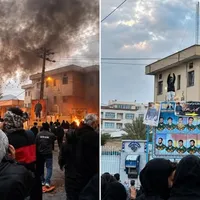
After eleven days of uncertainty, Sheermohammadi confirmed that Langarneshin had been buried in Behesht Zahra cemetery in south Tehran, alongside other executed political prisoners.
Mohsen Langarneshin's burial place in Behesht Zahra cemetery in Tehran, Iran.
Iran’s nuclear chief said on Saturday that the Islamic Republic will not allow foreign powers to dictate its policies, adding that Tehran’s decisions are guided solely by its national interests and long-term goals.
Speaking at a ceremony commemorating the late Foreign Minister Hossein Amir-Abdollahian, head of the Atomic Energy Organization of Iran (AEOI), Mohammad Eslami, said Iran seeks to uphold its values and elevate its global standing.
“Our identity and values determine our path. We act based on our national interests and no one can decide for us,” Eslami said.
He added that despite sanctions and external pressures, Iran’s nuclear industry has reached parity with advanced nations. “Iran has managed to attain a global level of capability in the nuclear field, and this is hard for some to believe,” he said.
Negotiations are based on mutual give-and-take, but would be pointless if the United States aims to destroy Iran, said Mohammadreza Ahmadi Sangari, secretary of the Iranian parliament’s education and research committee.
Citing a remark by Supreme Leader Ali Khamenei—“Who is America to tell Iran not to enrich?”—Ahmadi said Iran alone will decide its level of enrichment and will not take orders from others.
A prisoner exchange involving Elizabeth Tsurkov, an Israeli-Russian academic kidnapped in Baghdad in 2023, is expected to be finalized within days, multiple Iraqi and regional sources have said, amid quiet negotiations between Washington, Baghdad, and groups aligned with Tehran.
An Iraqi interior ministry security source confirmed to Iran International that Tsurkov’s release will come in exchange for “several Iranian prisoners,” some of whom are convicted in Iraq of security-related offenses, including kidnapping and murder.
Tsurkov, a PhD student at Princeton University and fellow at the New Lines Institute, disappeared in March 2023 while conducting research in Iraq.
Israeli officials believe she is being held by Kata’ib Hezbollah, an Iran-backed Shi’ite militia. While the group has denied involvement, an Iraqi official told Israel’s Channel 11 that she was first detained by Iraq’s intelligence service—or by individuals impersonating officers—before being transferred to the militia.
Earlier on Saturday, Iraq’s Al Rabaa TV, which is aligned with Iranian-backed groups, reported that Tsurkov would be released in a deal involving one Iranian and six other individuals detained over attacks on US interests in Iraq.
Saudi-owned Al Hadath and other regional outlets said the agreement came after a senior Iraqi security official visited Washington, and that Tsurkov may first be sent to a neutral country before returning to Israel.
Who is the Iranian involved?
While no official comment has been made by Tehran, an Iraqi security source told Iran International that among those considered for the exchange is Mohammadreza Nouri, a member of Iran’s Islamic Revolutionary Guard Corps (IRGC) Quds Force.
Nouri was sentenced to life imprisonment in Iraq in September 2023 for orchestrating the murder of American citizen Stephen Troell in Baghdad in November 2022.
Troell, a Tennessee native and English teacher, was shot while driving through Baghdad’s Karrada district. According to US and Iraqi officials, Nouri, along with members of the Iran-aligned Harakat Hezbollah al-Nujaba, attempted to kidnap Troell for ransom.
A militant group called Ashab al-Kahf later claimed responsibility, citing retaliation for the 2020 US drone strike that killed IRGC commander Qassem Soleimani and Popular Mobilization Forces (PMF) leader Abu Mahdi al-Muhandis.
Iran’s judiciary official Kazem Gharibabadi has denied the charges against Nouri, calling him a "defender of the shrine"—a title Iran uses for personnel active in Syria.
Gharibabadi acknowledged that the US had requested Nouri’s extradition, but said Baghdad rejected the request. Although Iraq and Iran have an extradition treaty, Iraq did not transfer Nouri to Iran either.
Israeli officials had confirmed diplomatic efforts to secure Tsurkov’s release, with support from the United States and other allies. “We continue to seek her release through multiple channels,” an Israeli official told Ynet.
Tsurkov’s sister, Emma, said the family had no details about the reported deal but remained hopeful.
Meanwhile, a source close to Iraqi Shi'ite factions told Israel’s Kan public broadcaster that Kata’ib Hezbollah had not yet given final approval for Tsurkov’s release.
If done, this would mean a complex negotiation involving the Iraqi government, Iran-aligned militias, and indirect coordination with Israel and the US.