Iran FM rules out negotiations over enrichment, says Khamenei set red line
Iran’s Foreign Minister Abbas Araghchi said on Tuesday that uranium enrichment is not open to negotiation, following comments by Supreme Leader Ali Khamenei expressing doubt over the outcome of ongoing indirect talks with the United States.
“We are witnessing completely unreasonable and illogical positions from the Americans,” Araghchi said. “The issue of enrichment is not negotiable at all,” he added.
Referring to Khamenei’s comments, he added: “Today, the Supreme Leader made the position completely clear.”
Iran said Tuesday that the timing and location of the next round of indirect talks with the United States have not been finalized.
Foreign Ministry spokesperson Esmail Baghaei said proposals had been made, including by Oman, but no agreement had been reached.
“As far as we are concerned, no final decision has been taken on this matter,” Baghaei said. “There have been proposals for time and place from the Omani Foreign Ministry, but as of this moment, nothing has been confirmed.”
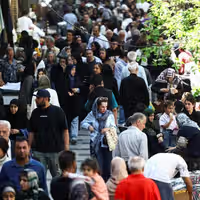
Iran’s rial plummeted on Tuesday after Supreme Leader Ali Khamenei said he did not expect ongoing indirect talks with the United States to succeed.
The rial fell sharply in Tehran’s unofficial market, dropping from around 820,000 to over 840,000 per US dollar shortly after Khamenei’s remarks, according to foreign exchange traders.
“We don’t think the current negotiations will lead to a result,” Khamenei said at a public event.
Similar declines have occurred in the past following negative signals from Khamenei regarding nuclear talks.
Iran’s Supreme Leader Ali Khamenei said on Tuesday that the current indirect nuclear talks with the United States are unlikely to succeed as he refused Washington's demands for Iran to halt uranium enrichment.
"Indirect negotiations took place (under Raisi) as well—just like now—but without results,” Khamenei said during a memorial ceremony for the late president and others killed in a helicopter crash last May. “We do not think it would yield results now either. We do not know what will happen.”
Turning to US calls for zero uranium enrichment, Khamenei said: “Since negotiations have come up, I want to give a warning to the opposing side. The American side that engages in these indirect talks and have discussions, should try not to spout nonsense.
"Saying things like 'we won’t allow Iran to enrich uranium' is way out of line. No one is waiting for anyone’s permission. The Islamic Republic has its own policy, its own approach, and it will continue to pursue it."
US President Donald Trump’s envoy to the Middle East on Sunday said Washington will not accept any level of uranium enrichment in a potential agreement with Tehran.
“We cannot allow even one percent of an enrichment capability,” Steven Witkoff told ABC News. “Everything begins from our standpoint with a deal that does not include enrichment. We cannot have that.”
Iran maintains its nuclear program is peaceful and Khamenei said that he would explain "at a later date" why the issue of enrichment is such a key focus of the talks, leaving the issue open.
On Monday, the United Arab Emirates-based The National cited an Iranian official as saying that Iran had not accepted Oman's invitation for a fifth round of talks with the US due to take place in Rome.
The American officials' insistence on "zero enrichment" has left Iran uncertain about the usefulness of more talks, the report said.
"Iran does not want to have another round of talks and them to fail", the official was quoted as saying. "With zero enrichment, we don't have a deal."
Iran is the only non-nuclear weapon state enriching uranium to 60% U-235, a level that causes "serious concern," according to International Atomic Energy Agency (IAEA) Director General Rafael Mariano Grossi.
The IAEA has consistently maintained that there is no credible civilian use for uranium enriched to this level, which is a short technical step from weapons-grade 90% fissile material.
Iran's stockpile of 60% enriched uranium had increased to 275 kg, enough to theoretically make about half a dozen weapons if Iran further enriches the uranium.
Earlier in the day before Khamenei's speech, deputy foreign minister Kazem Gharibabadi said Iran has received a proposal for the next round of indirect negotiations with the United States.
“We have received a proposal about the next round of negotiations with the US, and it is under review,” Gharibabadi told state media without providing further details.
Iran’s Supreme Leader Ali Khamenei said on Tuesday that he did not expect the current indirect talks with the United States to succeed, in his most pessimistic remarks since US-Iran nuclear talks began last month.
“Since negotiations have come up, I want to give a warning to the opposing side. The American side that engages in these indirect talks and has discussions, should try not to spout nonsense, "Khamenei said during a memorial ceremony for the late president and others killed in a helicopter crash last May
"Saying things like 'we won’t allow Iran to enrich uranium' is way out of line. No one is waiting for anyone’s permission. The Islamic Republic has its own policy, its own approach, and it will continue to pursue it."
"Indirect negotiations took place (under Raisi) as well—just like now—but without results,” Khamenei added. “We do not think it would yield results now either. We do not know what will happen.”
Iran will retaliate with costly and damaging measures against any attempt by Europe to activate the snapback mechanism and reimpose UN sanctions, a hardline Iranian newspaper affiliated with the Revolutionary Guards warned on Tuesday.
In a scathing editorial, Javan daily criticized the threat of snapback — a mechanism in the 2015 nuclear deal that allows the return of UN sanctions — as a “European stick for blackmail” and warned of punitive and high-cost actions against the economies of the United States and Europe.
The editorial said such sanctions would be countered with restrictions in trade routes and geographies under Iran's control, adding that these areas would expand through alignment with other actors "frustrated by US and European policies.”
"The US and European economies should expect punishment and cost-imposing actions. The sanctions will be followed by bans and restrictions on their access to routes and geographies under Iranian control. These geographies, motivated by other actors frustrated with US and European policies, will expand into major commercial corridors," it said.
While Javan did not name locations directly, the paper implied that Iran could disrupt major trade corridors such as the Strait of Hormuz, where a significant portion of the world's oil passes, and possibly the Bab al-Mandeb Strait, through Tehran-aligned Houthis in Yemen, as has been seen since the militant group imposed a maritime blockade in the wake of the war in Gaza.
“Any new sanctions must be met with real costs,” the editorial said, adding that the current Iranian negotiating position is no longer based on “Westoxicated thinking” but on firm demands for compensation and full sanctions relief from the outset of any agreement.
The paper said that Iran would only allow meaningful negotiations if its rights to enrichment and the preservation of enriched uranium stocks are recognized, and if all material and immaterial damages from what it called “illegal and inhumane” sanctions are paid in full.
'Trump eyes Arab wealth, not Iran investment'
Amid the ongoing indirect US-Iran nuclear talks, the editorial targeted US President Donald Trump, Javan accusing him of having no intention or ability to invest in Iran, saying his only objective is to “loot the wealth of Arab countries” to patch up America’s struggling economy.
“Trump, who is chasing after the pockets of Arab states, has no capacity for investment in any country,” the editorial stated. “He only dreams of healing the crisis-hit American economy.”
The piece mocked Trump’s recent regional tour and his military posture, claiming that US aircraft carriers and advanced weaponry had underperformed in conflicts such as Yemen and South Asia.
It argued that despite Trump’s rhetoric, “the US military's threatening gestures lack economic backing and have led to humiliating failure against Iran and China,” adding that Washington’s strategy had shifted to diplomacy out of necessity.
The editorial dismissed recent remarks by Trump’s Middle East envoy Steve Witkoff, who said that the US would not tolerate even 1% uranium enrichment by Iran, as bluster intended to sway negotiations and distract from Washington’s weak hand.
“This time, Iran is not negotiating with illusions, but with demands. If the West wants a deal, it must stop threatening, start compensating, and lift sanctions from day one,” the editorial added.
On Monday, the European Union and the United Kingdom voiced deep concern over Iran’s expanding nuclear program and its continued imprisonment of foreign nationals, according to a joint statement issued after high-level talks.