US swaps stealth bombers for B-52s at key Indo-Pacific base
The US military is replacing its B-2 bombers with B-52s at a base in the Indo-Pacific that was seen as being in an ideal location to operate in the Middle East, Reuters reported on Monday citing US officials.
The Pentagon deployed as many as six B-2 bombers in March to a US-British military base on the Indian Ocean island of Diego Garcia, amid a US bombing campaign in Yemen and mounting tensions with Iran.
The US military is replacing its B-2 bombers with B-52s at a base in the Indo-Pacific that was seen as being in an ideal location to operate in the Middle East, Reuters reported on Monday citing US officials.
The Pentagon deployed as many as six B-2 bombers in March to a US-British military base on the Indian Ocean island of Diego Garcia, amid a US bombing campaign in Yemen and mounting tensions with Iran.
Experts say that this had put the B-2s, which have stealth technology and are equipped to carry the heaviest US bombs and nuclear weapons, in a position to operate in the Middle East.
US President Donald Trump announced last week that a deal had been reached to stop bombing Yemen's Houthi group.
The B-2 bombers had been used to carry out strikes against the Iran-backed group.
An Iranian lawmaker has warned that failed negotiations between Iran and the United States could trigger inflation in the market.
“If the negotiations reach a deadlock, we will witness the effects of psychological inflation in the market, so measures must be taken now to control the situation,” said Mostafa Pourdehghan, who represents Ardakan in the central Yazd province.
Pourdehghan also pointed to recent remarks by Foreign Minister Abbas Araghchi, suggesting that the United States has not maintained a consistent position between what it says in the negotiations and what it expresses publicly.
“This means it is difficult to be optimistic about the talks under these conditions,” he said.
Iran's president Masoud Pezeshkian visiting nuclear facilities alongside nuclear chief Mohammad Eslami
Iranian commentators are floating a long-standing proposal to break the impasse in its nuclear negotiations with Washington: the formation of a regional nuclear consortium involving Iran, Arab states and the United States.
If Tehran has indeed introduced this idea in the fourth round of talks, it may represent new flexibility on the sticky point of enrichment and explain the positive assessment of both Iranian and American officials on the latest round of talks.
A commentary in the conservative Khorasan daily on Mondaysaid the idea of creating a consortium may have been among what Omani Foreign Minister Badr al-Busaidi referred to as “useful and original ideas reflecting a shared wish to reach an honorable agreement” after the completion of the fourth round of talks on Sunday.
Some signals suggest this idea may have been quietly floated in diplomatic channels: ahead of the Muscat talks on April 11, Iran’s Foreign Minister Abbas Araghchi visited Riyadh and Doha, followed by a trip to the UAE after the talks.
The idea was originally proposed by former Iranian nuclear negotiator Seyed Hossein Mousavian and Princeton physicist Frank von Hippel long before the current Tehran-Washington talks in an October 2023 article in the Bulletin of the Atomic Scientists.
Such a body consisting of Iran, Saudi Arabia,and other interested Middle Eastern countries would oversee enrichment under international safeguards and ensure that the enriched uranium it produced would be used only for peaceful purposes, they argued.
On the eve of the April 11 nuclear talks in Muscat, Mousavian addressed the risk of failure if the US refused to acknowledge Iran’s rights under the Nuclear Non-Proliferation Treaty (NPT).
“Steve Witkoff recently made an unreasonable statement, saying that Iran cannot benefit from the right to peaceful uranium enrichment technology. This stance is a clear violation of the NPT treaty. If this is the final US position, tomorrow's negotiations... will end in failure,” he warned.
In the same post, Mousavian again floated the consortium idea: “The solution is ... the establishment of a joint nuclear consortium among the Persian Gulf countries.” He argued this would resolve the US’s contradictory stance of supporting enrichment in Saudi Arabia while denying the same to Iran.
He also hinted at a broader vision: an Iran-US economic agreement worth up to $1 trillion, involving American investment in Iran’s nuclear, fossil, and renewable energy sectors. Such a deal, he suggested, could help “open the deadlock in US–Iran relations.”
Some commentators have described the idea as a possibility for a breakthrough.
“Araqhchi's visit to Saudi Arabia and the UAE is probably not unrelated to the proposal to create a joint regional enrichment consortium,” Rahman Ghahremanpour, a commentator and analyst of Middle East politics in Tehran, posted on X.
“Iran is trying to break the deadlock on zero enrichment, and if the countries in the region agree to this proposal, perhaps the Trump administration will change its position. This is an important confidence-building measure in arms control,” he added.
Abdolreza Davari, a conservative politician who supports Pezeshkian, also supported the idea in a post on X on May 10. This, he said, would be “similar to the model implemented in Europe that supplies fuel even to the United States.”
“This consortium could be the center of regional cooperation in the areas of nuclear technology exchange, safety, environment, production of fresh water and radiopharmaceuticals, and also include a regional non-proliferation regime," Reza Nasri, another commentator in Tehran, wrote on X before Araghchi’s visit to Riyadh.
Hossein Aghaei, a Turkey-based senior security and geopolitics analyst, referred to Saudi Arabia’s wish to create a consortium in collaboration with the US and possibly Russia in a post on X on May 8. He said Iran could be a participant in the consortium to ensure it will not be able to build nukes.
However, he warned that Israel’s vision is completely different. “In the nuclear matter, Israel may not even trust Saudi Arabia, let alone the Islamic Republic.”
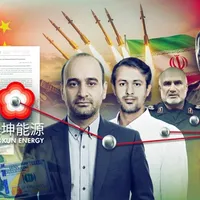
The United States on Monday issued new sanctions against one Iranian entity and three individuals it alleged contributed it Iranian nuclear activities with potential military uses.
An announcement by the US Treasury listed the company as Fuya Pars Prospective Technologists, also known as Ideal Vacuum Store.
Secretary of State Marco Rubio elaborated on the move in a statement.
"Today, the Department of State is sanctioning three Iranian nationals and one Iranian entity with ties to Iran’s Organization of Defensive Innovation and Research, which is known by its Persian acronym, SPND – the direct successor organization to Iran’s pre-2004 nuclear weapons program, also referred to as the Amad Project."
"All individuals sanctioned are involved in activities that materially contribute to, or pose a risk of materially contributing to, the proliferation of weapons of mass destruction," he added.
It’s impossible to give a timeline for when this will be resolved or what the outcome will be. We are trying," said Majid Takht-Ravanchi, deputy foreign minister for political affairs. "We believe the path we’re on is the right one, though there are many challenges."
"Economically, the country is in a difficult state, and our people are under sanctions that we believe are deeply unjust," Takht-Ravanchi added during an appearance at the Tehran International Book Fair.
"Our effort in the diplomatic apparatus is, within our capacity and in line with national policies and the guidelines given to us, to use our expertise to lift these sanctions."