A senior Iranian cleric said on Friday that dismantling the country's uranium enrichment infrastructure would be a national humiliation and urged the United States to accept Iran’s right to low-level enrichment.
“No rational nation would accept the humiliation of dismantling its centrifuges,” said Hassan Ameli, the Supreme Leader’s representative in Ardabil province, during Friday prayers, according to Iranian state media.
He said low-level enrichment to meet medical and industrial needs posed no threat and was “far removed from any link to nuclear weapons.” If the United States accepted enrichment at that level, Ameli added, the nuclear dispute could be fully resolved.
Ameli also said Iran was willing to export enriched uranium to a country chosen by the other side as a gesture of compromise, and warned that rejecting such concessions suggests a broader effort to deny Iran scientific and technological independence.
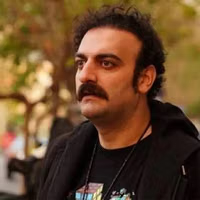
A former senior Iranian government official appeared before Canada’s Immigration and Refugee Board on Thursday as part of Ottawa’s ongoing efforts to remove top-ranking figures associated with the Islamic Republic, Canadian media reported.
Afshin Pirnoon, a former director general in Iran’s Ministry of Roads and Urban Development, was brought before the board as the Canada Border Services Agency (CBSA) argued he should be deported due to his role in the Iranian government.
Pirnoon, 49, arrived in Canada in 2022 and has since worked as an Uber driver while seeking refugee status.
Photos published on Iranian government websites show Pirnoon attending official events and speaking at public meetings alongside political and religious leaders. He has denied holding decision-making authority and said his work as a road safety expert was aimed at saving lives.
“Whatever I’ve done in my life so far was to safeguard human beings’ lives,” Pirnoon said at the hearing, according to Global News. “Working for a government does not mean supporting it.”
The hearing is one of several under a 2022 Canadian policy aimed at barring or expelling former Iranian officials accused of rights abuses or ties to groups such as Hamas and Hezbollah. While immigration authorities have investigated dozens of individuals, only one deportation has been completed so far, with others leaving voluntarily.
A senior Iranian nuclear official has responded to recent comments by US Secretary of State Marco Rubio, saying his statement about uranium enrichment was incorrect.
Behrouz Kamalvandi, deputy head of Iran’s Atomic Energy Organization, said that several countries enrich uranium without possessing nuclear weapons. “Countries like Belgium, the Netherlands, South Korea, Japan, Argentina, and Germany conduct uranium enrichment and do not have nuclear weapons,” he told Iranian media.
“It is unfortunate that the US secretary of state made such a statement without proper knowledge,” Kamalvandi said.
Rubio said last week, “The only countries in the world that enrich uranium are the ones that have nuclear weapons,” in remarks that drew criticism in Tehran.


Iran has issued its first drilling order in the Caspian Sea in nearly 30 years, aiming to revive long-stalled exploration in the region, Oil Minister Mohsen Paknejad said on Friday.
Paknejad said the new operations could unlock substantial reserves. “There is potential to extract over 600 million barrels of crude oil in place from this area,” he told reporters on the sidelines of the 29th International Oil Exhibition in Tehran.
Exploratory drilling in Iran’s sector of the Caspian Sea had been largely inactive since the mid-1990s, due to technical, financial, and logistical challenges.
The minister did not specify when drilling would begin or which block would be targeted first.
The decision marks a renewed effort to join other Caspian littoral states — including Russia, Azerbaijan, Kazakhstan, and Turkmenistan — that have developed significant offshore production in recent decades.
Iran remains the only Caspian country not currently extracting oil or gas from the sea. According to industry data, the region’s other coastal states collectively produced over 1.2 million barrels per day of oil and 50 billion cubic meters of gas in 2023, backed by more than $160 billion in cumulative investments.
International companies such as BP, TotalEnergies, Lukoil, Eni, and Dragon Oil have led offshore development in neighboring states. Meanwhile, Iran’s own efforts have faced repeated setbacks, including equipment failures, limited foreign investment, and deepwater technical constraints.
Despite previous announcements, including seismic surveys and attempted drillings using the Amir Kabir rig, Iran’s Caspian offshore activity has yielded no commercial output to date.

An Iranian graduate student detained for six weeks as part of the Trump administration’s immigration crackdown has decided to voluntarily leave the United States, even after the government dropped the initial charge that led to his arrest, the Associated Press reported on Friday.
Alireza Doroudi, a mechanical engineering student at the University of Alabama, was detained in March and held at a facility in Louisiana after his visa was revoked. A US government attorney later said the revocation was “prudential,” meaning it would not take effect until he left the country.
Doroudi’s lawyer, David Rozas, told AP there was no evidence to support the government’s earlier claim that Doroudi posed a national security risk. He called the case a “travesty of justice.”
Doroudi’s fiancée, Sama Ebrahimi Bajgani, said the prolonged detention left him feeling pressured to abandon his legal challenge. “They just want to make him tired so he can deport himself,” she told AP.
In a letter written from detention, Doroudi called the case “pure injustice” and said he had followed all legal procedures. The immigration judge in the case denied his request for bond and set a deadline at the end of May for further motions. Rozas said Doroudi chose to stop fighting and self-deport.
Doroudi had specialized in metallurgical engineering, and his detention sparked concern on campus. The University of Alabama College Democrats described the arrest as a “cold, vicious dagger through the heart of UA’s international community.”
Doroudi’s case comes amid renewed scrutiny of the Trump administration’s policies on international students, including potential new visa restrictions for citizens of countries like Iran. In recent weeks, several other foreign students and recent graduates — including individuals from Turkey and Palestine — have been detained under national security-related reasons, prompting concern from rights groups and legal advocates.
Iranian Parliament Speaker Mohammad Bagher Ghalibaf said on Friday that current diplomatic engagement is only possible because US President Donald Trump has retreated from earlier demands.
“Negotiations are taking place today only because the bully has backed down,” Ghalibaf said, according to state media.
“We can give up everything, but never our dignity,” he said, emphasizing that talks must be conducted with awareness.
Ghalibaf said Iran is not opposed to diplomacy, but stressed that negotiations must follow clear principles and not rely on trust in those who “change their words every day.”