Kayhan blasts Trump as 'an exceptionally destructive fool', vows no full nuclear rollback
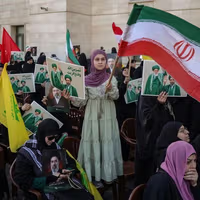
Iran’s ultra-hardline Kayhan newspaper on Saturday slammed US President Donald Trump as “an exceptionally destructive fool,” accusing him of pursuing reckless foreign policies and warning that Tehran will never agree to full nuclear disarmament.
The paper, which is run by a representative of Supreme Leader Ali Khamenei, said Trump’s efforts to reshape global politics could end in failure. “Even his fiercest critics may have to acknowledge his ambition,” Kayhan wrote, “but that same ambition could leave behind a world more unstable and dangerous than the one he inherited.”
In a stinging rebuke, the editorial added: “The title he gave Biden — ‘the worst and most incompetent president’ — may ironically become his own. He is, in the end, an exceptionally destructive fool.”
On Iran’s nuclear stance, the paper suggested limited flexibility: Tehran might agree to reduce uranium enrichment to a non-military level and allow independent verification. However, Kayhan made clear that “Iran will never submit to total nuclear disarmament.”
The comments follow US Secretary of State Marco Rubio’s warning on Thursday that Iran must end all enrichment and open its nuclear facilities to American inspectors or face serious consequences, including military action.
Republican Senator Ted Cruz said Friday that US President Donald Trump has made clear to Iran’s Supreme Leader there will be “no deal unless Iran dismantles its enrichment and centrifuges.”
The outspoken Iran hawk said in a post on X that Trump is reimposing maximum pressure and will not tolerate any agreement that leaves Iran’s nuclear infrastructure intact.
The Texas senator added that under Trump, Iran’s oil exports were heavily restricted, but those limits collapsed under President Joe Biden, allowing Tehran to expand its nuclear program while selling up to 2 million barrels per day.
A child's gas mask and a shoe are seen at a kindergarten in the abandoned city of Prypiat near the Chernobyl nuclear power plant, April 4, 2011.
The devastating port blast on Iran’s southern coast has prompted comparisons to the Chernobyl disaster, with some Iranian thinkers seeing echoes of the Soviet Union’s final days in their own country’s unraveling.
Like the explosion at the nuclear power plant in 1986, the deadly blast at Iran’s Bandar Abbas port—reportedly caused by missile fuel stored at a civilian facility—has become a symbol of decay, incompetence, and state secrecy.
Chernobyl ushered in political change and the collapse of Communism. Could this be the beginning of the end of the Islamic Republic?
Historical analogies are never perfect, but they are often revealing.
In the late 18th century, both Russia and Iran were backward agrarian societies ruled by monarchs, burdened by inequality, and haunted by their failures to modernize. Russia's army was a formidable force, but the empire still lagged behind Western Europeans in industry and capital accumulation.
By the mid 19th century, leftist and liberal movements had begun to emerge in Russia, aiming to abolish serfdom and challenge autocracy as part of a broader push for modernization. In Iran too, the educated few, often inspired by the west, were beginning to call for fundamental change.
In Russia, this quest culminated in the dual revolutions of 1917. In Iran, it led to the Constitutional Revolution of 1905 which brought Iranians partial representation but little material progress.
That began only with the rise of Reza Shah in 1925.
Reza Shah confronted the clergy and their medieval traditions' hold on Iranian society. He oversaw an extensive program of modernisation that continued under his son and transformed the country in many ways.
But without democratic development and under pressure from leftist and clerical opposition, Iran’s own “October Revolution” came in 1979.
As in Russia, Iran's post-revolutionary regime was anti-West. It was largely backed by pro-Soviet activists—most of whom were soon crushed by the religious camp while some quietly adapted and remained in the system.
Iranian Red Crescent rescuers work following an explosion at the Rajaei port in Bandar Abbas, Iran, April 27, 2025.
The Islamic Republic, like the Soviet Union, sidelined foreign capital, prioritized homegrown militarization, and sustained itself on repression and slogans. After almost half a century, the revolutionary fervor is gone, corruption is rampant, and the economy is wrecked with years of sanctions and mismanagement.
Could it be argued then that the Islamic Republic today stands at a similar crossroads to that of the Soviet Union in the late 1980s? I think not.
Yes, the theocracy is under enormous pressure from the United States and Israel. A clear majority reject the ruling ideology and want out, as evidenced by widespread protests and growing defiance of Islamic restrictions.
But the Soviet Union had reform-minded leadership.
By the 1980s, some Soviet leaders recognized the system’s failure."The only one truly believing in Communism at the time was chief ideologist Mikhail Suslov," the last leader of Armenia’s Communist Party, Karen Demirchian, told this author in 1999.
And at the very top stood Mikhail Gorbachev, who became General Secretary in 1985 and launched the reformist movement of Perestroika and Glasnost.
By contrast, Iran is ruled by an 85-year-old cleric, Ali Khamenei, who is no Gorbachev— and may even have a few lessons to teach Suslov in rigidity. Khamenei's security forces have shown no hesitation in shooting unarmed protesters.
Gorbachev could act because the Soviet Union was run by a monolithic party that controlled the state, the military, and the security services. No party apparatus rules in Iran. Power rests with one man who presides over a web of largely dysfunctional institutions, tied and surviving mainly by their will to repress.
The Soviet Union collapsed not by popular uprising, but with Gorbachev's top-down liberalization. No such campaign would be entertained let alone initiated by the leader of the Islamic Republic.
The explosion in Bandar Abbas may have shocked and angered Iranians, but it was no Chernobyl in scale—and it's unlikely to be a Chernobyl in impact. Khamenei has never been fond of reform. Until he’s gone, any 'Soviet moment' is more of a warning than a turning point.
Iran's foreign minister on Friday dismissed his American counterpart Marco Rubio's demand that Tehran halt all uranium enrichment, saying Tehran "has every right to possess the full nuclear fuel cycle as a founding signatory to the NPT."
Abbas Araghchi also warned the US that "maximalist positioning and incendiary rhetoric achieve nothing except eroding the chances of success."
"A credible and durable agreement is within reach. All it takes is firm political will and a fair attitude," he said.
In an apparent response to Rubio, Araghchi said that "there are several NPT members which enrich uranium while wholly rejecting nuclear weapons."
"Apart from Iran, this club includes several Asian, European, and South American nations," he added.
Rubio told Fox News on Thursday that “the only counties in the world that enrich uranium are the ones that have nuclear weapons.”
The UN nuclear watchdog said in March that Iran is only non-nuclear armed state enriching uranium to 60%. Several countries which do not possess nuclear weapons, including Japan, Brazil, Germany and the Netherlands, enrich uranium at lower levels.
President Masoud Pezeshkian’s campaigned on transparency, but his administration is presenting inflated and misleading data about Iran’s energy sector in an apparent bid to soothe public dissatisfaction with deepening blackouts.
In recent months, authorities have repeatedly cited sizeable increases in gasoline and natural gas production and some officials have even assured the public that this summer’s looming electricity shortfall will be resolved.
But a confidential document from the Oil Ministry obtained by Iran International shows these claims are not only inaccurate, but the country's energy shortages are in fact accelerating.
Iran currently suffers from year-round energy deficits. During peak demand season, electricity and natural gas shortages climb as high as 25%, while the gasoline shortfall reaches 30%.
With energy development projects stagnating, officials have turned to optimistic public messaging, using spurious statistics to suggest improvement that their own confidential data shows does not exist.
In late 2024, Mohammad-Sadegh Azimifar, CEO of the National Iranian Oil Products Distribution Company, said the country’s daily gasoline output had increased by 10 million liters, and diesel by 13 million liters over the past year.
However, a confidential internal report from the same company shows base gasoline production at Iranian refineries increased by only 1.5 million liters in late 2024 compared to the same period in 2023. Even for the entire year, the growth was just 3.5% or just 3.76 million liters per day.
Diesel output showed similarly modest growth—just 3% or 3.38 million liters per day for the year. Meanwhile, consumption of both fuels jumped by 7.5% in 2024, or 7 million liters per day, further deepening Iran’s fuel deficit.
Despite the absence of any new refineries in recent years, the government has continued to push over 1.5 million low-efficiency domestically manufactured vehicles into the market annually—adding more strain on fuel demand.
In 2024, Iran’s daily base gasoline production was around 101 million liters, while consumption topped 123 million liters.
Gasoline output lags consumption as additive use in fuels rises
Boosting additives
The government’s main strategy for managing this growing gap, according to the Oil Ministry report, has been to dilute refinery-grade gasoline with large volumes of substandard additives.
These additives include various chemical compounds, fuels from petrochemical plants, and the controversial chemical MTBE—a compound banned in many Western countries due to its environmental and health hazards—as well as industrial octane boosters.
While additive use stood at just 5 million liters per day or 6% of total gasoline in 2018, it now exceeds 20 million liters or over 20% of the fuel supply, raising serious concerns about air quality and public health.
The same confidential report also revealed that only one-quarter of gasoline produced in Iranian refineries meets European standards and even within that limited share it is not fully clear whether the fuels truly adhere to required specifications.
Gas production: claims versus reality
The head of South Pars Gas Complex recently announced a 6 billion cubic meter increase in gas fed into the national grid in the last fiscal year, ending on March 20. The South Pars field alone accounts for 73% of Iran’s natural gas supply.
Simultaneously, the CEO of the Iranian Central Oil Fields Company—which provides around 25% of the nation’s gas—said the company boosted production by 10 million cubic meters per day during the autumn and winter, equating to at least 2 billion cubic meters of annual growth.
Based on these statements, Iran should have increased its gas production by at least 8 billion cubic meters last year.
However, international institutions such as the International Energy Agency (IEA) and the Gas Exporting Countries Forum (GECF)—of which Iran is a member—have both estimated Iran's gas output growth at only around half that amount.
From 2010 to 2020, Iran enjoyed annual gas production growth rates above 5%. But from 2021 to 2024 the rate has fallen to around 2% on average. The IEA forecasts that in 2025, gas production will rise by just over 1%.
Iran must agree to end all uranium enrichment in a nuclear deal or be prepared to face attack, Republican Congressman Mike Lawler told Iran International's Eye for Iran podcast.
“Iran is not going to win this,” said Lawler during the podcast. “The sooner they come to that realization and acceptance, the better the outcome will be for everybody.”