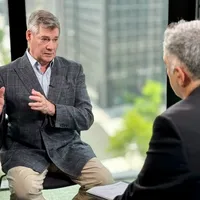
Iran must agree to end all uranium enrichment in a nuclear deal or be prepared to face attack, Republican Congressman Mike Lawler told Iran International's Eye for Iran podcast.
“Iran is not going to win this,” said Lawler during the podcast. “The sooner they come to that realization and acceptance, the better the outcome will be for everybody.”
The explosion on Saturday at Iran's Rajaei port was caused by a chemical fire that began in a shipping container, The Washington Post reported citing visual evidence and explosives experts.
The report cited a surveillance video first published on X showing a forklift driving into and out of a shipping container at the port when moments later flames appear inside the container followed by a large blast.
The report quoted Gareth Collett, a retired British Army Brigadier who specialized in counter-terrorist bomb disposal as saying that the video could “depict confined storage of an oxidizer.”
The incident was likely caused by a violent chemical reaction that resulted in a fire and led to the explosion, the report cited four unnamed explosive experts as saying.
The experts said the color of the smoke indicated that nitrate-containing compounds, or perchlorates, were present at the site of the explosion.
Three experts cited by The Post said perchlorates and some nitrates can be used for rocket fuel, but also have domestic uses in large quantities, like fertilizer.
Iran's president Masoud Pezeshkian in an event to mark May Day, Tehran, Iran, April 30, 2025
President Masoud Pezeshkian's government has yet to mount a defense to parliamentary motions aiming to impeach two of his ministers following the port blast that killed scores and injured more than a thousand people.
Hardline MPs have initiated a process that may result in Pezeshkian losing his energy minister Abbas Aliabadi and transport minister Farzaneh Sadeq, but the president has yet to enter the fray.
The inaction could be calculated, hoping that the impeachments calm a public angered by the tragic event and the lack of accountability. It could also deflect attention from the state entities involved in the port's operations which would otherwise take most of the heat for the apparent accident.
First to be named in the parliament was Sadeq, one of the very few female ministers in the history of Iran. She was to be held accountable for “oversight and inefficiency,” according to five MPs sponsoring the motion.
Calls to impeach Aliabadi gained traction shortly after. MPs blamed him for power outages that harmed households and industries. Surprisingly, some from the pro-Pezeshkian camp backed the motion.
“When a minister is weak, he must be replaced,” former presidential candidate Mostafa Hashemi Taba was quoted as saying by the moderate daily Arman-e Melli.
Another moderate outlet, Khabar Online, reported that hardliners in Iran's parliament—mainly from the ultraconservative Paydari Party—had been planning to remove both ministers since March, following the ousting of economy minister Abdolnasser Hemmati.
Back then, the administration didn't concede without a fight.
Officials and moderates outlets launched a campaign warning that impeachments would weaken the administration’s legitimacy, some even asserting cryptically that supreme leader Ali Khamenei viewed Pezeshkian's government as the Islamic Republic's last viable option and opposed destabilization.
Hardliners often submit multiple impeachment motions to increase the chances of at least one being approved for parliamentary debate.
Unofficial reports in Iranian media suggest Sadeq may be removed to show the government is responding to public demands.
Those with most power—and more likely to be culpable for the port blast—are expected to remain untouched: the Revolutionary Guards (IRGC), for example, or the Mostazafan Foundation, which operates under Khamenei’s office.
The IRGC likely imports weapons materials through the port, which a subsidiary of the foundation operates.
The motion to impeach Sadeq has over forty signatures to date, according to an official tally, which can be read as a sign of things to come as no more than ten is required to set off the proceedings against a minister.
Previous initiatives to impeach Sadeq fell short, according to unofficial reports in Tehran's media, because Pezeshkian had hinted in closed session that she was Khamenei’s preferred candidate.
This time, the only outlet to come out in support of the transport minister is Etemad, whose proprietor Elias Hazrati serves as the government’s public relations chief. The daily has framed the motion as a move against the government.
Pezeshkian or his team are yet to publicly defend the two embattled ministers. It is a rare silence, perhaps signaling their patience until an actual battle in the parliament if and when the impeachment takes place.
Mike Lawler, US representative for New York's 17th congressional district since 2023
Iran must agree to end all uranium enrichment in a nuclear deal or be prepared to face attack, Republican Congressman Mike Lawler told Eye for Iran.
“Iran is not going to win this,” said Lawler during the podcast. “The sooner they come to that realization and acceptance, the better the outcome will be for everybody.”
“If Iran doesn’t comply, then action will have to be taken,” he added.
Despite his hardline stance, Lawler supports diplomacy before war.
“It would be foolish not to try diplomacy first.” Invoking Reagan’s "trust but verify" adage, Lawler said diplomatic engagement was a tool to avoid war and not a sign of weakness.
Oil sanctions
The New York representative is one of the Congress's most vocal advocates of stepping up pressure on Tehran. He recently co-sponsored bipartisan legislation targeting China’s purchase of Iranian crude oil—part of a legislative package responding to Iran’s direct military attacks on Israel last year.
Lawler sees Iran’s oil trade—particularly with China—as the Islamic Republic's financial lifeline.
The Enhanced Iran Sanctions Act of 2025 targets Chinese purchases of Iranian crude oil and cracks down on facilitators like banks and insurers.
“They (Iran) have been the greatest sponsor of terrorism around the globe,” Lawler said. “Their funding stream comes in large measure from the petroleum industry and the illicit oil trade with China. China purchases the vast majority of Iranian petroleum—amounting to a $200 billion revenue increase under Joe Biden’s watch.”
Lawler praised Trump's current strategy, calling it "night and day" compared to that of his predecessor.
Separately on Thursday, President Donald Trump declared that all purchases of Iranian oil or petrochemical products must cease, warning that any buyers would be subject to secondary sanctions. “They will not be allowed to do business with the United States of America in any way, shape, or form,” Trump posted on Truth Social.
Timing of talks is justified
Lawler also rejected criticism from some Iran hawks that the Trump administration is negotiating too early and giving away leverage.
With Iran’s nuclear capabilities more advanced than in years past, he said the urgency is warranted.
“We’re in a different world. Iran is further along today than they were four years ago or eight years ago,” he told Eye for Iran. “So I don’t know how much longer people want to wait.”
That urgency, however, now faces a new obstacle. The fourth round of US-Iran nuclear talks, initially scheduled for May 3 in Rome, has been postponed for reasons still unknown.
Lawler, who represents a district with a significant Persian community, said many of his Iranian-American constituents support a tougher US stance.
Journalist Mansoureh Ghadiri was stabbed and bludgeoned to death by her husband in Tehran in November 2024
Iran's government has announced the withdrawal of a critical draft law on violence against women from parliament after hardliners watered it down, dealing a new setback to women's rights in the theocracy.
The bill—originally proposed by former President Hassan Rouhani’s administration—was intended to strengthen protections for women by increasing penalties for physical abuse and providing support services for victims.
But modifications by hardline lawmakers have significantly altered the bill’s core principles, leading the government to abandon the effort.
Hardline lawmakers replaced the term “violence” with “ill-behavior” throughout the draft bill and its title from “Safeguarding Women’s Dignity and Protecting them Against Violence” to “Safeguarding Women’s Dignity and Supporting Women and Families”.
Unlike the original bill, the revised version does not propose increased penalties for a broad range of injuries inflicted on women—such as cuts, bruises, or other forms of bodily harm but only limits harsher punishments to cases involving dismemberment.
“We requested the draft bill to be withdrawn when we realized that (parliamentary committees) had changed the character and substance of the draft bill," Zahra Behrouz-Azar, President Masoud Pezeshkian’s Women’s Affairs Deputy.
"It no longer addresses prevention (of violence),” she told reporters on the sidelines of a cabinet meeting on Thursday.
Despite the government's decision, the hardline-dominated Parliament is likely to move ahead with its own version of the law, the chair of the Parliament’s Social Committee Zohrehsadat Lajevardi has indicated.
The draft bill now mandates the Ministry of Higher Education to create separate classrooms, study spaces, and even universities exclusively for women when the original draft called for interdisciplinary research programs and academic courses on violence prevention as well as to establish counseling centers for victims.
“One cannot expect support for women from a parliament that has approved an oppressive hijab law," Iranian journalist Mina Emamverdi argued in a post on X. "The functional incongruity is a sign of the lack of a structural understanding of gender-based violence.”
A glaring example is a law that exempts fathers – who legally own the right to the “blood” of their offspring – from the death penalty if they kill them. Another law allows a father to pardon his children’s killers, for the same reason, if he so chooses.
Such provisions have led to lenient sentences in many so-called honor killing cases.
In a particularly tragic case in February 2022, Mona Heydari, a 17-year-old mother of three, was beheaded by her husband in Ahvaz in southwestern Iran. The victim’s father had helped the husband, his nephew, to bring his daughter back from Turkey where she had fled after being refused a divorce.
Pardoned by the victim’s father, the husband who had proudly paraded her severed head on the street was sentenced to slightly over eight years in prison.
“The lack of deterrent laws, legal loopholes, and the father's escape from punishment make domestic violence a modest crime,” Iranian journalist Samira Rahi commented about the recent killing of an 18-year-old girl, Fatemeh Soltani, by her father in a post on X.
The young woman had allegedly revealed her father’s infidelity to her mother, also a victim of domestic violence.
Under current laws, the father could face a maximum of ten years in prison.
Long journey of the proposed bill
The fourteen-year delay in presentation of the bill, first proposed by former President Mahmoud Ahmadinejad’s administration and finally submitted to the Parliament by Rouhani’s government in 2021, reflects the broader tensions between maintaining cultural and religious norms and protecting women’s rights.
Iran’s Supreme Leader, Ali Khamenei, weighed in on the issue in 2017. While condemning violence against women, he warned that government and parliament officials should be careful not to follow Western values in such matters.
“(Saying) it is violence if a father interferes in a daughter’s marriage (by not allowing it), for example … What is violence and what is not violence should not be learned from the West; it should be understood from our own rational logic, from our own Islamic belief.”
These, Rahman said, included a lack of comprehensive definitions of various forms of abuse such as psychological and economic violence and exclusion of marital rape and child marriage.
Rahman also warned over a provision requiring a period of mandatory mediation in domestic violence cases which could place victims in even greater danger before action was taken against alleged perpetrators.
France, Britain and Germany (the E3) will reimpose sanctions on Iran if it does not abide by its commitments under a 2015 nuclear deal with world powers, Al-Hadath reported citing a French official.
"Reimposing sanctions on Iran would not be blackmail but rather the implementation of an agreement," the official was quoted as saying.
The official said "time is pressing for all parties as the 2015 agreement nears its expiration in October. There is now an urgent need for a new agreement with Iran."