Waltz says US waiting for Iran to return to negotiating table
"You heard Secretary Hegseth say Iran needs to wake up. Iran needs to get the message that it can be a responsible country. The president of the United States wants peace, he's ready to make a deal, and that it cannot have a nuclear weapon," national security adviser Mike Waltz said in an interview with Fox News.
"Not only can it not have a nuclear weapon, it cannot provide funding, resources, missiles and assistance to a terrorist organization that is attacking international shipping, attacking United States assets, shooting at our planes. Enough is enough, and the President has been loud and clear."
"We sincerely hope Iran receives that message, and again, our great ambassador Witkoff is waiting for them to come back to the table."
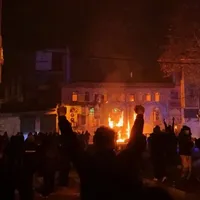
More than 1,100 people were rescued within hours of the explosion and fire at Rajaei port in Bandar Abbas, said Iran’s Red Crescent chief on Thursday. Over 340 rescue workers and specialists were deployed immediately after the blast, Pir Hossein Kolivand told reporters.
“Only 30 people remain hospitalized,” he said, adding that there were no reports of theft or security breaches at the site.
The editor of Iran’s ultra-hardline Kayhan newspaper, Hossein Shariatmadari, criticized Iranian negotiators for taking seriously European threats to trigger UN snapback sanctions, saying the 2015 nuclear deal is no longer valid.
In an editorial published Thursday, Shariatmadari wrote, “Is there even a JCPOA left for the snapback mechanism to apply to?” He added, “Europe has no independence and is once again playing the role of ‘bad cop’ to deceive us.”
Shariatmadari, whose paper is managed under the supervision of the Supreme Leader’s office, argued that the Joint Comprehensive Plan of Action (JCPOA) lost legal standing after the US withdrawal in 2018, and that the European troika’s latest threat was “empty.”
His comments came after France’s foreign minister warned that Paris could initiate the snapback process if talks with Iran fail to address European security concerns.
A Tehran MP has accused entrenched corruption of derailing efforts to install X-ray scanners at Iran’s ports, warning that the absence of basic security measures has left the country exposed. “There’s a power struggle over which company gets the contract,” said Morteza Mahmoudi, who visited Bandar Rajaei after a devastating fire engulfed thousands of containers.
Mahmoudi said rent-seeking interests have blocked the purchase of screening equipment critical to national safety. “This is tied to the country’s security, but it’s being sabotaged by behind-the-scenes power games,” he added.
The MP said that at the time of the explosion, over 3,600 containers were piled at the site, with 2,000 of them catching fire. He blamed negligence, poor oversight, and lack of non-military defense planning for the disaster.
A picture showing former Syrian President Bashar al-Assad meeting with Iran's Supreme Leader Ali Khamenei, lies at a hotel used by Iranians under former Syrian President Bashar al-Assad's regime, near the Sayyida Zaynab shrine, in Damascus, Syria, December 14, 2024.
Iran’s multi-billion-dollar bid to rebuild postwar Syria and cement long-term influence has collapsed following the ouster of President Bashar al-Assad, according to documents obtained by Reuters from Tehran’s ransacked embassy in Damascus.
Modeled on the US Marshall Plan that helped rebuild post-WWII Europe, Tehran’s strategy sought to create political and economic dependency through reconstruction projects, religious diplomacy, and trade.
A 33-page Iranian policy study found in the looted embassy explicitly referenced America’s postwar blueprint, describing Syria as a "$400 billion opportunity" for Iran.
Instead, with Assad deposed by rebel forces in December and exiled to Russia, Iran’s assets in Syria were swiftly dismantled. Embassies were looted, paramilitaries withdrawn, and dozens of projects—including power plants, religious sites, and railways—abandoned.
Pieces of shredded documents are scattered on the floor of the Iranian embassy in Damascus, Syria, December 16, 2024.
Reuters reporters uncovered contracts, correspondence, and financial records showing Iran’s deep economic footprint and how it unraveled amid Western airstrikes, corruption, and internal mismanagement. The news agency used artificial intelligence tools to analyze nearly 2,000 documents.
One key project, a €411 million Latakia power plant built by Iran’s Mapna Group, remains half-finished. Other efforts, such as an oil venture in eastern Syria and a $26 million Euphrates rail bridge, were destroyed or halted. At least $178 million in unpaid debts to Iranian firms remain, though estimates of total losses exceed $30 billion.
The collapse comes as Iran faces regional setbacks, including heavy losses among its allies Hezbollah and Hamas, and growing diplomatic pressure from the US.
An exterior view of the abandoned Iranian embassy in Damascus, Syria, December 16, 2024.
“The Syrian people have a wound caused by Iran, and we need a lot of time to heal,” said new Syrian President Ahmed al-Sharaa, a former rebel leader, in an interview.
Iran’s foreign ministry declined to comment. Many Iranian officials involved, including Revolutionary Guard commander Abbas Akbari, did not respond to Reuters' inquiries.
For Syrians who worked on Iran-backed projects, the exit is bittersweet. “Iran was here, that was just the reality, and I made a living from it for a while,” said a Syrian engineer who worked on the stalled Latakia project.
A picture of Iran's Supreme Leader Ali Khamenei hangs on a wall in the Sayyida Zaynab neighborhood, in Damascus, Syria, December 14, 2024.
Seventy people injured in the Rajaei port explosion remain under medical care in Bandar Abbas, with five others transferred to Shiraz for advanced burn treatment, a senior health official said on Thursday.
“Two to three patients are in intensive care and the condition of most others is stable,” said Sajjad Razavi, deputy health minister for treatment. He added that three of those moved to Shiraz are in critical condition.
Razavi noted that a public response averted a blood shortage. “There was readiness to send 800 units from Tehran, but local donations met the need,” he said.