IRGC cleric says enemies seek to disarm Iran but forces are ready
A senior Iranian cleric said Wednesday that Iran’s adversaries are trying to weaken the country by pushing for its disarmament, but that its armed forces remain fully prepared to respond to any threat, state media reported.
“Enemies seek to disarm us,” said Abdollah Hajji Sadeghi, Supreme Leader Ali Khamenei’s representative in the Islamic Revolutionary Guard Corps (IRGC). “But to their dismay, our missile, drone, and conventional forces are at the peak of readiness.”
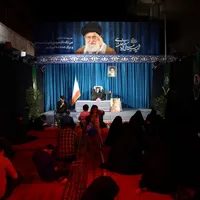
Speaking at a military ceremony in Tehran, Hajji Sadeghi said Iran’s military, including the IRGC and Basij militia, was prepared to respond with force if ordered. “If a command is issued, our response will leave the enemy deeply regretful,” he said, according to IRNA.
A senior Iranian lawmaker cautioned European nations on Wednesday that Tehran would take retaliatory measures if its interests are disregarded in ongoing nuclear negotiations.
"If Europe ignores Iran's interests, we will make decisions that will harm them," said Alaeddin Boroujerdi, a member of the Iranian parliament's National Security and Foreign Policy Commission, as reported by state media.
Boroujerdi criticized European countries for what he described as a passive role in the indirect talks between Iran and the United States concerning Tehran's nuclear program. He expressed particular concern over recent statements from French officials advocating for the activation of the "snapback" mechanism, which could reinstate United Nations sanctions on Iran.
"Europe's inaction and France's remarks about reimposing sanctions lack logic," Boroujerdi said. "We have adhered to international regulations and are advancing our nuclear program based on global treaties and the principles of the International Atomic Energy Agency."
The lawmaker also suggested that the United States may prefer to exclude European involvement in the negotiations. "I don't believe America is keen on Europe's direct participation in the talks, as their proposal was for bilateral discussions," he added.
Iran is scheduled to meet with the European parties to the 2015 nuclear deal—Britain, France, and Germany—in Rome on Friday, ahead of a new round of US-Iranian negotiations set for Saturday.
France warned on Monday that it would reimpose sanctions on Iran if European security interests were not guaranteed under the expiring nuclear deal.
The 2015 Joint Comprehensive Plan of Action (JCPOA) aimed to limit Iran's nuclear activities in exchange for sanctions relief. However, the agreement has been under strain since the United States withdrew from it in 2018, leading to renewed tensions and ongoing diplomatic efforts to reach a new deal.
Operations at Rajaei port have resumed after the explosion, said Iran’s Deputy Roads Minister Saeed Rasouli, insisting the damage was confined to a 15-hectare area of the container yard.
“So far, 26 ships have docked, and maritime activities are ongoing without interruption,” he added.
Rasouli said the rest of the 2,400-hectare facility remains intact and that only part of a 4,000-container stockpile was affected by fire. Investigations into the contents of the containers are ongoing, he said.
The head of Bandar Abbas’s medical council warned that some victims of the explosion at Rajaei Port may still face life-threatening complications despite being discharged from hospitals.
“Some injured individuals may have left with prescriptions for CT scans or specialist tests, but these essential steps must be followed up,” Hossein Karampour told IRNA.
He said internal bleeding, brain trauma, or chemical inhalation injuries may not appear immediately but could prove fatal. Karampour, a radiologist, also cautioned about toxic gas exposure symptoms emerging up to two weeks later and urged tetanus vaccination for the wounded.
Former Iranian Foreign Minister Mohammad Javad Zarif said Thursday that Iran will no longer tolerate attacks without retaliation, declaring that “the era of hit and run is over,” according to the Iranian Students’ News Agency (ISNA).
Speaking at a Persian Gulf Day event in Tehran, Zarif pointed to Iran’s missile strike on a US base following the 2020 killing of Quds Force commander Qassem Soleimani, as well as recent strikes on Israel, as signs of a new deterrent stance.
“We are the only country that launched missiles at a US base after being attacked,” Zarif said. “Israel attacked us, and we hit back… If our missiles had hit populated areas, you’d have seen what Iran is capable of.”
Zarif also referenced the recent explosion at the Shahid Rajaei port, offering condolences to the victims’ families and saying “all of Iran is mourning Bandar Abbas.”
He said Iran has developed “an internal capacity to defend national security” and rejected claims that the country has grown weaker. “We paid a high price for where we are today,” he said, expressing gratitude to war veterans, martyrs, and Iranian leaders.
Former Iranian Foreign Minister Mohammad Javad Zarif speaks at a Persian Gulf commemoration event in Tehran, May 1, 2025.
Nobel laureate Shirin Ebadi said workers are the “first victims of inhumane policies,” condemning Iranian authorities in a message marking International Workers’ Day.
Referring to the explosion at Rajaei Port in Bandar Abbas, Ebadi wrote that more than five days have passed since the explosion in Bandar Abbas, but more than 20 of the victims have still not been identified. “Dozens of families, in anguish and uncertainty, are shouting a bitter truth,” she said.
Ebadi urged solidarity among workers, teachers, retirees, and students as “the key to change.”