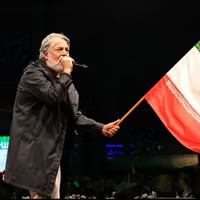
Only toppling Islamic Republic can solve nuclear issue, Swedish MP says
Alireza Akhondi, a member of the Swedish parliament of Iranian heritage, says only the overthrow of the Islamic Republic establishment can prevent a nuclear disaster, criticizing the ongoing US-Iran negotiations.
"There is no diplomatic or military solution to the Iranian nuclear issue, only toppling the regime will prevent disaster,"Akhondisaid speaking to Israeli media during a public visit to Israel.
He expressed concern that a potential deal between the Trump administration and Iran would undermine efforts to weaken the Islamic Republic.
"They are at their weakest point during the 46 years since the Islamic Revolution," Akhondi said, adding that "any deal will set back two and a half years of my work to weaken the Islamic Republic."
"Any kind of deal is a threat," he said, arguing that even a comprehensive agreement dismantling Iran's nuclear infrastructure would be insufficient.
Akhondi, who was born in Iran and immigrated to Sweden as a child, criticized what he called the US envoy's inexperience and suggested that Iran and Russia were exploiting his lack of expertise.
“To be honest, I’m upset that they used an amateur like Witkoff as a negotiator. The Islamic Republic demanded that it not be Marco Rubio, but Witkoff. Russia demanded him, too. It’s the same strategy. Why? Because it’s easy to play with him. He has no experience in such sensitive geopolitical issues,” Akhondi said.
Alireza Akhondi, a Swedish-Iranian member of the Swedish Parliament
Conservative leader Pierre Poilievre is hoping to beat Liberal leader Mark Carney to become Canada's next prime minister
Pierre Poilievre, a contender to become Canada’s next prime minister, has vowed to purge the country of “IRGC thugs” who, he says, feast on “stolen money from the Iranian people.” If elected on Monday, will he—or can he—deliver?
Poilievre asserted recently that about 700 operatives and affiliates of the Islamic Revolutionary Guard Corps (IRGC), which Canada has designated as a terrorist entity, must be tracked down and expelled.
But this was nothing new. He had expressed similar views in many speeches and interviews before. So what is different this time? How could rhetoric translate into action beyond gestural politics, built on a tenuous perception of Canada’s strategic leverage?
Poilievre and his caucus appear to have presumed that IRGC operatives would vanish the moment Canada listed the group.
Last June, when reports broke hours before the announcement, they erupted in a frenzy, lamenting the leak as if operatives were standing by the door moving assets in anticipation. Yet once the dust settled, everyone returned to their routines, leaving the world undisturbed.
With bells tolling for the Liberals after a lost decade, and the Conservatives hoping to be incoming sheriffs, they must face a deeper reality. Tehran’s reach is not a statistic but a network resistant to rhetoric. Something beyond grandstanding is inevitable.
The Myth of 700
First, one must ask: where did the 700 figure originate?
It came from an independent effort by a coalition named Stop IRGC, aimed at identifying those affiliated with the Islamic Republic who settled in Canada through legal channels. While notable, it was not government-backed and lacked security resources for verification. No intelligence assessment, inquiry, or briefing has substantiated it.
Poilievre nonetheless repeated it as fact, reducing complexity to a tally shaped by partisan urgency.
Mahmoudreza Khavari, senior Iranian official in Tehran (left) and Canada
I do not, for a second, believe the IRGC’s presence ends there. Years of inaction have turned lingering suspicion into undeniable reality. Activists, whether living in Canada or passing through, must now calculate their security risks.
Nor did operatives scramble to flee upon the listing. For Tehran’s fortune-brokers, Canada was never an obstacle. Even when the Conservative government had a chance over a decade ago to act against Mahmoud-Reza Khavari—a top Iranian banker who financed the IRGC’s missile program, embezzled billions, and fled to Canada—it turned a blind eye.
The regime and its IRGC presence are the product of sustained drift, allowing influence to fester across levels and seep into corners.
Beyond numbers: a real plan
Poilievre and his allies must recognize that strategy cannot rest on recital. A committed resolve is the only way to dismantle the IRGC’s hold. The Liberals never had one; when superficial action was taken, it collapsed under contradictions, punishing the wrong people.
A two-pronged strategy, I propose, is required to deal with the problem. First, focus on critical entities: IRGC and Basij members, operatives posing as civilians, financial networks, propaganda arms, and regime-linked organizations. Second, avoid actions that unjustly impact innocents.
A real strategy recognizes that IRGC operatives do not arrive in bloodstained green uniforms. They come as businessmen, investors, and tourists, traveling freely from the land they loot to the land where they hoard.
Any action has to hinge on the recognition that the IRGC and the Iranian state are one—indistinguishable in form, inseparable in purpose.
It is alarming that last December, an IRGC-affiliated news agency boasted of a “private sector” bypassing sanctions, especially in Canada. Individuals from a Canadian-registered nonprofit were interviewed on “innovative solutions” to do so.
This same group hosts webinars on exporting oil, gas, and petrochemical products, claiming collaboration with Iran’s Ministry of Industry—whose officials are sanctioned and banned from entering Canada for human rights violations.
Collaboration with entities sustaining the power structure of the Islamic Republic cannot be permitted under the pretense of legitimacy. Targeting the theocracy means little if you enable the institutions that sustain it.
Tehran’s playbook has long capitalized on Canada’s strategic vulnerability. The story is not about mythical figures who once slipped through. It is about a decades-old infiltration campaign that has unsettled our foundations from within.
Has Poilievre assigned the color of his cards before the real test calls?
Poilievre’s true test
If the Conservatives take power, let them not chase ghosts. Let them identify a handful of real, high-profile regime and IRGC operatives, transparently held accountable in full view of the public. That alone would shake Canada’s quiet standing as a sanctuary for tyranny’s enforcers more than any grand arithmetic of slogans.
The duplicity of senior Iranian officials in Canada offers a case study in calculated deceit—silencing hearings, disclaiming crimes, vanishing when accountability nears. Sadly, even rare breakthroughs fade under a Liberal establishment where secrecy lingers and accountability bends.
For any future leadership to set a real precedent, groundwork must begin before power is seized. Not hours before a designation. Not weeks into a mandate.
As a powerful voting bloc, the Iranian-Canadian community appears to be moving towards the Conservatives to turn the page on staged politics. For years, those in charge sold them a political vaudeville called a pie in the sky on Canada’s political Broadway.
If Poilievre plans to peddle another ticket to the same tired show, he should know: not a single seat will be sold. No more.
An Iranian newspaper close to parliament speaker Mohammad Bagher Ghalibafsaid that the recent explosion at the Rajaei port in southern Iran might be a deliberate act to undermine ongoing negotiations with the United States.
In an editorial, Sobh-e No daily said that while the cause of the large blast remains officially undetermined, the timing of the incident alongside nuclear talks and threatening rhetoric from Israel warranted consideration of potential sabotage aimed at derailing diplomatic progress.
"The swift news reporting by foreign media and the creation of rumors regarding the containers that caught fire is the same scenario of disrupting the negotiation atmosphere by the Zionist regime,” read the article.
The newspaper highlighted a prior warning from Foreign Minister Abbas Araghchi, who tweeted two days before the explosion about potential disruptive actions by Israel against the Iran-US nuclear diplomacy. Araghchi had said that Iranian security forces were on high alert for potential sabotage and assassination attempts.
“Considering the political aspects of this incident, the economic sensitivity of this port, and the history of attacks on nuclear facilities, the possibility of sabotage cannot be ignored; just as the possibility of negligence and a natural accident also exists."
Containers burning at Rajaei port, Bandar Abbas (April 2025)
Negotiations between Iran and the United States over Tehran's rapidly advancing nuclear program will move to the expert level on Wednesday, a development analysts suggest indicates the talks are progressing swiftly, according to an Associated Press opinion.
However, experts not directly involved in the discussions cautioned the AP that this step does not necessarily mean a deal is on the horizon. Instead, it shows that the initial high-level discussions between Iranian Foreign Minister Abbas Araghchi and US Mideast envoy Steve Witkoff have not collapsed over the core issue: Tehran limiting its atomic program in exchange for the lifting of economic sanctions.
Kelsey Davenport, the director for nonproliferation policy at the Arms Control Association, told the AP that "agreeing to technical talks suggests both sides are expressing pragmatic, realistic objectives for the negotiations and want to explore the details." She added that Iran would likely not engage at the technical level if Washington presented maximalist demands like the dismantling of its enrichment program.
Richard Nephew, an adjunct fellow at the Washington Institute for Near East Policy, who previously worked on Iran sanctions at the US State Department, told the AP that the value of expert talks hinges on an existing commitment to do something, with experts tasked with determining the specifics. Without such political agreement, he warned, the expert discussions could be unproductive.
The AP opinion also talked about the crucial role of technical experts in the 2015 nuclear deal, citing the understanding reached between then-US Energy Secretary Ernest Moniz and Ali Akbar Salehi of the Atomic Energy Organization of Iran.
(From left) Former US Secretary of Energy Ernest Moniz, former US Secretary of State John Kerry, former Iranian Foreign Minister Mohammad Javad Zarif and Ali Akbar Salehi, former head of Iran’s Atomic Energy Organization
The United States has positioned two aircraft carriers and a fleet of B-2 stealth bombers in the region near Iran, indicating potential military readiness amid ongoing nuclear negotiations, according to a Fox News opinion piece by Dr. Rebecca Grant, vice president of the Lexington Institute, a US-based think tank focused on defense and logistics.
“Two aircraft carriers and a fleet of B-2 stealth bombers are pointed straight at Iran,” Grant wrote. “Never before have we seen such a big forward deployment of B-2 bombers.”
She argued that a campaign to target Iran’s nuclear weapons program is “no longer far-fetched,” citing Israeli airstrikes in 2024 as having lowered the political and military risks of such an operation. “Frankly, the attacks on Iran’s air defenses carried out by Israeli F-35s and other planes last year have lowered the risk calculus,” she said.
Grant linked the deployment to President Donald Trump’s broader diplomatic strategy ahead of talks with Iran. “To keep the talks going, a big part of Trump’s strategy is to deploy to US Central Command the forces required to smash Iran’s nuclear weapons manufacturing capability,” she wrote.
The op-ed said that the United States can act unilaterally if needed. “The military calls this ‘sovereign options,’ because Trump needs no other country’s permission to launch strikes from aircraft carriers and bombers,” she said.
According to Grant, the deployment of six B-2 bombers to Diego Garcia—capable of delivering 30,000-lb. bunker-busting bombs—suggests planning for sustained precision strikes on Iran’s underground facilities.
The Islamic Republic is compelled to yield to demands made by the United States in ongoing negotiations primarily because the US retains the option of military action, according to Jalil Roshandel, a professor of international relations.
Roshandel told Iran International that the goals in the talks see Tehran seeking relief from sanctions and financial difficulties, while Washington aims to strip Iran of any military capability.
Roshandel said that “the potential for a US military strike always exists over the Islamic Republic's head," serving as an enforcement mechanism for US demands."It is for this reason that the Islamic Republic is forced to submit to America's demands.”