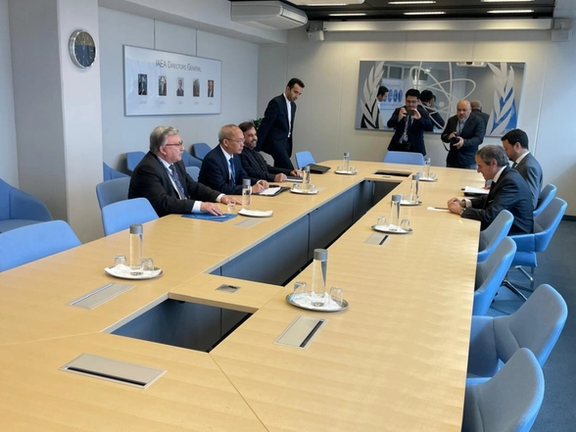
Envoys from Iran, Russia, and China met with Rafael Grossi, Director General of the International Atomic Energy Agency (IAEA), to discuss the agency’s role in ongoing diplomatic efforts related to Iran’s nuclear program, Iran's state media reported on Thursday.
Reza Najafi, Iran’s representative to the United Nations office in Vienna, joined his Russian and Chinese counterparts in delivering a joint note to Grossi outlining their positions on the current state of Iran’s nuclear activities.
"Today the Permanent Representatives of China, Iran and Russia delivered to the IAEA Director General a joint Aide- memoire on various aspects of the situation around the Iranian nuclear programme," Mikhail Ulyanov, permanent representative of Russia to international organisations in Vienna,wrote on X on Thursday.
The parties stressed the importance of dialogue and encouraged the IAEA to maintain a professional and constructive role in support of diplomatic progress, according to Mehr News.
A senior Iranian lawmaker said on Thursday that the Supreme Leader has expressed support for the country’s nuclear negotiating team, urging all branches of the state and the public to back their efforts as talks with the United States continue.
Valiollah Bayati, spokesperson for the Iranian parliament’s Internal Affairs and Councils Committee, said: “The leader has emphasized the need to support the negotiating team, and given this backing, all elements of the system and the people must also support them.”
Bayati added that “the team has so far been able to conduct the talks well, and the process has been satisfactory and in full coordination with the Supreme National Security Council.”
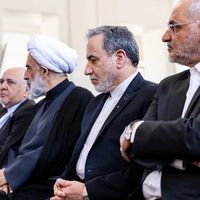
Iran's Supreme Leader has approved the foreign minister and commander of the Revolutionary Guard’s extraterritorial force joining the board of trustees of the country’s main war heritage foundation, signaling deeper integration of foreign policy and regional military strategy.
The appointments were made to the board of the "Foundation for the Preservation and Publication of Sacred Defense Values," which oversees efforts to commemorate Iran’s eight-year war with Iraq in the 1980s.
In a separate decision, the foundation’s name has officially been changed to include the term “Resistance.”
The change was proposed by the board and approved by Ali Khamenei, reflecting Iran’s broader framing of its support for regional armed groups known as Iran's 'axis of resistance'.
The Quds Force is responsible for the IRGC’s overseas operations, and its inclusion alongside the foreign ministry signals a deeper institutional integration of Iran’s foreign policy and regional military strategy with the country’s war-time legacy narrative.
The foundation plays a prominent role in shaping public opinion and political discourse around what Iran refers to as the "Sacred Defense," a term used to describe the Iran-Iraq war (1980–1988).
Its activities often glorify martyrdom and stress the importance of ideological continuity, a concept which has been greatly challenged since the 2022 uprising when the Iranian government has faced its lowest levels of support since the founding of the Islamic Republic in 1979.
Enforcing Iran's new hijab law is the top priority for the parliamentary cultural committee, its spokesperson said as authorities come under mounting conservative pressure to implement legislation expanding surveillance and penalties.
“A group of devout citizens has a rightful demand, and that is the enforcement of the hijab law — a demand that holds value for the Islamic system,” said spokesman Ahmad Rastineh on Thursday.
The law was passed by parliament in September 2023 but is yet to be fully enforced as the government tries to avoid mass backlash. It mandates harsh penalties for women and girls who defy compulsory veiling and has been branded by the UN as amounting to gender apartheid.
Punishments under the strict new law include travel bans, social media restrictions, prison sentences, lashes, and fines. It also criminalizes promoting hijab resistance.
The legislation was introduced following mass protests triggered by the death of Mahsa Amini in police custody in 2022 which led to nationwide hijab rebellion and a loss of control by authorities.
Although the law’s enforcement was postponed in December following public outcry and international pressure, calls for its immediate implementation have intensified.
Last month, a group of pro-hijab activists staged a sit-in outside parliament, demanding the law be enacted. The protest, which coincided with Quds Day, was dispersed by police on the grounds that it lacked official authorization.
As measures to enforce hijab continue, a recent cooperation agreement was signed between Iran’s police and the education ministry which has sparked outrage from teachers’ unions.
Critics say the deal, which allows police input on school policies, could militarize schools and enforce hijab compliance among students.
“Teachers across the country will not allow schools to be turned into military barracks,” said the Iranian Teachers' Trade Association.
“This is a degrading and alarming stance,” added Mohammad Habibi, the group’s spokesman, accusing the education minister of surrendering the civilian space of education to security forces.
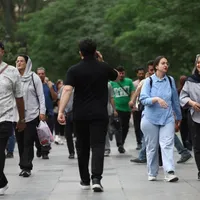
Many women around the country now openly reject the compulsory headscarf, long tunics, and trousers mandated by Iran’s Shariah law. Acts of defiance have become increasingly visible, with women frequently seen unveiled, singing, and dancing in public as a challenge to the religious establishment.
The head of the UN nuclear watchdog voiced concern over Iran’s failure to clarify construction activity near its Natanz nuclear site, where satellite images appear to show a new, deeply buried tunnel next to an older one, along with a newly built security perimeter.
The images were released this week by the Institute for Science and International Security (ISIS), a US think tank, which suggested the site may be part of Iran’s expanding underground nuclear infrastructure.
Rafael Grossi, speaking in Washington after a recent visit to Tehran, said the International Atomic Energy Agency (IAEA) has asked Iran to explain the construction, but has not received a satisfactory response.
“We’re asking them, what is this for? They are telling us, it’s none of your business,” Grossi said on Wednesday, noting Iran’s position is “unique in the world” in not providing prior information on such developments.
While he said it “cannot be excluded” that the site could be used to store undeclared nuclear material, Grossi stressed the agency’s focus is on continued dialogue.
He confirmed that an IAEA technical team will travel to Tehran in the coming days to follow up on his visit and discuss reinstallation of monitoring equipment.
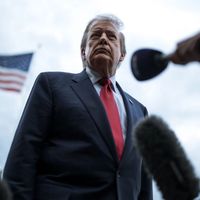
Grossi also commented on renewed diplomatic engagement between Iran and the United States, expressing hope for progress. “There’s a general expectation that this goes well and that the agreement is verified by the IAEA,” he said.
Germany’s foreign ministry told Iran International that it welcomes the ongoing dialogue between the United States and Iran.
It said the US and the three European countries – France, Germany, and the United Kingdom (E3) – share a common goal of preventing Iran from developing or acquiring nuclear weapons.
“As the E3, we are in close contact with both the United States and Iran on this matter,” the ministry added.