Iran would already have built an atomic bomb if not for Israel: Netanyahu


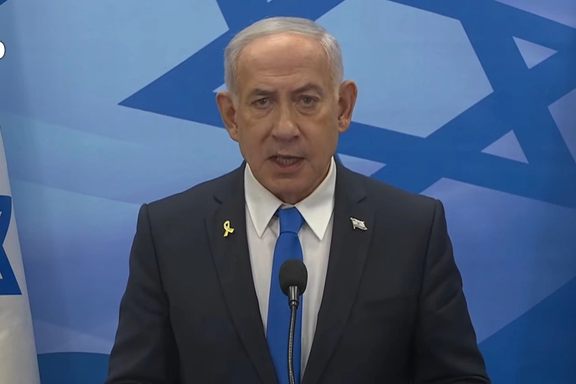
Prime Minister Benjamin Netanyahu said he remains firmly committed to preventing Iran from obtaining a nuclear weapon, warning that without Israel’s past actions, Tehran would already be nuclear-armed.
“I am committed to preventing Iran from acquiring a nuclear weapon. I am not giving up on that, I am not letting go of it, and I am not backing away from it. Not even by a millimeter,” Netanyahu said in a public address Saturday.
He defended his record on Iran’s nuclear program, saying critics of his approach had opposed operations that delayed Iran’s progress. “Without those actions, Iran would already have had a nuclear weapon ten years ago,” he said.

Iran’s Foreign Minister Abbas Araghchi said on Saturday it was made clear during the second round of talks with the United States in Rome that many in Iran no longer view the 2015 nuclear deal, known as the JCPOA, as sufficient, and he agrees with that.
“We made clear how many in Iran believe that the JCPOA is no longer good enough for us,” Araghchi wrote on X.

The JCPOA was a multilateral agreement signed between Iran and six world powers to curb Tehran’s nuclear program in exchange for sanctions relief. The United States withdrew from the deal in 2018 under President Donald Trump.
“To them, what is left from that deal are ‘lessons learned.’ Personally, I tend to agree,” he added.
Araghchi described the atmosphere in Rome as “relatively positive” and said it enabled progress on the principles and objectives of a possible deal.
"For now, optimism may be warranted but only with a great deal of caution," he said.
Israel has the capability to carry out a military strike on Iran’s nuclear facilities and must be prepared to act if diplomacy fails, opposition leader and former defense minister Benny Gantz said in an interview aired Saturday on Israel’s Channel 12.
“I think Israel can strike in Iran,” Gantz said, adding that “there is a convergence of necessity and opportunity.”
He said Israel has developed its military capabilities over many years and that recent regional and operational developments make a potential strike more feasible. “An operational situation has developed that allows this strike more easily than in other places,” he said. “I think we should prepare this strike.”
Gantz said that while cooperation with the United States would be preferable, Israel must be ready to act independently if necessary. “It is possible to act in coordination with the Americans. It is preferable to act in cooperation with them... but we must be prepared for a strike.”
Gantz added that he supports a diplomatic agreement if it prevents Iran from acquiring nuclear weapons and includes unrestricted monitoring. “If there is a good agreement that rolls Iran back... then they should present the evidence,” he said. “But we must prepare the strike.”

Following the second round of Tehran's talks with the United States, Iran's currency rial rallied to 824,000 per dollar on Saturday, marking its lowest rate since Donald Trump returned to office in January.
The currency had previously peaked at 1,058,000 on April 8, amid heightened tensions and uncertainty.

Former US secretary of state Mike Pompeo has warned against reaching what he called a “fake deal” with Iran, arguing that any agreement must go beyond nuclear enrichment limits and lead to the complete dismantling of Tehran’s nuclear and regional capabilities.
In an article published by The Free Press, Pompeo set out three conditions for an agreement with Iran.
First, he said Iran must “fully and verifiably dismantle all uranium enrichment sites and destroy all equipment and components connected to enrichment activities,” including allowing the International Atomic Energy Agency unannounced, permanent access to any site.
Second, Iran would need to end all support for its regional allied groups and “turn over to the United States the senior leadership of al-Qaeda, which lives comfortably in Iran.”
Third, Pompeo said Iran should dismantle external operations of the Revolutionary Guards (IRGC) and stop threatening Israel.
He also wrote that if no agreement is possible, military action remains a viable alternative. “President Trump has made clear that there is another option in the event there is no deal to be made: a military attack on Iran,” Pompeo wrote.
"Such an attack could set back the Iranian nuclear program for a significant period," he added.
Pompeo rejected the framing that the US faces only two choices — war or a deal. “This is propaganda,” he wrote.
"It is a false choice propagated by those who would prefer to coddle the regime in Tehran and cut a deal that will ensure that Iran obtains a full-on nuclear weapons program over time," he added.