The apparent swift progress of talks between the United States and Tehran has caused some observers to wonder whether Washington's former embassy, the emblem of their original bitter rift, may be reinstated in the event of success.
Early on Sunday, dissident lawyer and civil activist Hassan Younesi posted on X that he had heard “some groups and organizations stationed at the embassy building … have been ordered to evacuate it.” The post quickly drew attention, partly because Younesi’s father, Ali Younesi, served as intelligence minister under reformist President Mohammad Khatami.
Hours later, however, Younesi deleted the post and published a follow-up, saying he had been contacted by what he called “responsible authorities” who denied the reports and said his post had created the mistaken impression that preliminary steps were being taken to prepare the embassy for a handover.
Such deletions by political activists and media figures—often under pressure from security agencies—are not uncommon in Iran.
Some users suggested that a potential handover could pave the way for American investments in Iran, especially after President Masoud Pezeshkian commented recently that Supreme Leader Ali Khamenei had “no objection” to American investors entering the Iranian market.
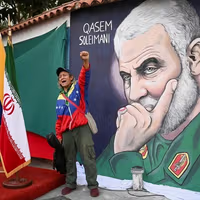
The main US embassy building covered with Qasem Soleimani's banner. 2020
“Why would Trump push for direct talks unless it’s about reopening the embassy?” one user posted. “How else can US companies invest here?”
Former Israeli official and spokesperson Ben Sabeti also weighed in on X: “Iran makes cheap gestures toward @POTUS for the success of negotiations? There are reports about the US Embassy in Tehran being vacated for the first time since 1979. Is the regime also ready to make nuclear concessions?”
Meanwhile, Iranian media—highly constrained by censorship—picked up Younesi’s now-deleted post, but offered minimal commentary. “If true, this is a very meaningful step,” read a brief article titled What’s the story of the evacuation of the US Embassy building? published by Rouydad24 on Sunday. Fararu, another popular online outlet, published a gallery of recent photos showing foreign tourists visiting the former embassy, under the headline US Embassy in Tehran Draws Attention Again on Day of Talks—without offering any further remarks.
The US embassy takeover forty-six years ago
Islamist students occupied the embassy in November 1979. The students held tens of American diplomats and other staff hostage for 444 days. The embassy compound, which the students called “Den of Spies”, however, has been used as a base by IRGC-affiliated groups, including the Basij militia and its affiliated Daneshjoo (Student) News Agency.
Other parts of the building were converted into a museum and opened to the public in recent years. The Swiss embassy has represented US interests in Iran in the past forty-six years.
The US embassy in Tehran with a shredded US flag.
Calls for normalization of relations and re-opening of the embassy
In recent years, various Iranian political and media figures have supported the idea of restoring diplomatic ties with the United States and returning the embassy building after decades of occupation.
Most recently, reformist politician and cleric Mohsen Rohami suggested in an interview published by Khabar Online that Iran and the United States could re-open their embassies and that higher officials than foreign ministers could sit at the negotiation table.
“This will have a positive psychological impact, besides its practical outcome, on our society and neighbors,” Khabar Online on Sunday quoted Rohami, who served as the legal deputy of Pezeshkian’s campaign last year, as saying.
Back in August 2024, Mehdi Ghazanfari, head of the National Development Fund, called for the reestablishment of consular relations with the United States. He controversially blamed the Communist Tudeh Party for provoking the 1979 embassy seizure and urged the Pezeshkian administration to act fast before what he called his political rivals' honeymoon with him ended.
His suggestion was echoed by some other politicians and public figures including Mohammad-Hossein Khoshvaght, a former official of the Islamic Guidance Ministry and managing director of Fararu. Khoshvaght has close ties to Khamenei’s household through the marriage of his sister to Khamenei’s eldest son, Mostafa.
Khoshvaght contended that normalization of relations could benefit both countries. "An Iran that has normal relations with the United States is a nightmare for Russia and Israel; for Putin, an Iran with nuclear weapons is less dangerous than an Iran that has normal relations with the United States!" he wrote on X.
In a 2015 interview with The Guardian, Akbar Hashemi Rafsanjani said reopening the embassy was “not impossible” if both sides changed their behavior. Similarly, in a 2014 interview with Swiss TV during the Davos Forum, President Hassan Rouhani said animosity with the United States could eventually turn into friendship.
"On the day when the whole world was afraid of America, we seized the 'Den of Espionage' (US embassy in Tehran in 1979) and captured its marines (in 2016). Now that it has no strength left, why should we be afraid?" said Revolutionary Guard deputy commander Mohammad-Reza Naghdi.
A front-page editorial in Iran's Hamshahri newspaper on April 13 read "Iran's will shown to the world in negotiations" and carried the sub-headline "Message of authority from Muscat."
"President Trump is dead serious on this issue. He's dead serious that Iran cannot have a nuclear weapon," Defense Secretary Pete Hegseth told Fox News on Sunday.
"He's also dead serious that if we can't figure this out at the negotiating table, then there are other options, to include my department," he added.
Hegseth expressed hope the US military will never have to use the military option against Iran.
However, he said, "what we're doing with the Houthis and in the region, we have shown the capability to go far, deep and big. We don't want to do that but if we have to, we will to prevent a nuclear bomb in Iran's hands."
Some Iranians are questioning whether US-Iran talks will alleviate persistent economic hardship and political repression.
The talks took place on Saturday and were led by Iran’s Foreign Minister Abbas Araghchi and Donald Trump’s Middle East envoy Steve Witkoff.
While both sides described the exchange as “positive and constructive,” Iranians interviewed anonymously by Iran International or in the form of messages to its submission service questioned the impact of the discussions on their lives.
“This negotiation won’t lower prices or fix the economy,” said one citizen in a video message showing a small grocery purchase costing over ten million rials (around $11).
“Even if billions are unfrozen, not a single rial will reach the people. It’s all in the name of the people, but for the benefit of the regime,” another added.
Iran's economy has been in crisis since 2018, when Trump exited the JCPOA nuclear deal and imposed heavy sanctions on Iran. Tens of millions subsist at poverty level, with workers making around $120 a month.
Some pointed to systemic mismanagement and repression as the root of Iran’s crises, not international sanctions. They criticized the West for engaging diplomatically with a government they believe is at its weakest.
“Why negotiate when the regime is vulnerable?” asked one voice message. “Why not support the Iranian people and end this nightmare?”
The move toward talks, despite Supreme Leader Ali Khamenei’s longstanding opposition to negotiations with what he has repeatedly called a untrustworthy United States, was seen by some as an act of desperation.
“Khamenei once said Qasem Soleimani’s shoes were worth more than Trump,” said a citizen to Iran International, referring to the IRGC commander killed in 2020 on Trump's orders. “Now he negotiates with the man he called Soleimani’s killer.”
As Trump continues to press for a new deal—recently warning that Iran must comply or face consequences—many Iranians say the clerical rulers have caved to external pressure for the sake of survival.
“They refused American vaccines during COVID, but now they’re ready to shake Trump’s hand to stay in power,” said another.
Several messages also highlighted a growing sense that the only path to change may be confrontation. “We’re even ready for war,” said one citizen. “If that’s what it takes to end this regime.”
Images circulating online captured public sentiment, including a Tehran banner reading: “With or without a deal, this executioner republic will fall by the will of the Iranian people.”
A senior commander in Islamic Revolutionary Guard Corps (IRGC) said on Sunday that the United States has been compelled to engage in negotiations due to the Islamic Republic's deterrent military capabilities.
Speaking on the sidelines of a commemoration for the death anniversary of those killed in Israeli strike on Iran's consulate in Damascus, Brigadier General Iraj Masjedi, the deputy coordinator of the IRGC's Quds Force, said that Iran possesses a level of deterrence that makes its enemies aware of the "crushing and decisive response" they would face to any threats.
Masjedi added that the US's current approach of coming to the negotiating table is a direct result of Iran's power.
He suggested that the best way forward would be for both sides to engage in mutual interaction and respect to resolve their issues.
The commander said that "Mr. Trump and the Zionists realized they could not speak to the Islamic Republic with the language of force and that they had to engage in proper dialogue, listen to Iran's positions, and that Iran hopes for favorable outcomes.”