"Iran seeks dialogue from a position of equality—not a situation in which it is threatened on one hand and asked to negotiate on the other," President Masoud Pezeshkian said Saturday.
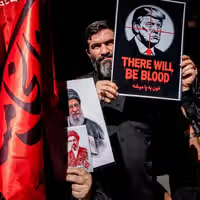
"If you want negotiations, then what are the threats for?" he added, referring to Donald Trump's threats to bomb Iran if talks over its disputed nuclear program fail.
"Today, the United States not only humiliates Iran but also the world. This behavior contradicts its call for negotiations," he said.
Any potential US airstrike would target not only Iran's nuclear facilities but also its air defense and missile capabilities in a bid to prevent possible retaliation, the former commander of US Central Command told Iran International.
In an exclusive interview with Iran International, former CENTCOM commander and CIA chief David Petraeus said Donald Trump would not stop at a limited attack on Iran's nuclear sites and would go after the Islamic Republic's air defense and missile capabilities.
"You probably have to take out some of the retaliatory capacity of Iran as well because you don't want to just take out the nuclear program and then have them go after the bases where we have forces, and that would then bring in all these other countries, of course," he said.
"This is not just a surgical attack on discrete nuclear capabilities. This is against the retaliatory capabilities, against the defense capability, and that's what has to be done if you're going to carry out this operation."


The Yemeni information minister announced that 70 Iran-backed Houthis and members of the Revolutionary Guards (IRGC) were killed in a US airstrike on Tuesday, claims denied by the IRGC, which called it “false news”.
The IRGC affiliated Tasnim News Agency called the Saturday announcement by Muammar Al-Eryani "psychological warfare”. Al-Eryani is the minister of Yemen's official government, which is at war with the Houthis.
"It seems that this false news has been published in the context of psychological warfare and in order to push the region towards an all-out war, while officials and military commanders of the Islamic Republic of Iran have repeatedly announced that the Yemeni Ansarullah forces are fighting the US and Israel completely independently,” Tasnim wrote.
Al-Eryani said in a press statement that the attack targeted a point that was "used to plan terrorist attacks against commercial ships and tankers in the Red Sea, Bab al-Mandab, and the Gulf of Aden” amid the Houthis’ maritime blockade.
The Houthis maintain a narrative of victory when publicizing information on engagement with US military action.
A press statement this week said: "We are in an advanced position on the maritime front, and the American aircraft carrier 'Truman' is in a constant state of retreat, with pursuit ongoing,” the US vessel on the frontline of the maritime conflict.
The US has carried out multiple airstrikes across Houthi-controlled areas of Yemen since last month as it cracks down on the Iran-backed group which has been imposing the blockade since November 2023 in the wake of the Gaza war.
The group began the blockade targeting Israeli-linked ships, claiming to be working in allegiance with Hamas in Gaza but has since targeted multiple international vessels and killed international seamen.
US President Donald Trump has warned that any firing by the Houthis in Yemen will be directly attributed to the Islamic Republic of Iran and will have serious consequences for Tehran.
"From this moment on, every shot fired by the Houthis will be considered a shot fired by Iranian weapons and leadership. Iran will be held responsible, it will bear the consequences, and these consequences will be serious," he wrote in a message on his social media account, Truth Social.
In spite of denials from Tehran that they are controlling the group, Trump continues to attribute blame to Iran for funding and arming the group, the blockade initiated on the orders of Supreme Leader Ali Al Khamenei.
”Let no one be fooled! The hundreds of attacks carried out by the Houthis, these evil thugs and thugs based in Yemen who are hated by the Yemeni people, all originate from and are directed by Iran,” Trump said.
According to the Associated Press this week, satellite images show the deployment of at least six nuclear-capable B-2 Spirit bombers to Camp Thunder Bay on the island of Diego Garcia in the Indian Ocean, which is within striking distance of both Iran and Yemen.
Tensions also remain high between Iran and the US over Tehran’s rapidly advancing nuclear program.
The B-2 would be crucial in potentially bombing Iran’s underground nuclear sites and has been used in combat to target the Houthis in the past.
As messaging between Tehran and Washington rapidly evolves, Iranian politicians and media continue to send mixed—and at times irrelevant—signals, while the US stance remains relatively consistent under President Donald Trump, who holds the final say.

As messaging between Tehran and Washington rapidly evolves, Iranian politicians and media continue to send mixed—and at times irrelevant—signals, while the US stance remains relatively consistent under President Donald Trump, who holds the final say.
His latest remarks on negotiations with Tehran—telling reporters to forget about past letters exchanged with Iran’s Khamenei and suggesting that Iran now seems to favor direct talks—may hint at behind-the-scenes communication between the two sides and possibly some early progress.
An indication of that progress came with the news of President Masoud Pezeshkian telling Saudi Arabia’s Crown Prince Mohammed Bin Salman in a telephone conversation on Friday that "Tehran is prepared to reduce the tensions," and reiterated that "all of Iran’s nuclear activities can be subject to verification."
Meanwhile, the Entekhab website in Tehran quoted “diplomatic sources in Iran” as saying that if the indirect talks in Oman proceed positively, they could be followed by direct negotiations.
Despite a shift in tone from some quarters, harsh rhetoric toward the United States has continued in Iran. Deputy IRGC Commander for Political Affairs Yadollah Javani warned that any attack on Iran’s nuclear facilities—as previously threatened by US officials—would push the country’s nuclear program into a “new phase,” implying potential weaponization. “In that case,” he said, “the West will need to redefine its understanding of Iran and the axis of resistance,” according to Etemad Online.
Javani added that US and Israeli threats would not succeed in destroying Iran’s nuclear knowledge or capabilities and reiterated that nuclear weapons have no place in Iran’s defense doctrine.
His remarks appeared to contrast with those of Supreme Leader Ali Khamenei’s senior adviser, Ali Larijani, who recently said that a military strike could prompt Iran to build nuclear weapons. However, a report on the Rouydad24 website downplayed that aspect of Larijani’s interview with state TV, emphasizing instead his suggestion that there is an opportunity for improved US-Iran trade relations.
The report appeared to frame Larijani’s comments as a pacifist message intended to encourage US investment in Iran. It also quoted Larijani as calling Donald Trump “a very talented man in the area of economy.”
Some Iranians on social media welcomed President Trump’s announcement of a 10% tariff on imports from Iran, framing it as a symbolic gesture of support for the opposition—even though Iran’s exports to the United States are negligible.
In a notably aggressive comment, ultraconservative commentator Mohammad Marandi warned on X that if Iran’s nuclear facilities were attacked, “Iran can destroy Qatar.” His remarks stood in sharp contrast to other hardliners, such as cleric and Majles presidium member Alireza Salimi, who dismissed recent US threats as mere “bluffs,” according to Etemad.
Meanwhile, Chief of Staff of Iran’s Armed Forces, General Mohammad Bagheri, struck a more conciliatory tone. In a video message recorded at the historic ruins of Persepolis, he said Iran seeks friendly relations with all its neighbors—an apparent attempt to reassure the public and ease regional tensions. He was wearing civilian cloths instead of IRGC uniform.
A report in the pro-reform Etemad newspaper said that Iranian lawmakers have drafted two bills related to the country’s nuclear program, with at least one focused on “expanding the peaceful use of nuclear technology.”
Meanwhile, Reformist commentator Abbas Abdi said in an interview with a Tehran-based website that despite President Trump’s threats last week, the United States has not yet made a final decision to launch a military strike against Iran. He added that Iran continues to advance its drone and missile capabilities, now capable of reaching any target in the region.
Another Reformist commentator, Ahmad Zeidabadi, urged figures like Ali Larijani to refrain from discussing the militarization of Iran’s nuclear program, warning that such remarks play into what he described as “a trap set by Israel” to depict Iran as an aggressor.


A media outlet affiliated with Iran’s Revolutionary Guard has lashed out at a politician who recently suggested that President Masoud Pezeshkian should have accepted Donald Trump’s offer to meet.
Javan newspaper criticized Ali Motahari, a conservative politician known for occasionally outspoken views, for suggesting that President Masoud Pezeshkian should not have waited for Supreme Leader Ali Khamenei’s reaction to Trump’s offer and should have accepted it immediately—arguing that if Khamenei later opposed direct talks, the meeting could simply have been canceled.
Javan wrote: “Common sense and conventional understanding tell any political figure that even if the constitution had not granted the Supreme Leader authority over foreign policy, in a time of war and external threats, one should not say, ‘Let the president speak for himself, and if necessary, the Leader can oppose it later’.”
In early February, President Trump revived his pressure campaign against Tehran while simultaneously calling for direct talks with his Iranian counterpart.