Iran began its new fiscal year on March 21 amid deepening economic and energy crises, with even officials of the Islamic Republic acknowledging that conditions are likely to worsen in the year ahead.
•
Meanwhile, the return of Donald Trump to the White House and the revival of the US administration’s maximum pressure policy have further tightened the noose on Iran’s economy.
While the Central Bank reported a year-on-year inflation rate of 45% last month, local media suggest that actual price increases are far higher. In reality, the cost of food, medicine, and other essential goods has nearly doubled.
Moreover, the fiscal year is ended with the US dollar surging to nearly 1 million Iranian rials, marking a 65% increase since the beginning of the past fiscal year. The depreciation of the rial has accelerated sharply in recent days.
At the same time, Central Bank data reveals that Iran’s foreign reserves have been rapidly depleting, plunging to just one-fourth of their level in March 2024 and a mere tenth of their March 2023 levels.
Iran’s foreign trade situation:
The latest figures from the Central Bank show that Iran's foreign exchange revenue crisis persisted in the first half of the current fiscal year, which began on March 20, 2024. No data has yet been released for the second half of the year.
During this period, Iran recorded a positive overall trade balance of $11.5 billion, including oil, goods, and services. However, the country also experienced capital flight totaling $12.5 billion.
As a result, the net balance of foreign currency inflows and outflows—including gold bullion—turned negative.
Given the sharp decline in Iran’s oil exports to China since September, the situation is expected to worsen—particularly as oil, petroleum products, and natural gas account for more than half of the country’s total exports.
Over the first 11 months, Iran has imported approximately 93 tons of gold bullion worth $7.3 billion in exchange for its oil and goods exports—three times the amount imported in the previous year. More than 55% of this gold was purchased from Turkey.
Indeed, around 13% of Iran’s total oil and non-oil exports have been bartered for gold instead of foreign currency. This highlights the government’s inability to collect payments for exported goods and oil and transfer foreign currency into the country, due to US banking sanctions. As a result, Iran is facing a severe shortage of foreign exchange reserves.
Government debt crisis
Recent data from the Central Bank shows that the Iranian government’s debt to the banking system has surged by 41% during the current fiscal year. To cover its widening budget deficit, the government has relied heavily on borrowing from domestic banks, tapping into the National Development Fund, and issuing bonds.
According to the International Monetary Fund (IMF), Iran’s total government debt now exceeds $120 billion—roughly one-third of the country’s economy. In contrast, Iran’s total external debt, including both governmental and non-governmental liabilities, stands at less than $10 billion—just 2% of GDP—underscoring the country’s extreme financial isolation and the reluctance of international institutions to fund Iranian projects.
Two decades ago, before the imposition of heavy sanctions, Iran’s external debt was more than 12% of GDP, largely driven by foreign investment in oil and gas projects. Today, the government’s increasing dependence on domestic borrowing has sharply boosted liquidity, further fueling inflation. Over the past year alone, liquidity in Iran has risen by 28%.
The economic crisis has pushed more Iranians into poverty. Official reports suggest that one-third of the population lives in extreme poverty. However, based on the World Bank’s global poverty standards, around 80% of Iranian households earn less than $600 per month and fall below the poverty line.
Energy and Water Crisis
For the first time, Iran has experienced electricity and gas shortages across all seasons. During peak summer demand in 2024, electricity shortages reached 20%, while winter gas shortfalls surged to 25%. Officials warn that energy shortages could worsen by at least 5% in the next fiscal year.
Industrial reports show that since summer 2024, energy disruptions have forced 30–40% of Iran’s industrial capacity to shut down. At the same time, the country has been grappling with growing gasoline and diesel shortages since 2023. Without new refinery projects, these fuel deficits are expected to escalate rapidly.
Meanwhile, Iran’s water crisis has reached a critical stage. Tehran’s main reservoirs are reportedly at just 7% capacity, and officials warn of severe water shortages by summer 2025.
Iran has the right to pursue peaceful nuclear energy and is acting within the framework of international law, Kremlin spokesperson Dmitry Peskov said on Friday, as Washington continues to pressure Tehran to curb its nuclear activities.
Peskov, speaking at a briefing with reporters, added that Moscow accepts Iran’s assurances that it has no intention of developing nuclear weapons.
"We are convinced that the problem of Iran's nuclear program should be resolved exclusively by peaceful political and diplomatic means, and we believe that everything necessary is available for this. All that is needed is political will," Peskov said.
The subject of Iran was among the key issues discussed during an extended phone conversation earlier this week between US President Donald Trump and Russian President Vladimir Putin. According to the White House, both leaders “shared the view that Iran should never be in a position to destroy Israel.”
Tensions between Tehran and Washington have escalated in recent weeks. US President Donald Trump said last week that Iran faces two paths: “military action, or a deal.” Iran’s leadership dismissed the ultimatum, with President Masoud Pezeshkian insisting Tehran "will not bow to US orders to talk."
Peskov's comments echoed statements he made last week, reaffirming that Iran has “every right to develop peaceful nuclear energy” and is “fulfilling its obligations under international agreements.” Speaking to reporters then, Peskov emphasized that Iran’s nuclear activities remain within legal frameworks established by international law. “We see that Iran is acting within these legal frameworks,” he said.
His comments also come as Iran, China, and Russia strengthen coordination on nuclear diplomacy, following trilateral talks in Beijing last week. In a joint statement issued after the meeting, the three countries emphasized the need to resolve the nuclear issue through dialogue based on mutual respect and condemned what they described as “unlawful” unilateral sanctions imposed on Iran.
“The right of Iran to the peaceful use of nuclear energy must be fully respected,” the statement read, calling for the lifting of all sanctions.
Led by deputy foreign ministers—Russia’s Sergei Ryabkov, Iran’s Kazem Gharibabadi, and China’s Ma Zhaoxu—the talks in Beijing signaled a unified stance against expanding the scope of nuclear negotiations. According to Gharibabadi, the three sides agreed that any future discussions must focus solely on Iran’s nuclear program and the removal of sanctions, explicitly rejecting the inclusion of Iran’s missile program or regional activities.
Foreign Minister Abbas Araghchi expressed cautious openness to indirect talks through Oman but warned that negotiating under maximum pressure would reflect “a position of weakness.”
Meanwhile, concerns over Iran’s nuclear activities have grown. The International Atomic Energy Agency (IAEA) reported that Iran has significantly ramped up uranium enrichment, nearing weapons-grade levels. Iran denies seeking nuclear weapons, saying the move is a response to continued US sanctions.
A magnitude 5.0 earthquake struck near Badroud in central Iran on Thursday, shaking areas roughly 26 kilometers (16 miles) from the Natanz nuclear facility, the country’s main uranium enrichment site.
A second tremor, measuring 4.5 magnitude, followed just hours later at 1:03 PM local time, according to the Iranian Seismological Center.
In response to concerns about the site’s safety, Behrouz Kamalvandi, the deputy head of Iran's Atomic Energy Organization, said the earthquakes had no impact on the Natanz nuclear facility. “The Natanz nuclear site is designed to withstand earthquakes far more powerful than what occurred today,” he added.
Local officials reported shattered windows in several residential buildings across nearby villages, though no casualties have been reported so far.
Iran's nuclear enrichment site in Natanz, Isfahan Province.
The Natanz facility, mostly deep underground and central to Iran’s controversial nuclear program, has been the target of past sabotage. In July 2020, a blast at the centrifuge assembly plant at Natanz caused extensive damage, which Iranian officials later blamed on sabotage. Less than a year later, in April 2021, a second major incident struck the facility, again reportedly the result of sabotage, with Iran directly accusing Israel.
The 2021 attack came just after new advanced centrifuges had been activated, and US intelligence sources later told The New York Times that the strike destroyed the facility’s independent internal power system, delaying enrichment activities for months.
Last year, an Israeli airstrike targeted an S-300 air defense system near Esfahan, the same province housing Natanz—raising regional security concerns.
The quake comes at a delicate time, as US and Israeli officials prepare for high-level consultations in Washington next week to discuss Iran's nuclear program and potential diplomatic options. With tensions simmering, analysts warn that even natural events near sensitive sites could escalate geopolitical anxieties.
Natanz remains a flashpoint amid growing scrutiny from the International Atomic Energy Agency (IAEA), which recently expressed concern over Iran’s stockpile of near-weapons-grade uranium.
Iran's supreme leader Ali Khamenei shrugged off warnings of a potential military confrontation with the United States if a nuclear deal was not reached, asserting that any aggression against Tehran will be met with a 'harsh slap'.
“Americans must know that threats will get them nowhere in confronting the Islamic Republic,” he said during a nationally broadcast speech in Tehran on Friday. “If anyone commits villainy against the Iranian people, they will be struck with a harsh slap.”
The remarks follow reports that US President Donald Trump sent Khamenei a direct letter earlier this month offering negotiations under a limited timeframe. According to Axios, the message included a two-month window to reach a new nuclear agreement, paired with a warning of consequences should Iran further expand its nuclear program.
The letter was described as firm in tone and was reportedly shared in advance with close US allies, including Israel, Saudi Arabia, and the United Arab Emirates.
Tehran has acknowledged receiving the letter, but has not commented publicly on its contents. The Iranian foreign ministry has criticized Washington’s approach, accusing the US of sending mixed signals, and said any official response would remain private.
While Khamenei has publicly ruled out negotiations under pressure, other officials have appeared more flexible. Last week, Iran’s Foreign Minister Abbas Araghchi suggested that indirect talks with the United States could be possible, potentially through intermediaries such as Oman.
“It is not a strange method, and it has happened repeatedly throughout history,” Araghchi said in an interview with the Iran newspaper. “What is important is the will to negotiate under fair and equal conditions; the form it takes does not matter.”
Khamenei, however, offered no acknowledgment of that possibility in his speech. “We have never been the ones to start a conflict,” he said. “But if someone acts with malice, the response will be firm.”
He also rejected Western descriptions of Iran’s role in the region, denying that Tehran relies on proxy forces. “The Islamic Republic has no need for proxies,” he said. “The people of Yemen and the resistance centers stand and fight on their own.”
The comments come as the US escalates military strikes on Yemen’s Houthi fighters, who have attacked shipping in the Red Sea in support of Gaza. Washington blames Tehran for arming the group with advanced weaponry.
This week, Trump demanded Iran end all Houthi support, warning of “dire” consequences. “Iran must stop the sending of these supplies IMMEDIATELY,” he posted on TruthSocial. Over the weekend and again Monday, US airstrikes hit Houthi positions, with Yemeni officials reporting dozens killed.
Despite denials from Tehran, US officials view the Houthis as a key pillar of Iran’s regional strategy.
Friday's speech came one day after Khamenei’s annual New Year message, in which he described the past year as turbulent, drawing comparisons to the early 1980s, a period marked by war, political assassinations, and deep internal crises. He cited the death of President Ebrahim Raisi, the killing of Iranian advisors in Damascus, and ongoing economic difficulties as major national challenges.
While neither speech referenced the US letter or the possibility of renewed nuclear talks, both struck a tone of resilience and resistance. The absence of traditional New Year greetings or Nowruz symbolism in either address underscored the gravity of the moment. This is the second consecutive year Khamenei has remained in the capital during Nowruz, a decision that may reflect the overlap with Ramadan, or broader concerns about regional security.
The timing of his remarks also comes as the United States and Israel prepare to hold high-level consultations in Washington early next week, focusing on Iran’s nuclear program and regional posture. Israeli officials have expressed skepticism about the prospects for diplomacy and are reportedly preparing for a range of scenarios, including potential military confrontation.
Meanwhile, international concern over Iran’s nuclear program continues to grow. A recent report by the International Atomic Energy Agency raised questions about the purpose of Iran’s enriched uranium stockpile, which the agency said could not be fully explained by civilian uses.
The United States and Israel are set to discuss Iran's nuclear program and potential talks with Tehran early next week, Axios reported on Thursday citing Israeli and US officials.
The consultations, planned to take place in the White House according to the report, comes amid heightened tensions between Iran and the US, with Trump asking Iran's leadership to choose between a deal and potential military confrontation.
Israel's prime minister Benjamin Netanyahu remains skeptical about the chances of a new deal and seeks to coordinate a response should tensions escalate to military action, Axios said citing an Israeli official.
Iran's supreme leader Ali Khamenei has rejected talks with the US under Trump, recalling that he withdrew the US from a multilateral deal agreed in 2015.
The discussions are expected to be led by Israeli strategic affairs minister Ron Dermer and national security adviser Tzachi Hanegbi and will include senior officials from the the military, Mossad, and Israel's Atomic Energy Commission.
They are set to meet with a US team led by national security adviser Mike Waltz, along with officials from the State Department, Pentagon, and intelligence agencies.
This marks the first gathering of the US.-Israel Strategic Consultative Group since Trump took office.
The forum, which serves as the highest-level platform for U.S.-Israeli discussions on Iran, is expected to lay the groundwork for future policy coordination between the two allies.
Iran's exiled prince Reza Pahlavi urged world leaders, including US President Donald Trump, to stand with Iranians in their struggle for freedom in an address marking their New Year on Thursday.
"Together, we can dismantle the Islamic Republic and end decades of global terror, blackmail, and hostage-taking," he said in the video, titled A Norooz Message to the World: Imagine a New Iran.
"I extend our hand in friendship and partnership— to our neighbors from Israel and the Arab states, to our steadfast allies in the West, including President Trump and the United States, and to leaders across Europe and the G7," he added.
Pahlavi's remarks come amid rising tensions between Washington and Tehran, following an ultimatum from Trump, who sent a letter to Iran's Supreme Leader Ali Khamenei proposing direct negotiations for a new nuclear agreement or face potential military consequences.
Khamenei rejected Trump's letter last week as deceptive, saying Trump's demands would intensify sanctions and increase pressure on Iran.
"A free Iran is no longer a distant dream; it is a reality being forged today by the hands of its own people," Pahlavi said. "The question is not whether Iran will be free, but which nations will be with us in the fight and make our victory sweeter."
He framed the fall of the Islamic Republic as a turning point for global security, arguing that Iran’s current leadership has fueled instability across the Middle East and beyond.
"This new reality will profoundly benefit not only Iranians but citizens everywhere—from the cities of America to the capitals of Europe, from Israel to the Arab world."
Calling himself a servant of the Iranian people, he declared his commitment to leading what he described as historic change, promising a clear and actionable plan to dismantle the Islamic Republic.
While Pahlavi's supporters view him as a unifying figure in the opposition, some Iranians—particularly those skeptical of monarchy—express reservations about his political vision for Iran’s future.
Pahlavi has made clear in interviews, including in an interview with the German outlet Spiegel, that he does not advocate for either a monarchy or a republic, emphasizing that the Iranian people should determine their future governance through a democratic vote.
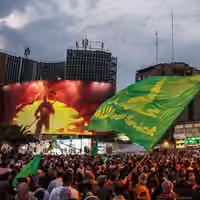
Tens of thousands of Iranians gathered at major historical sites across the country on Thursday to mark Nowruz, chanting national and pro-monarchy slogans in defiance of the Islamic government.
"Imagine the Middle East liberated from the shadow of nuclear blackmail and threats. Imagine our region without endless proxy wars, extremist ideologies, and terrorism—all driven by a regime whose policies have caused mass migration, instability, and suffering far beyond Iran’s borders," he added.