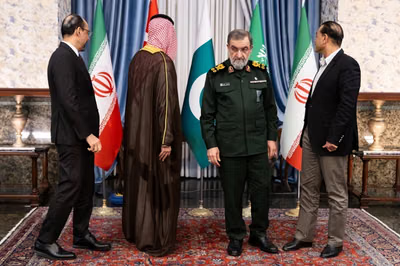
Iran's supreme leader Ali Khamenei, Tehran, March 15, 2025
The threat of war looming over Iran by President Trump’s ultimatum to make a nuclear deal or face attack may be a blessing in disguise for rulers in Tehran as they seek to manage growing popular discontent.
Iranian officials have repeatedly rejected negotiations with the United States under terms set by Donald Trump, doubling down on Supreme Leader Ali Khamenei's hardline stance.
Questioning the point of talks with a "deal-breaking" US president, Khamenei on Monday nonchalantly dismissed the consequences of shunning Washington.
"The United States is threatening militarization,” Khamenei said on the day his foreign ministry finally confirmed receiving a personal letter from Trump to Khamenei. “War is not a one-sided blow. Iran is capable of retaliating and will certainly do so,” he added.
War, once a distant threat, now looks a distinct possibility. It should concern those in power Tehran—and it perhaps does. But it may serve them as an instrument to deter adversaries and to enforce control at home.
War as a mechanism for control
Looking at Iran’s official outlets, the refrain of war is omnipresent. Military figures dominate state media and security-focused language overshadows other narratives.
This change of tone and substance—transmitted mainly inside Iran—appears to be not just a response to foreign threats, but a calculated strategy to unify and subdue the populace, forcing societal alignment by amplifying fears of conflict.
And this approach is driven by insecurity as much as intent.
Behzad Nabavi, a former minister and veteran lawmaker of the Reform camp, said recently that a wartime atmosphere could foster national solidarity, suggesting that even moderates long-shunned from power circles see fear as a unifying force.
Meanwhile, those in power have intensified the crackdown on the internet, branding the free flow of information a “cognitive war.” The sentiment was best summed up recently by Iran’s national police chief Ahmadreza Radan.
“Back then, we were encircled in the Komeil trench,” he said, invoking memories of the eight-year war with Iraq in the 1980s. “Today, we are surrounded in virtual trenches. If we’re not fighters now, we’ll surely retreat and surrender the homeland."
War as a gambit for survival
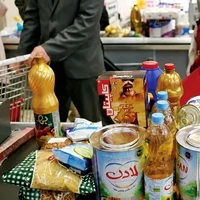
The Islamic Republic faces multiple challenges of significant severity: an ailing economy, environmental collapse, budget shortfalls, and entrenched corruption. Public trust has eroded, with sporadic protests signaling discontent.
Fearing another “sedition”—a term used to label past protests and justify their brutal suppression—officials now see war’s shadow as a lifeline.
The theocracy has a proven record of internet blackouts, arbitrary arrests and harsher suppression of dissent in general. It can be expected to do more in a state of inflated external threats, dishing out labels of “subversion” and “enemy collaboration.”
This isn’t mere opportunism—it’s a high-stakes gamble.
Iranians did rally during the war with Iraq, especially the early years. But that was forty-odd years ago. And Khamenei is no Khomeini, the first supreme leader who had all but universal following when he called for Iran’s monarchy to be replaced by an Islamic Republic.
Today, the system, as Khamenei likes to call it, is all but universally loathed. While he clings to power by keeping loyal forces primed and its critics silenced, millions of ordinary Iranians face an unrelenting battle of survival.
Stoking war fears and siege mentality to stifle unrest may work for the supreme leader. Or it could backfire spectacularly and save Trump a war he clearly does not want.
War as a lever for defense and deterrence
The Islamic Republic frames conflict as both a defensive necessity and a means to intimidate foes. Israel and Arab states astride the Persian Gulf have often borne the brunt of this rhetoric.
A senior commander of the Revolutionary Guards (IRGC) warned recently that an attack on Iran’s nuclear facilities would spark “a fire in the region that cannot be contained.” Another senior IRGC figure made it clearer: "True Promise 3 will take place at the right moment, destroying Israel and leveling Tel Aviv and Haifa.”
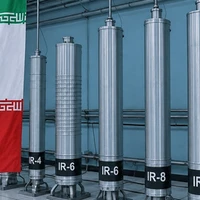
These threats are backed by action. Iran has nearly doubled its military exercises since October 2024, according to the Financial Times, with drills concentrated near the Natanz nuclear facility and the Strait of Hormuz.
This posturing may not be as effective in deterring the US or Israel but does help shape domestic perceptions amid worsening economic and social crises.