• العربية
  • فارسی
Brand
  • Iran Insight
  • Politics
  • Economy
  • Analysis
  • Special Report
  • Opinion
  • Podcast
  • Live TV
  • Iran Insight
  • Politics
  • Economy
  • Analysis
  • Special Report
  • Opinion
  • Podcast
  • Live TV
  • Theme
  • Language
    • العربية
    • فارسی
  • Iran Insight
  • Politics
  • Economy
  • Analysis
  • Special Report
  • Opinion
  • Podcast
  • Live TV
All rights reserved for Volant Media UK Limited
volant media logo

Iran's capital should be moved from Tehran toward the Persian Gulf, president says

Jan 1, 2025, 21:35 GMT+0
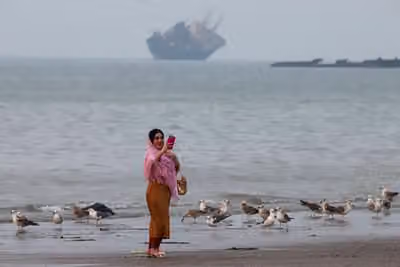
A view of Iran's capital city, Tehran

Iran’s President Masoud Pezeshkian has reignited discussions about relocating the capital from Tehran to a coastal city, citing economic inefficiencies and regional disparities.

“One of the reasons that has led us to consider changing the capital is the imbalance between resources and expenditures in Tehran,” he said in a meeting with representatives from the central region of Semnan.

Tehran, home to over 9 million residents, has long struggled with overpopulation, traffic congestion, air pollution, and resource mismanagement. Pezeshkian argued that moving the capital closer to the Persian Gulf would streamline economic operations.

“Transporting raw materials from the south to the center, processing them, and then returning them south for export drains our competitive capacity. We must shift the country’s economic and political center to the south and closer to the sea,” he said.

Previous Iranian administrations have explored various iterations of the idea. However, financial constraints and political inertia have consistently stalled progress.

It gained traction during the presidency of Mahmoud Ahmadinejad, mainly over concerns about Tehran’s vulnerability to earthquakes. President Hassan Rouhani revisited it in the mid-2010s, citing the city’s unsustainable growth and environmental challenges.

Relocating the capital would require massive investment and pose logistical challenges, while potentially harming Tehran’s economy. It seems unlikely, therefore, that Pezeshkian follows his remarks with actions that his predecessors avoided in less challenging times.

Most Viewed

US-Iran talks focused on phased deal to reopen Hormuz
1

US-Iran talks focused on phased deal to reopen Hormuz

2
INSIGHT

Pezeshkian straddles Iran’s divide at UN as US talks test balance

3

China shipments help sustain Iran’s weapons programs despite US pressure - WSJ

4
ANALYSIS

New US-Iran talks run into old question of who speaks for Tehran

5
INSIGHT

Threats and counter-threats complicate new US-Iran diplomacy

Banner
Banner

Spotlight

  • From Hormuz to Indian Ocean: Iran threatens to redraw the map of the war
    ANALYSIS

    From Hormuz to Indian Ocean: Iran threatens to redraw the map of the war

  • 'Bully at home, victim abroad': Iranians on Pezeshkian's UN speech
    VOICES FROM IRAN

    'Bully at home, victim abroad': Iranians on Pezeshkian's UN speech

  • Pezeshkian gets the generals' applause, and no word from the man above them

    Pezeshkian gets the generals' applause, and no word from the man above them

  • War deepens Iran’s energy crunch ahead of winter
    ANALYSIS

    War deepens Iran’s energy crunch ahead of winter

  • Threats and counter-threats complicate new US-Iran diplomacy
    INSIGHT

    Threats and counter-threats complicate new US-Iran diplomacy

  • They can erase you without arresting you
    TEHRAN INSIDER

    They can erase you without arresting you

Banner
Banner