Rebels promised Iran to protect Shiite Muslims, their sites - NYT
Hayat Tahrir al-Sham, the main rebel group advancing in Syria, sent Iran a private diplomatic message this week, The New York Times reported citing three Iranian officials.
"The group promised that it would protect Shiite religious sites and Shiite minorities and asked Iran not to fight its forces," the report said.
Iran, in turn, asked the group to allow safe passage of its troops out of Syria and to protect the Shia shrines, according to two officials cited by the Times.
Iran's Foreign Minister Abbas Araghchi says the government of Bashar al-Assad was supposed to implement reforms and constitutional changes but "showed little flexibility and speed in this process."
"Everything was clear, and the analyses had predicted this event. Iranian and Syrian intelligence systems were fully aware of the movements in Idlib, and this information had been conveyed to the Syrian government. What was surprising, however, was the inability of the Syrian army and the unexpected speed of developments," Araghchi said in a televised interview on Sunday night.
"In a meeting we had with Bashar al-Assad, he himself was surprised by the army's performance. The Syrian army was affected by psychological and media operations rather than the real war," Araghchi added.
Asked about Iran's withdrawal of its forces from Syria, Araghchi said Tehran's "plan was not to engage with their internal opposition instead of the Syrian army."
"Our emphasis has always been on dialogue between the Syrian government and opposition groups," he noted.
Araghchi said that after Assad's fall, Tehran is now specifically concerned about Israelis taking advantage of the situation.
"We are monitoring the situation to ensure that the existing concerns do not come to fruition. These concerns include the possibility of a renewed internal and sectarian civil war between the tribes, the fragmentation of Syria, and, of course, the specific concern of the Islamic Republic, which is the potential exploitation by Israel, especially as movements have started since yesterday," he noted.
"It is important to issue a warning regarding these developments. Resistance groups in the region are closely monitoring and watching Israel's movements," he added.
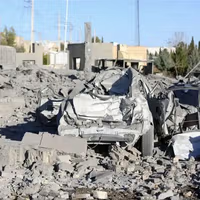
Israel conducted three airstrikes in the Syrian capital on Sunday against a security complex and a government research center which it has said in the past was used by Iran to develop missiles, Reuters reported citing two regional security sources.
Israel conducted three airstrikes in the Syrian capital on Sunday against a security complex and a government research center which it has said in the past was used by Iran to develop missiles, Reuters reported citing two regional security sources.
The strikes caused extensive damage to the main customs headquarters and buildings adjoining the military intelligence offices within the security complex, which is located in the Kafr Sousa district of Damascus, the sources said.
The strikes had hit infrastructure used to store sensitive military data, equipment and guided missiles parts, one of the sources added.
A man refuels his car at a petrol station in Tehran, Iran January 25, 2016.
The US may soon impose sanctions on gasoline exports to Iran, escalating the pressure on Tehran’s energy sector as it struggles with severe fuel shortages.
Iran’s reliance on imported gasoline has intensified amid a domestic energy crisis marked by rolling blackouts, gas shortages, and an overburdened electricity grid.
With the Islamic Republic facing growing economic strains, Washington may target the importation of refined petroleum products, further isolating Iran from the global energy market.
The Washington Institute's recent report pointed out that Tehran is now "newly susceptible to pressure against its oil product imports, not just its oil exports," as the country grapples with energy shortages that have triggered public frustration and political instability.
In particular, the Institute suggested that Washington may reapply sanctions from the Comprehensive Iran Sanctions, Accountability, and Divestment Act (CISADA), which gives the US authority to penalize companies and governments providing essential services—such as insurance, financing, and shipping—for Iran’s gasoline and other petroleum imports.
The report says that imposing sanctions on gasoline imports is more feasible and less diplomatically complicated than targeting Iran's crude oil exports, which are primarily sent to smaller refineries in China.
"Enforcing sanctions on Iran’s gasoline imports is more straightforward and less diplomatically fraught than sanctioning its oil exports, most of which go to small refineries in China. This gasoline is produced at foreign refineries that may be reluctant to incur U.S. penalties just for the sake of a relatively small customer like Iran," wrote Patrick Clawson, the Research Counselor at the Washington Institute.
This potential strategy comes as Iran faces a sharp rise in domestic fuel consumption, including gasoline, with daily demand reaching at least 120 million liters—far surpassing the country's production capacity.
Last year, Iran spent $2 billion on gasoline imports, and its reliance on foreign fuel is expected to rise, with projected imports of 15 million liters per day. The country’s inability to produce enough gasoline domestically has made it increasingly vulnerable to external sanctions targeting its refined oil products.
As the Trump administration prepares to tighten its sanctions regime, European powers may lend their support, fueled by dissatisfaction with Iran's nuclear ambitions and its recent actions, including the acceleration of uranium enrichment and non-compliance with the International Atomic Energy Agency's inspections.
The timing is critical for both Iran’s government and its citizens, as energy shortages continue to strain daily life, potentially leading to social unrest reminiscent of the 2019 protests sparked by fuel price hikes.
Following a televised interview by President Masoud Pezeshkian on Monday, speculation about the potential increase in gasoline prices has grown in Iran. In the interview, the president referred to energy shortages and stated that gasoline prices would rise, but did not announce the timing of the decision.
At the same time, the government and parliament are facing a challenge regarding who will take responsibility for this price increase.
In addition to gasoline shortages, Iran is also grappling with a growing natural gas deficit, exacerbated by inefficient energy policies.
The shortage of natural gas, used in 90% of Iranian homes for heating, has left the country in a precarious position, especially as it heads into a harsh winter.
As Iran faces mounting internal challenges, the US may find leverage in pushing for a reduction in gasoline exports, further isolating Tehran from the global market and heightening the strain on its economy.
Iran's ambassador to Damascus Hossein Akbari said on Sunday that the only crime committed by Bashar al-Assad was his involvement in the Tehran-backed Axis of Resistance.
The "axis of resistance" is a term coined by Iran's Supreme Leader Ali Khamenei to describe anti-US and anti-Israeli groups and governments in the Middle East, on whom Iran has spent billions of dollars since 2011 to secure their support.
Akbari's comments come as Assad is accused of committing crimes against humanity.
"Under the rule of Bashar al-Assad, and before him his father Hafez al-Assad, Syrians have been subjected to a horrifying catalogue of human rights violations that caused untold human suffering on a vast scale," Amnesty International said in a statement on Sunday.
"This included attacks with chemical weapons, barrel bombs, and other war crimes, as well as murder, torture, enforced disappearance and extermination that amount to crimes against humanity."
Iran's president Masoud Pezeshkian meets Qatar's Emir Sheikh Tamim bin Hamad al-Thani in Doha, Oct. 2024
The relationship between Qatar and the Islamic Republic of Iran is one driven by mutual interests over ideological alignment, helping both to fulfil regional and international objectives.
Qatar is a Sunni-led monarchy, while the Islamic Republic of Iran is a Shiite theocracy. This marked difference, however, has not undermined their relationship. Why? Because it serves both sides immensely.
For Qatar, this partnership balances its extensive Western ties with a regional power that opposes the United States. For Iran, it provides a diplomatic boost in international forums, helping circumvent its growing isolation.
In recent discussions, Iranian and Qatari officials emphasized expanding trade and economic cooperation. They outlined plans to facilitate business connections and improve infrastructure for bilateral projects. Notable examples include the initiative to construct the world’s longest undersea tunnel connecting the two countries and a joint currency exchange entity designed to bypass international sanctions and streamline financial transactions.
Amid rising tensions between Israel and Iran, Qatar has aligned itself closer to Tehran. This was evident during Iranian President Masoud Pezeshkian’s visit to Doha in October 2024. The two countries discussed enhancing cooperation in economy, energy, culture, and education, with a particular focus on resolving the $6 billion in Iranian assets frozen in Qatar.
The visit underscored Qatar’s role as a diplomatic mediator, as Pezeshkian met with regional leaders, including Hamas representatives, to address crises in Gaza and Lebanon. Such diplomatic collaborations draw much attention—and understandably so. But it often comes at the cost of closer look at realities that help explain the dynamics of this alliance.
The Reality in Iran
Under the leadership of Supreme Leader Ayatollah Ali Khamenei, Iran enforces Sharia law with a totalitarian grip. The regime systematically represses dissent through tactics like torture, extrajudicial killings, and harsh prison sentences targeting political dissidents, ethnic minorities, and women’s rights advocates.
The death of Mahsa Amini in 2022 ignited protests demanding gender equality and basic freedoms. In response, the regime imprisoned thousands, killed hundreds, and executed many in sham trials, showcasing its intolerance. Iran also targets dissidents abroad through abductions and assassinations, disregarding international norms.
Beyond its borders, Iran funds violence and instability across the Middle East through proxies like Hezbollah. These actions are often justified under the guise of “humanitarian support” but serve to advance Iran’s ideological and political agenda.
The Reality in Qatar
Qatar’s election to the UN Human Rights Council for 2025-2027 highlights a dissonance between its global image and its domestic record. Human Rights Watch has reported arbitrary arrests and abuse of LGBT individuals, along with discriminatory laws against women.
Labor law reforms, while significant, face concerns about enforcement, particularly after Qatar reinstated exit permits for domestic workers, increasing their vulnerability to exploitation.
Qatar's longstanding decision to host Hamas came under more scrutiny after October 7. It's a relationship that may be better described as seeking leverage---and not a humanitarian gesture, as Doha prefers to depict it.
A Masked Agenda
Though Qatar and the Islamic Republic of Iran present their partnership as a means to promote regional stability, their alliance is rooted in political and strategic interests.
The cooperation between Tehran and Doha is often framed in idealistic terms but conceals a deeper agenda focused on power, influence, and suppression.