Canada designates Iran-backed Houthis as terrorist organization

Canada on Monday listed Yemen's Ansarallah as a terrorist entity, joining other Western nations in proscribing the Iran-backed group commonly referred to as the Houthis.

Canada on Monday listed Yemen's Ansarallah as a terrorist entity, joining other Western nations in proscribing the Iran-backed group commonly referred to as the Houthis.
Since the beginning of the Gaza war in October 2023, the Houthis, claiming solidarity with Iran-backed Hamas, have enforced a maritime blockade of the Red Sea, targeting commercial shipping following a call for a blockade of Israel by Iran's Supreme Leader Ali Khamenei.
"Ansarallah has met the definition of a 'terrorist group' under Canada’s Criminal Code which prohibits certain actions in relation to terrorist groups, including those related to terrorist financing, travel and recruitment," a statement by the Canadian government said.
Canada's Public Safety Minister Dominic LeBlanc said Ottawa's designation of Houthis as a listed terrorist entity "contributes to our efforts in fighting terrorism globally and aligning Canada with our allies."
"Acts of violent extremism and terrorism have no place in the world and we will continue to take action to curtail the spread of these activities internationally and to counter threats to Canada, its citizens and its interests around the world," he added.
Initially focused on the Red Sea, the Houthis' attacks have now extended to other key waterways, including the Indian Ocean, disrupting international shipping and resulting in dozens of international seamen unrelated to Israel being taken hostage.
On Sunday, the Houthis announced they had attacked three US-flagged commercial vessels as well as a US Navy destroyer.
A US-led coalition of over 20 nations has mobilized to address the threat to global trade and the freedom of movement in the vital maritime corridors.
For years, Iran has provided the Houthis with funds, weapons and technical expertise, enabling the group to develop long-range missiles and drones. These shipments, often disguised as commercial cargo, have sometimes been intercepted by US naval forces and other international military operations.
The Houthis have also waged an insurgency in Yemen since the early 2000s seeking to unseat the internationally recognized government of Yemen. They currently control vast swathes of northwestern Yemen, including Sana’a, the Arab country's capital city.
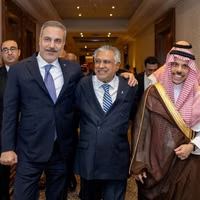
The Saudi Crown Prince’s firm call this week for Israel to “cease all hostile actions on Iranian territory” surprised many, sparking questions about what is drawing the longtime rivals closer.
Pundits say besides a mutual wish to help bring the war in Gaza and Lebanon to an end, intertwined security interests play a decisive role in the significant but cautious recent improvement of relations between Shia Iran and Sunni Saudi Arabia.
They say Tehran may be wary of the fact that Donald Trump’s presidency and an end to the war in Gaza and Lebanon may push Saudi Arabia forward in the path of joining the Abraham Pact and normalizing its relations with Israel.
The United Arab Emirates (UAE) and Bahrain, which broke its diplomatic relations with Tehran in 2016, have already established normal diplomatic relations with Tel Aviv.
This, they believe, can completely isolate Tehran in the region at a time when sanctions have drastically damaged its economy and the threat of an all-out war with Israel hangs over its head.
“Trump’s foreign policy regarding the Persian Gulf region [during his first term] was generally giving carte blanche to Saudi Arabia and Israel while conducting a ‘maximum pressure’ campaign against Iran,” Javad Heiran-Nia, director of Persian Gulf Studies at the Center for Scientific Research and Middle East Strategic Studies, wrote Tuesday in an article published by the Iranian think-tank.

This situation, he said, could entail a US-led military coalition with Israel and Persian Gulf Arab countries to be formed. “In response, Iran has been trying to improve its relations with Saudi Arabia, Bahrain, and the United Arab Emirates and prevent a unified US-Israeli-Arab air defense system from forming,” Heiran-Nia wrote, adding that that further convergence of Persian Gulf Arab states with Israel could tip the balance of power against the Islamic Republic and its allies in the region.
Heiran-Nia also argued that realizing that the United States was not going to give it military support against the Islamic Republic, Saudi Arabia wanted to be “a supporter of order in the region rather than a leader” after Iran-backed Houthis’ attack launched rockets and drones on Saudi Aramco’s oil facilities in Jeddah and Riadh, has pushed Saudi Arabia to adjust its policies regarding Iran with less reliance on the United States.
Besides hoping that the Saudis could help to end the war in Gaza and Lebanon to an end, some pundits have also suggested that Iran may be counting on Riadh to play a mediatory role between Tehran and Washington when Trump takes office given the Saudi's traditional good relations with US Republicans and Trump.
“Let’s keep in mind that after the Zionist regime, it is Saudi Arabia that has the most and the strongest lobbies in the power centers of the United States, whether in the Republican Party or among Democrats, and its power of playing a role in improvement or sabotaging relations between Tehran and Washington should not be underestimated,” Persian Gulf region analyst Vahid Pour-Tajrishi wrote in Tahlil-e Bazar Tuesday.

Iran's backing of Shia Houthis has been a thorny issue in Tehran-Riadh relations. Some analysts have pointed out that Riadh, in turn, may be hoping Iran would help end years of conflict with Yemen.
The normalization of Tehran-Riadh relations on political and military levels will have a positive impact on the situation in Yemen alongside the mediatory role that Oman is currently playing between Riadh and Sanaa, journalist and political analyst Salah Al-Saqladi wrote in an article Monday entitled “Saudi-Iranian Military Coordination: What Does This Mean for Yemen” in Rai al-Youm, an Arab world digital news and opinion website.
Political analyst Ruhollah Rahimpour in a tweet Wednesday has also argued that while Iran's state media present Mohammed Bin Salman’s support for Iran as an achievement for the Islamic Republic’s foreign policy, the move helps define a “leading role in the Islamic world” for the de facto Saudi ruler and leaves Iran in his debt to prevent future challenges from Tehran to this role.
Riadh broke its diplomatic relations with Tehran in 2016 when an ultra-hardliner mob attacked and vandalized the Saudi embassy in Tehran and its consulate in Mashhad with Iranian security forces allegedly giving them free reign to burn diplomatic property and documents.
The attack came after Saudi Arabia’s execution of a prominent Shia cleric, Nimr al-Nimr, and the Revolutionary Guards’ promise of “harsh revenge” against the Saudis.
The two countries came nearly to the brink of a war in 2019 following the Houthis attack on Saudi oil facilities.
In 2021, Iraq initiated a mediatory effort to reconcile Tehran and Riadh which led to an agreement in March 2023 to resume their diplomatic relations. The agreement was surprisingly signed not in Baghdad but in Beijing which has deepened its relations, not only with the Islamic Republic, but also with Saudi Arabia in the past few years.

An official in Jake Sullivan's office leaked information about Saudi Israeli peace talks just before the Hamas attack on Israel in October 2023, a US academic who assisted Jared Kushner in the Abraham Accords, told Iran International.
Jeff Sonnenfeld, appearing on the Eye for Iran podcast, said a deputy on National Security Advisor Jake Sullivan’s team may have leaked information about the Biden administrations discussion with Saudi Arabia and Israel on expanding the Abraham Accords, just prior to Hamas launching the Oct 7 attacks.
A spokesperson from the National Security Advisor told Iran International that this claim is false.
Sonnenfeld did not expose the individual's identity and said that person, who he described as a man, did not have malicious intent, but allegedly bragged too much and that gave Hamas wind of what was to come.
“Jake Sullivan, who I think is fantastic, he had a deputy who apparently can't stop talking and stuck a finger in the eye of Hamas on October 5th or 6th, just days before the next critical conclusory stage of the Abraham Accords was to be signed with Saudi Arabia and even Mahmoud Abbas from the Palestinian Authority signing on,” said Sonnenfeld.
“It would have been amazing but by tempting fate like that Hamas realized this was their last moment to strike,” he added.
There have been several analysts who speculated that the Iran-backed proxy launched Oct 7 to counter a formal alliance between Israel and Iran’s Sunni adversary Saudi Arabia, thereby shifting the balance of power in the Middle East.
While Saudi normalization with Israel was within reach, the Oct 7 attack and new revelations about the alleged leak killed any chance of a peace deal between the two nations.
The historic Arab-Israeli normalization agreements of 2020 have been touted as a triumph of US diplomacy. Under the Trump administration, the US brokered four deals in five months that built diplomatic, social, economic and peaceful relations between Israel, the United Arab Emirates, Bahrain and Morocco. Direct flights between Israel and some of the Arab countries started and embassies opened for the first time.
It was a massive rupture from the rhetoric in which Arab nations would not negotiate with Israel until Palestinians received an independent state of their own
Just days before Saudi Arabia was set to sign on, Hamas launched its attack, sparking a war with Israel that derailed the process amid intense violence in Gaza.
The Biden administration inherited the Abraham Accords—one of the few policies the outgoing president chose to carry forward from his predecessor, Donald Trump.
It appears a certain member of the Biden administration had a knack for revealing too much at a critical time, according to Sonnenfeld who attended the 2019 Peace through Prosperity conference in Bahrain, which outlined the Abraham Accords.
"There is one deputy in there that you name the crisis from the Middle East to Central Europe, this guy can't stop talking."
Sonnenfeld had a lot of praise for President Joe Biden and National Security Advisor Jake Sullivan but said the individual who allegedly leaked the information did a lot of harm.
"He's beyond naive. It is his negligence and malpractice in office, but he's rather full of himself and quite a dandy on top of that," Sonnenfeld described the man he didn't name for legality purposes.
Sonnenfeld said the leaks that would come out what he called the ill-timed bragging was detrimental to progress.
When asked on the Eye for Iran podcast whether this individual may have inadvertently influenced the timing of the Iran-backed Hamas attack on Israel, Sonnenfeld responded, “It didn’t help.”
"That was an ill-timed irritant. As President Biden had acknowledged months later, they were just days away from that formal signing that as this reckless individual, I don't think he had any personal gain out of it. It was just pure arrogance and self-importance."
You can watch the full episode of Eye for Iran featuring Jeff Sonnenfeld on YouTube, or listen on Spotify, Castbox, Apple or Amazon.

While in Kuwait as part of his Middle East tour, Iran’s Foreign Minister said that none of its neighboring Arab states would allow Israel to use their territory or airspace for any planned attack on Iran.
"All of our neighbors have assured us that they will not allow their territory or airspace to be used against the Islamic Republic of Iran," Abbas Araghchi stated in a press conference.
As part of his regional mission, Tehran's top diplomat has been intensifying efforts to rally support from Arab nations in response to the looming threat of an Israeli attack, visiting about a dozen states.
Iran’s diplomatic outreach to its neighbors has intensified following its own missile strike on Israel on October 1, during which over 180 missiles were launched. This marked the second missile strike initiated by Tehran against Israel this year. Israel has said it will retaliate against the missile barrage and is preparing its military for such an eventuality.
Iran's attack followed Israel’s assassinations of top leaders of militant groups backed by Iran, including those of Hezbollah and Hamas, and the Islamic Revolutionary Guards (IRGC).
As Tehran continues its efforts to engage with its neighbors, a report by the US-funded news outlet Alhurra this week cited a senior Israeli source stating that Arab nations along the Persian Gulf have urged Israel to deliver a decisive blow to Iran.
The report further suggested that the Arab nations also view this moment as an opportunity to weaken Tehran through support of Israel’s military actions.
Arab nations are aware that Iran could retaliate against their oil facilities if they are seen as supporting attacks on its oil or nuclear sites by Washington or Tel Aviv – particularly, in light of the 2019 Saudi Aramco attacks, which inflicted significant damage on the kingdom's oil-dependent economy and were widely attributed to Iran. Their willingness to engage with Iran in recent weeks could be an attempt to lessen the likelihood of any Iranian hostile act during tit-for-tat attacks with Israel.
Iran's Foreign Minister, however, claimed there is a shared understanding to prevent tension and escalation.
"The Islamic Republic of Iran does not seek war in the region, although we are prepared for war. We have made every effort to reduce tensions, but we are both ready and capable of confronting any scenario,” Araghchi stated.
The foreign minister of the Islamic Republic, which has faced accusations of international crimes since coming to power in 1979, also expressed hope that international laws would prevent Israel from attacking its nuclear facilities.
He further claimed that "all the countries" in the region have informed Tehran of their opposition to any attack on Iran, particularly targeting its nuclear infrastructure.
"I emphasize again, however Israel attacks Iran, Iran will respond in kind," he said.

US-funded outlet Alhurra cited an Israeli source saying Arab nations along the Persian Gulf have urged Israel to deliver a decisive blow to Iran even as Tehran continues efforts to engage with those states to de-escalate tensions with Israel.
"Gulf countries have sent messages to Israel stressing the need for its response to Iran to be strict and clear," Alhurra cited the source as saying.
"Israel is receiving contacts and requests from Gulf countries to inform it in advance of the expected response so that it can take precautions in the event of a counterattack," the channel added.
Israel says it will retaliate for an Oct. 1 attack in which Iran launched over 180 ballistic missiles at the Jewish state. Iran has publicly said it is not seeking full-scale war but officials have emphasized the country is prepared for a conflict should one arise.
Iranian Foreign Minister Abbas Araghchi sought to shore up support among regional nations to mitigate Israel’s actions during a recent tour of the Middle East which included visits to Saudi Arabia and Iraq .
Iran also conveyed to its Arab and regional neighbors that they would face retaliation if US or Israeli attacks on the Islamic Republic used their territory or air space, the Wall Street Journal reported.
Over the weekend, Israeli Prime Minister Benjamin Netanyahu accused Iran of orchestrating an assassination attempt after three drones targeted one of his residences. Neither Netanyahu nor his wife were at home during the incident.
The attempted strike comes just days after the Israeli Defense Forces (IDF) killed Hamas leader Yahya Sinwar in a precision operation in southern Gaza.
“The attempt by Iran’s proxy Hezbollah to assassinate me and my wife today was a grave mistake,” Netanyahu said in a statement on Saturday night, adding Israel would “eliminate the terrorists and those who dispatch them”.
Alhurra’s interviews cited former Israeli military spokesperson Jonathan Conricus saying the assassination attempt on Netanyahu could represent a miscalculation by Iran by providing Israel with a justification for a broader response.
The news outlet further reports that Israel, while coordinating with regional militaries under US Central Command (CENTCOM), sees its response to Iranian missile attacks as a strategic opportunity to assert its military power in the Middle East and counter the threats from Tehran, both direct and indirect.
Israeli sources, including Conricus, emphasized to Alhurra that Israel's goal is not just to shift the balance of power between Israel and Iran, but to reshape the broader dynamics of the Middle East.
The report suggests that Arab nations on the Persian Gulf also view this moment as an opportunity to weaken Tehran through support of Israel’s military actions.
While in Germany last Friday, US President Joe Biden told reporters that he has a good understanding of how and when Israel plans to respond to Iran’s missile attack but declined to provide further details.
Although the timing and specifics of Israel's retaliation remain unclear, sources informed CNN last week that it is expected to take place before the US presidential election on November 5.
Previous reports from multiple news outlets indicate that Israel has assured the US it will refrain from targeting nuclear or energy infrastructure, though other reports suggest that all options are still on the table.

A senior Israeli cabinet minister revived the prospect of an attack on Iranian nuclear sites after media reports had suggested the United States had convinced its ally to focus its fire on Iranian military infrastructure.
Energy minister Eli Cohen, a former foreign minister, said on Friday Israel was "committed to preventing the Iranians from acquiring nuclear weapons, and therefore, all options are on the table, including attacking nuclear facilities".
He made the remarks in an interview with Israeli news website Walla News three days after a CNN report said Israeli officials, including Prime Minister Benjamin Netanyahu, had assured the US that any retaliatory strike on Iran would be confined to military targets.
A Tuesday report by The New York Times citing sources confirmed that nuclear enrichment sites are not among Israel's targets
"Even if Israel avoids Iran’s nuclear enrichment and oil sites, it could still hit a wide array of military targets," the American daily wrote. "They include missile and drone launchers, missile and drone storage sites, missile and drone factories, as well as military bases and major government buildings."
Citing two Israeli officials, the report said: "Israel could also strike nuclear research laboratories, even if it avoids Iran’s subterranean nuclear enrichment sites."
In his Friday interview, Cohen said, "There is no military facility or infrastructure or person in Iran who is immune from an Israeli attack in response to Iranian aggression."
"We proved that we know how to go anywhere, with a large variety of armaments. By the way, we have not yet shown even 10% of our unprecedented armament and intelligence capabilities," he added.
Tensions between Israel and Iran have mounted since October 1, when Iran launched 181 ballistic missiles towards Israel in response to the Jewish state's killing of the leader of Hezbollah Hassan Nasrallah in Beirut and Hamas political leader Ismail Haniyeh in Tehran.
Israel’s air defenses intercepted most of the missiles, but several struck military and civilian targets, causing minor damage. This convinced the Pentagon to deploy a THAAD missile defense battery to Israel this week for protection against Iran's possible retaliatory attack.
'Chance for de-escalation'
While it is not yet clear when the Israeli strike on Iran will take place, US President Joe Biden told reporters on Friday he has an understanding of how and when Israel was going to retaliate. He declined to elaborate, but also said there was a chance for a ceasefire.
"There's an opportunity in my view and my colleagues agree that we can probably deal with Israel and Iran in a way that ends the conflict for a while. That ends the conflict, in other words, that stops the back and forth," Biden said.
Biden added that he believed there was a possibility of achieving calm in Lebanon but that such efforts would be harder in Gaza.
Earlier on Thursday, Biden referred to the Israeli killing of Hamas leader Yahya Sinwar, calling it an opportunity to free hostages held by the militant group and end the year-long Gaza war.
Yahya Sinwar, the mastermind behind the October 7 attack, was believed by US and Israeli officials to be the main obstacle to reaching a hostage deal.
While Biden has long pushed for a ceasefire deal to secure the release of Israeli hostages, an imminent Israeli strike on Iran could further enflame the region, denying Biden the truce he would like to add to his legacy as his presidency draws to a close.