Iranians blame foreign policy for economic woes but back military role - poll
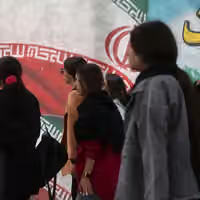
People shopping in Tehran Bazaar in 2021
A new public opinion poll suggests conflicted Iranian attitudes toward foreign policy, with a majority blaming it for domestic economic woes but approving of the country’s military role in the Middle East.
The survey was conducted by polling firm Stasis in association with Washington DC-based thinktank the Middle East Institute in late September and early October, and included 1,189 Iranians aged 18 and older.
The results show Iranians are critical of certain aspects of foreign policy yet resolute on others, particularly around Tehran's military influence in the region.
78 percent of respondents said they believed Iran’s foreign policy was harming their livelihood yet 60 percent said they favor providing military support to allied armed groups across the Middle East.
On the diplomatic front, around two in three respondents favored establishing relations with the United States but most opposed normalization with Israel. Only around a quarter said they completely or somewhat agree with the statement that “Iran should normalize its relationship with Israel.”
“The extraordinary circumstances surrounding the survey period—with Iran and Israel teetering on the brink of war—likely heightened patriotic or emotional responses, particularly toward Iran’s military activities in the region,” said Alex Vatanka, Director of the Iran Program at the Middle East Institute.
He added that this urgency could help explain the significant support for maintaining a military presence in the Middle East and backing allied groups, despite widespread discontent over the cost.
Around half of those who took part in the survey approved of Iran’s presence in Syria.
Vatanka said this could point to possible gaps in public understanding of foreign policy and its scope. “Some respondents may have failed to see that the Islamic Republic’s regional military engagements are central to its foreign policy. They appear to have overlooked the connection between Iranian activities in the region and the isolation that has left the economy in ruins”.
The poll captured Iranian sentiment during a period marked by geopolitical tension, including the assassination of Hezbollah leader Hassan Nasrallah by an Israeli air strike last month and Iran’s retaliatory attack against Israel on Oct. 1.
A majority of those who took part in the survey (59 percent) felt Iran was in a stronger position following these developments. Even more (69 percent) said they felt safer as a result of the country’s military involvement in the Middle East, including its backing of regional armed groups.
Iranians were nearly evenly divided over the country’s alignment with global powers. 34 percent expressed a preference for strengthening ties with Russia and China, and an equal 34 percent preferred Western partnerships, including with the United States and Great Britain. Sixteen percent chose both, and another 16 percent were undecided.
Gauging the public mood in Iran is challenging, especially on issues of national security. Dozens are tried and jailed every year for expressing views on issues that the government deems sensitive.
“Rapid changes in the political environment of the region could potentially affect public opinion regarding some survey questions, especially those directly related to Iran’s foreign affairs,” Statis, the polling firm, wrote in its report.