Afghan influx strains Iran's resources and heightens social tensions
Afghans migrants in Iran
Concerns are mounting in Iran over the increasing number of Afghan migrants, particularly since 2023, when reports emerged that the interior minister and IRGC general Ahmad Vahidi, was encouraging the influx of Afghans into the country.
The move was reportedly part of a strategy to present Afghan refugees as Iranian citizens who would vote in the 2024 parliamentary elections and support the anticipated re-election bid of former President Ebrahim Raisi in 2025. Since 2020, Iranians have increasingly resisted participating in elections, which are widely perceived as biased and unfair, favoring hardline factions, including the ultraconservative Paydari Party.
During the past weeks, numerous reports in the Iranian press and social media posts have accused Afghan immigrants of being unwelcome elements exacerbating the country's already strained employment, health, and education sectors.
Iran has been grappling with a severe economic crisis since 2018, following the United States' withdrawal from the JCPOA nuclear deal and the subsequent imposition of sanctions. The inefficient, government-controlled economy has struggled to manage the fallout, with inflation soaring above 40 percent.
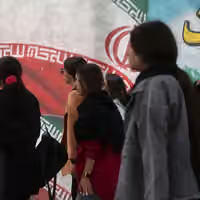
An Afghan girl holding the flags of the Islamic Republic of Iran and Afghanistan
Public infrastructure, already weakened by years of inadequate investment, is buckling under the pressure. School buildings are crumbling, and teachers earn as little as $250 per month. This summer, a severe power shortage gripped the country, leaving industries idle and homes enduring prolonged blackouts.
Amid these dire conditions, many Iranians argue that the country is simply not in a position to accommodate additional migrants. They accuse the government of negligence in failing to stem the influx of Afghan refugees, which, according to some estimates, has added 8 million people to the population—roughly 10 percent of Iran's total.
However, following the election of President Massoud Pezeshkian, some recent reports have sought to ease societal tensions in Iran. One of the latest reports argued that hostility towards Afghan immigrants is, in fact, an anti-Iranian stance. The report contended that the campaign against the presence of Afghans in Iran represents a form of hostile nationalism that fosters irrational xenophobia.
Meanwhile, other reports have revealed that contractors associated with the Tehran Municipality have been exploiting young Afghan children, employing them as trash collectors and recycling workers for wages that are up to five times lower than the minimum wage.
A Tehran City Councilor told Khabar Online that these children do not have identification documents and bank cards so if they do not receive their pay for any reason, they cannot file a complaint against the contractors in Iranian courts. They have no insurance or job security and contractors often impose difficult working conditions on them.
Meanwhile, an official acknowledged that the Municipality is aware that some Afghan children employed in its operations are becoming involved in social issues, including juvenile delinquency. He admitted that these children have entered Iran illegally and warned that without decisive action from the authorities, this delinquency could escalate into a significant and unresolvable social crisis.
Meanwhile, due to the extremely high fertility rate among Afghan women living in Iran, as much as 50 percent of all births in Alborz Province are attributed to Afghan refugees. An official from an insurance company reported that up to 73 percent of these births have been performed via C-section, which is more expensive than natural childbirth. He also noted that, in line with an agreement with the UN High Commissioner for Refugees, up to 6,000 of the poorest refugees are provided with free health insurance.
As in other countries experiencing high rates of immigration, there are conflicting accounts of how Iran treats its Afghan refugee population. Some reports suggest that Afghan refugees are being recruited to fight in the war in Syria, while others claim they are being used to compensate for the lack of Iranian participation in elections.