Syria says soldier killed, three wounded in Israeli strikes
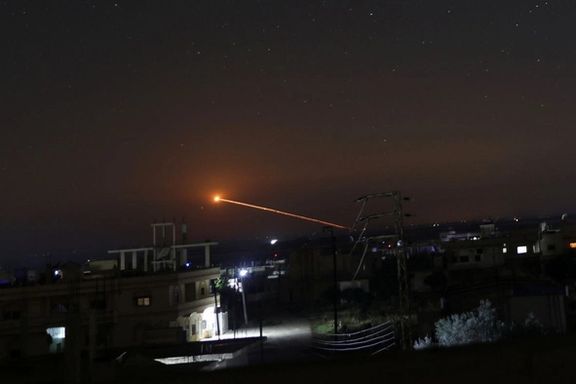
One Syrian soldier was killed and three others were injured in Israeli air strikes against military sites and a residential building in Damascus early on Sunday, the Syrian army said.

One Syrian soldier was killed and three others were injured in Israeli air strikes against military sites and a residential building in Damascus early on Sunday, the Syrian army said.
The army said in a statement that the attacks were launched from the Israeli-occupied Golan Heights.
For years Israel has been carrying out attacks against what it has described as Iran-linked targets in Syria, where Tehran's influence has grown since it began supporting President Bashar al-Assad in the civil war that started in 2011.
Reported Israeli strikes on Syria have intensified sharply since the start of the war in Gaza last October.
Sunday's strikes targeted "a number of our military sites in the southern region and one of the residential buildings in the Kafar Souseh area in the city of Damascus," the Syrian army said in a statement.
"Our air defence systems confronted the enemy's missiles despite their density and shot down a considerable number of them."
Israel's army said its strikes were in response to the launch of two drones from Syria towards the north of Eilat on Saturday, which it said were intercepted.
"Overnight, the IDF struck a Syrian military command center and infrastructure sites. Additionally, terror targets used by the Syrian military's Aerial Defense Unit were struck," it added.
In April, an alleged Israeli strike on the Iranian consulate in Damascus resulted in the death of Mohammad Reza Zahedi, a high-ranking Quds Force commander and several other IRGC officers. In retaliation, the Islamic Republic launched a barrage of missiles and drones toward Israel.
Israeli officials, despite their usual silence on such operations, have consistently declared their determination to prevent Iran from expanding its foothold in Syria.
(Reporting by Reuters)


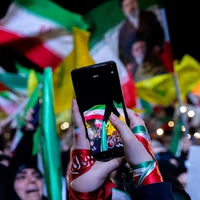
Iran's top military commanders from the Revolutionary Guard and the traditional army, met with President-elect Masoud Pezeshkian on Saturday, a week after he won a runoff against a hardline candidate.
The military leaders included Chief of Staff Mohammad Bagheri, IRGC Chief Hossein Salami, Army Commander Abdolrahim Mousavi, Police Chief Ahmad-Reza Radan, and Defense Minister Mohammad Reza Ashtiani.
Despite a history of tensions with some past governments, Bagheri declared, "The armed forces are ready to assist the new government in advancing the country's affairs."
Last week, the IRGC chief-commander had congratulated Pezeshkian on his election victory, stressing the Revolutionary Guard's "all-out preparedness" for enhanced cooperation with the incoming administration.

The IRGC, founded after the 1979 Islamic Revolution, has grown into a powerful entity with substantial military, economic, and political influence. Its hardline stance contrasts sharply with the reformist agenda of greater political openness, economic liberalization, and improved relations with the West.
Administrations, like those of Presidents Mohammad Khatami and Hassan Rouhani, pushed for engagement with the West, while the IRGC remains committed to preserving revolutionary principles and resisting Western influence. This has led to frequent power struggles, with the IRGC often undermining their policies and supporting hardline candidates.
Former centrist President Hassan Rouhani sharply criticized the IRGC in 2017 for exerting influence over political and economic affairs. However, Pezeshkian, who is presented by some as a reformer, has pledged to follow policies charted by Supreme Leader Ali Khamenei.
Economically, reformist attempts to curb the IRGC's dominance in sectors like construction, telecommunications, and energy have been met with resistance, as the IRGC seeks to maintain its economic stronghold.

Iran has once more rejected fresh US military claims that the Houthi rebels in Yemen received weapons from Tehran, despite the fact that several Iranian vessels carrying weapons for the Houthis have been seized in the past few months.
On Thursday, the US Defense Intelligence Agency said a missile launched by Houthis towards a Norwegian-flagged oil tanker in the Red Sea last December is likely to have been an Iranian-made anti-ship cruise missile.
Iran’s UN envoy on Friday denied that Iranian weapons may have been used to target commercial vessels, claiming that the Houthis have developed significant military capabilities on their own.
The Houthis began targeting commercial ships in the Red Sea after Israel began its onslaught against Gaza in response to Hamas’ attack on Israel last October. The rebel group says its only objective is to disrupt the flow of goods to and from Israeli ports. And it has to some extent succeeded at that, forcing many of the biggest logistics companies in the world to reroute.
Iran has consistently supported and praised the Houthis, but rejected claims that it has provided them with arms.
In January 2022, the French Navy intercepted an Iranian ship in the Gulf of Oman, with thousands of rifles, machine guns, and anti-tank missiles. A month later, another Iranian ship carrying ballistic missile components bound for Yemen was seized by British forces.
In late May this year, the IRGC affiliated Tasnim News Agency reported that the technology for Iran's first naval ballistic missile (called Qadr) had been transferred to the Houthis. The Houthi missile "Moheet" was reportedly modeled after the Qadr.
The US Defense Intelligence Agency in its Thursday report linked Iran with the attack on the Norwegian-flagged ship, Strinda. The report seems to corroborate the findings of a Norwegian insurance company that had examined material recovered from the ship.
The Strinda, carrying a cargo of palm oil from Malaysia to the Suez Canal, was struck by a missile on December 20 last year, causing a major fire but no crew injuries. An investigation by the US military showed that parts of the missile engine found on the ship matched those of the Iranian anti-ship cruise missile, “Noor”.
The missile, developed by reverse-engineering the Chinese C-802 anti-ship missile, has a range of up to 170 kilometers, with its upgraded version, Qadr, said to be capable of reaching targets 300 kilometers away. The Houthis possess a similar missile named Mandab-2 with comparable range.

The US Justice Department has been conducting interviews with survivors and families affected by Hamas’ October 7 attack in Israel to build a case against the militant group and its financial supporters, according to Bloomberg.
The report, citing people familiar with the investigation, also says that former hostages and families of US citizens murdered abroad have sat down with prosecutors and FBI agents.
Some have reportedly traveled from Israel and provided videos and text messages to help the authorities build a timeline of the attack and to identify those who carried out the kidnappings.
Citing people familiar with the inquiry, Bloomberg reports that although part of the US probe is looking at acts of terrorism, a broader focus is tackling the financial networks that have propped up Hamas.
This will see prosecutors from US Attorneys’ offices in New York, Washington and the Justice Department’s Counterterrorism Section to investigate any support from countries like Iran and Qatar, which are among the primary financial backers of the terrorist organization.
The inquiry will also reportedly look at whether financing touched US financial institutions or assets.
Last year, Hamas gunmen launched a deadly assault across Gaza's border into Israel, resulting in approximately 1,200 deaths and the firing of thousands of rockets. The victims included children, the elderly, and 364 young attendees of a music festival. Additionally, Hamas abducted over 250 individuals, holding them hostage in Gaza.
The BBC and the Guardian have reported that they have accessed evidence showing instances of rape and sexual assaults during the Hamas attacks. A UN report in March found “reasonable grounds to believe” that Hamas committed sexual violence “in multiple locations” during the attack.
Officials in Tehran have stated that they received no prior warning of the attack carried out by their proxy, with US intelligence indicating that senior Iranian government officials were taken by surprise by the assault. However, almost immediately after the attack, government backed celebrations took place in Tehran and officials and state media have been praising Hamas and pledging continued support.
In October 2023, the Wall Street Journal reported that Iranian security officials helped plan the attack on Israel and gave the green light for the assault at a meeting in Beirut. It also reported later that month that Hamas fighters trained in Iran before the attack.
Easter this month, more than 100 victims and relatives of victims of the Hamas attack sued Iran, Syria and North Korea for $4 billion, accusing the countries of providing Hamas support.
The lawsuit filed in federal court in Washington, DC, by the Anti-Defamation League is the largest case against foreign countries in connection with the attack, and the first backed by a Jewish organization, the ADL said in a press release.

Mohammad Shirazi, the head of Ali Khamenei's military office, lauded Iran's military capabilities, particularly highlighting the recent attack on Israel.
The Supreme Leader's military chief said that Iran is "at a point where we can confidently carry out similar operations and showcase our capabilities to the world," referring to the aerial assault on Israel in April when a barrage of 350 drones, rockets and missiles was sent towards Iran's archenemy.
Around 99 percent of the barrage was intercepted by Israel and a US-led coalition, though it continues to be a point of pride for Iran.
Shirazi further boasted, "We have reached a stage where major powers are extending their hands to us to meet their needs." While he did not specify which major powers he was referring to, his comments allude to Iran’s provision of drones to Russia in its ongoing war against Ukraine, as well as reports of supplying ballistic missiles.
Iran continues to back Yemen's Houthis which are currently blockading the Red Sea region and attacking commercial shipping, in allegiance with Iran-backed Hamas in Gaza. They say the blockade aims to force Israel into a ceasefire amid the longest Gaza war in history.
Meanwhile, Iran's largest proxy, Hezbollah in Lebanon, continues to attack Israel in support of Hamas. Iran's proxies in Syria and Iraq have also send projectiles towards the Jewish state in addition to targeting US facilities and personal in the region following its support of Israel's right to defend itself after Hamas's October 7 attack on Israel.

Iran’s president-elect Massoud Pezeshkian has responded to a congratulatory message from Hezbollah leader Hassan Nasrallah, pledging continued support to “resistance force” aligned with Tehran in the region.
“The Islamic Republic of Iran has always supported the resistance of the people in the region against the illegitimate Zionist regime. Supporting the resistance is rooted in the fundamental policies of the Islamic Republic of Iran, the ideals of the late Imam Khomeini, and the guidance of the Supreme Leader, and will continue with strength,” Pezeshkian wrote.
Pezeshkian won the election last Friday, campaigning as a "reformist," despite previously characterizing himself as a "principlist," a term in the Islamic Republic jargon meaning someone dedicated to the principles of the Islamic revolution.
From its inception in 1979, the Islamic government in Iran has been a staunch enemy of Israel and the United States. It established the Lebanese Hezbollah in the early 1980s as a proxy force to confront Israel. In the past two decades it has created other proxy forces in Iraq, Syria, Yemen and Palestinian territories. It also has networks in other Middle Eastern, African and Western countries.
Iranian have protested against the government's financial and military assistance to these groups as a waste of national resources. The slogan, "Neither Gaza nor Lebanon, my life for Iran" has been a familiar chant during anti-government protests in recent years. As Tehran has committed more resources, its own economic situation has worsened, driving million of people into poverty.
Pezeshkian went on to tell Nasrallah, “I am confident that the resistance movements in the region will not allow this regime [Israel] to continue its warmongering and criminal policies against the oppressed people of Palestine and other nations in the region.”