A group of Iranian diaspora in Sweden gathered in Stockholm to protest the holding of the presidential election. The protesters carried pictures of some of the protesters who were killed by the Islamic Republic forces.
The protest was held in front of the Iranian embassy in Stockholm. The protesters chanted slogans against the Iranian government and called for free and fair elections in Iran. They also called for the release of political prisoners and an end to human rights abuses in Iran.
The protest in Stockholm is one of a number of protests that have been held around the world in recent weeks in response to the Iranian election.
Rallies against the Islamic Republic are held outside Iran's consulate buildings in several other cities across the globe, such as Sydney, Hamburg, Copenhagen, London and Manchester.
Elham Asadzadeh, sister of Amir-Javad Asadzadeh, who was killed in Mashhad during the 2022 protests, posted a photo on Instagram of the "Amir al-Momenin" mosque on Pirouzi Boulevard. The mosque has now been turned into a polling station for the second round of elections.
She said that in the basement of this mosque, government agents beat her brother to death.
Asadzadeh wrote: "This mosque, tainted with blood, has now become a polling station; shame on those who set foot in this mosque."

Mahmoud Ahmadinejad does not endorse any of the two presidential candidates, a social media account linked to the former Iranian president announced on Friday as polls opened across the country.
The announcement did not say if Ahmadinejad would vote or not. Moderate website Rouydad24 reported that he left Iran for Turkey for a four-day trip.
He has become a vocal critic of the ruling elite since 2018, after his bid to run in the 2017 presidential election was stopped by the Guardian Council that vets candidates.He was disqualified again for this round.


Issa Zarepour, Iran's Minister of Information and Communications Technology, reported several acts of "sabotage" on fiber optic lines since Thursday, stating that the damages were quickly repaired and the network remains stable.
"Four hundred teams are monitoring fiber optics and communication infrastructure," Zarepour added.
He also mentioned that during the first round of voting, there were over 20 attacks on fiber optic lines, with nine resulting in outages.
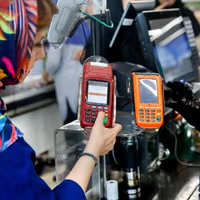
This comes as Iran's presidential election was held only with paper ballots, and no electronic voting machine was used, according to the Election Headquarters. However, the identity verification process was carried out electronically, according to Iranian authorities.

Whether the 60% who refused to vote in Iran on June 28 will abstain from voting in Friday’s runoff remains to be seen. However, many believe the majority has unequivocally demonstrated its demand for change.
The finalists, hardliner Saeed Jalili and a centrist Masoud Pezeshkian, both are seen by many Iranians as regime insiders, who seem unable to garner the trust of the majority.
Mohsen Renani, a prominent professor of economics and commentator, described Iranians' behavior in last week's elections as politically "mature," regardless of whether they chose to vote or abstain.
"Our nation no longer fears, nor can it be easily influenced. It is not swayed by tempting promises of gold subsidies or free housing, as some candidates have offered. Nor is it influenced by the analyses and solicitations of intellectuals, activists, and academics to take political action,” he wrote.
The Iranian nation "acts according to its own discernment, which represents significant progress in our national pursuit of democracy since the Iranian Constitutional Revolution of 1906," Renani wrote earlier this week. "They know when to act and what to do: when to protest in the streets and when to return home, when to remain silent and when to cry out, when to vote and when to abstain."
For the first time, unlike in any previous presidential elections, Supreme Leader Ali Khamenei remained conspicuously silent until Wednesday. When he finally spoke, he did not refer to the election as "an epic," a term he typically uses. Instead, he acknowledged that the turnout was "less than expected." However, he insisted that the low turnout was not due to popular dissatisfaction or opposition to clerical rule.
Turnout dropped to 39.92 percent in the first round according to official figures. This turnout rate was the lowest in the four decades since the Islamic Revolution of 1979. Only 48 percent voted in 2021 elections which set an earlier record of low turnout. Turnout had not dropped to below 59.7 percent since 2005 and had even been as high as 84.8 percent in 2009.
“There is still not too much enthusiasm to vote in the second round or even to discuss it among those who did not vote earlier,” Farhad, 48, an engineer, told Iran International.
“Of the people I know, family and acquaintances, some people are posting stories on Instagram condemning the vote comparing participation in the elections as betrayal of the blood of the victims of the past few years’ crackdowns on protesters. Others say they are voting to save Iran from the total dominance of ultra-hardliners,” he added.
“But there is also the core Jalili supporters who are enthusiastically campaigning for their candidate to win and to make a statement about the legitimacy of the ruling establishment,” Farhad said. “They are all over social media platforms.”
Of the two candidates, only Pezeshkian has unequivocally acknowledged that the low turnout was a result of popular dissatisfaction, calling it a "meaningful message to the government, society, and political groups." He has repeatedly stated in campaign speeches, films, and televised debates that he wants to represent the 60 percent who did not vote.
Rather than denouncing those who participated in the Woman, Life, Freedom protests of 2022-23 known as Mahsa Protests and calling them “rioters” as hardliners do, Pezeshkian has been criticizing the government for violence against Mahsa and others for hijab as he had done in a tweet a day after her death in custody in September 2020.
Pezeshkian’s supporters in the past few days have expressed their support for the Mahsa movement at campaign meetings. At his campaign gatherings including a gathering at Heydarnia Stadium in Tehran Wednesday, his supporters chanted Woman, Life, Freedom.
At the same time, he agreed with denying internet service to people during times of unrest, which the government did in November 2019 when security forces killed at least 1,500 civilians. He has also pledged to fully follow Supreme Leader Ali Khamenei's policies, exhibiting contradictory signals to voters who are highly mistrustful of regime politicians.


In a renewed call for the boycott of presidential elections, Iran’s exiled prince Reza Pahlavi has emphasized that once the current establishment is ousted, the country will be free of “entrenched mafia-like corruption.”
Pahlavi stated Thursday on X that with the current authorities gone, "there will be a truly healthy open economy," and all forms of "gender, sexual, and religious discrimination" will be eliminated.
“I firmly believe this is achievable, and I am confident that the primary resources to accomplish it are largely within Iran, ready to fill this void swiftly,” Pahlavi said.
Pahlavi urged Iranians to "join the families of the martyrs of Iran's national revolution from December 2017 to November 2019 to the Mahsa uprising" and to stand by political prisoners from various backgrounds.
He warned against the clerical establishment's use of citizens' names and “votes to support terrorists and criminals in Gaza, Lebanon, Syria, Iraq, and Yemen,” which “drags the region and the world into war and chaos.”
Furthermore, he highlighted the regime's misuse of national wealth and the rising costs of essentials like water, bread, and gasoline.
Pahlavi's call for an election boycott resonates with numerous other Iranian activists who have similarly boycotted Iran's presidential elections, making voter turnout a central theme of this campaign.